

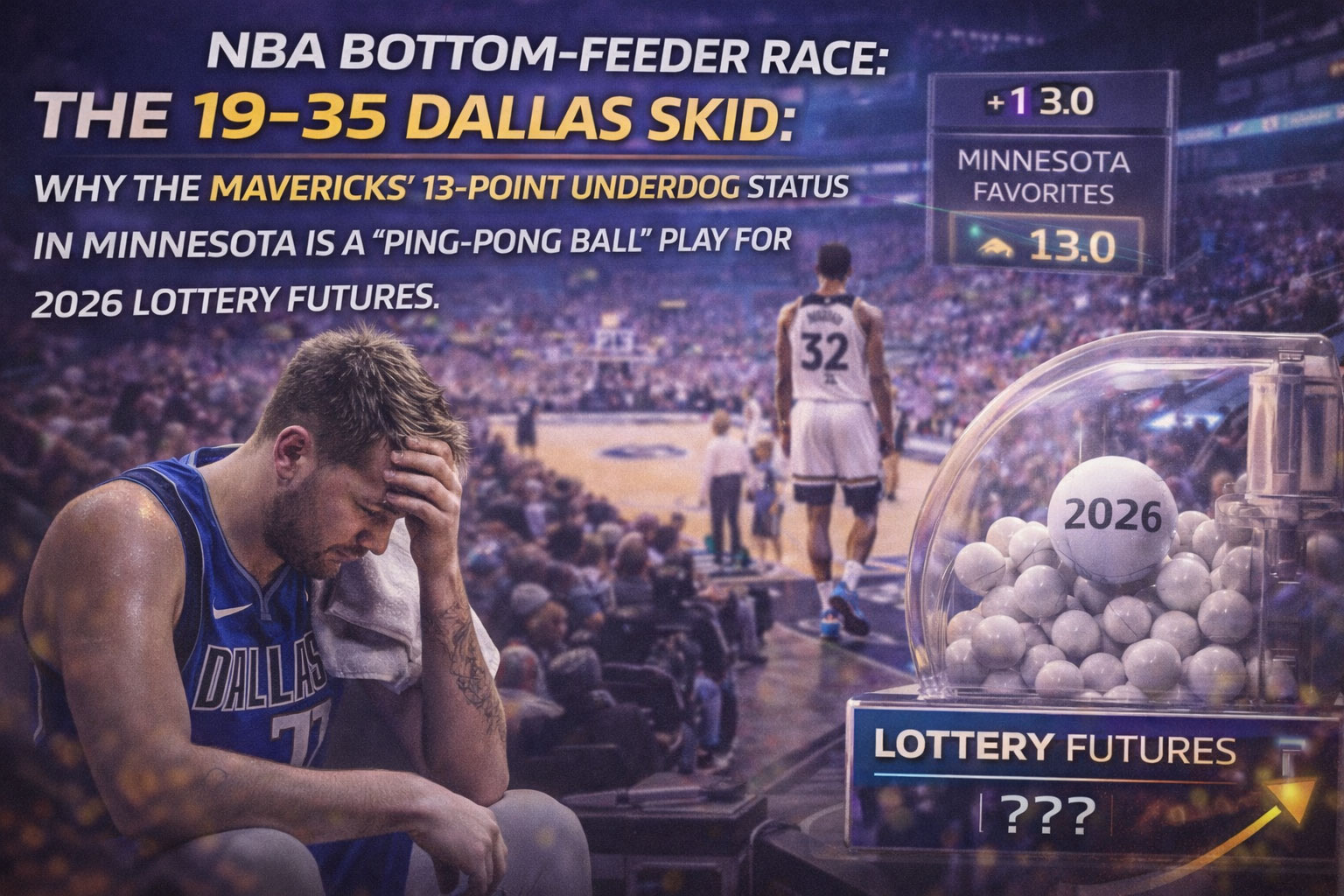
What’s up guys. Alright, I’m not here to tell you the Mavericks are “rebuilding” or going through a “tough stretch.” Let’s call this what it is: Dallas is running a masterclass in strategic tanking, and their 19-35 record isn’t bad luck—it’s asset management. When you see a team getting 13 points in Minnesota, your first instinct might be “free money on the home favorite,” but the sharps are looking at something completely different. This isn’t just a spread play; it’s a derivatives trade on 2026 lottery futures, and if you understand the incentive structure, there’s serious edge here.
Dallas Tank Job: Why Mavs Are Tanking Hard
The Mavericks went from Finals contenders to bottom-feeders faster than your buddy who discovered sports betting can blow through his tax refund. After the Luka trade rumors and the Kyrie experiment imploded (again), Dallas made a calculated decision: punt on 2025 and stack ping-pong balls for Cooper Flagg’s little brother or whoever’s the next generational talent. This isn’t some conspiracy theory—the roster construction screams “lose now, win later,” and Mark Cuban didn’t become a billionaire by chasing the 8-seed.
Here’s the market inefficiency everyone’s missing: when a team is this committed to losing, the spread becomes predictable, which makes it exploitable. Dallas has covered just 38% of their games this season, but more importantly, they’re 4-12 ATS as road underdogs of 10+ points. The public sees “Mavs getting points” and thinks value, but the sharp money knows Dallas has zero incentive to keep games competitive in the fourth quarter. Every loss is literally worth millions in future draft capital—that’s not hyperbole, that’s expected value calculation.
The 13-point spread against Minnesota isn’t about whether Dallas can compete; it’s about whether they want to. And spoiler alert: they don’t. The Timberwolves are fighting for playoff positioning, which means they’ll run up the score to boost point differential for tiebreakers. Meanwhile, Dallas is giving heavy minutes to G-League call-ups who are auditioning for summer league contracts, not trying to win basketball games. This is the definition of misaligned incentives, and when you spot that in markets, you hammer it.
Minnesota Spread: Your 2026 Lottery Ticket
So how do you monetize Dallas’s tank job? The obvious play is fading them on spreads, but the real alpha is in the futures market for 2026 draft positioning. Most books in New York, New Jersey, and Ontario are offering “bottom-3 finish” props at +180 for Dallas, which is basically free money if you understand their timeline. They’re not trying to win this year—every loss improves their lottery odds, and with the flattened odds system, being bottom-3 vs. bottom-5 is worth about 15% better chance at a top-4 pick. That’s massive ROI on intentional losing.
The Minnesota game specifically is a “ping-pong ball accumulation” spot because it checks every box for a scheduled loss. Road game against a playoff team? Check. Back-to-back situation? Check. Key “veterans” (and I use that term loosely) listed as questionable with “rest”? Check. This is the NBA equivalent of a company doing a controlled burn on their balance sheet to optimize tax loss harvesting. The Wolves laying 13 isn’t a bet on basketball talent; it’s a bet on organizational strategy, and Dallas’s strategy is crystal clear.
Here’s your actual play: parlay Wolves -13 with a Dallas “under” on season wins (if your book still has it) or sprinkle some units on Dallas finishing bottom-3 in the West. The correlation here is beautiful—every blowout loss like this Minnesota game compounds toward that futures ticket cashing. And if you’re feeling extra degenerate, live-bet Dallas in garbage time when the spread balloons to 20+; even tanking teams hit backdoor covers when the third-stringers are chucking. But the core thesis remains: Dallas losing isn’t a bug, it’s the entire feature of their 2025 season.
The beauty of the NBA tank race is that it’s one of the few sports betting markets where organizational incentives are completely transparent, yet the public still bets like every team is trying to win. Dallas at +13 in Minnesota isn’t a basketball bet—it’s a corporate strategy play, and the house money is on strategic incompetence. Whether you’re fading them on spreads or loading up on draft position futures, the edge exists because most bettors can’t separate “bad team getting points” from “bad team that wants to be bad.” So the question is: are you betting on basketball, or are you betting on balance sheets? Drop your tank-race takes in the comments—who else is running this playbook better than Dallas?
WannaBet.com may receive compensation from the sportsbooks mentioned in this post if you sign up using our links. This doesn’t cost you a dime, but it keeps the lights on. Please bet responsibly. If you or someone you know has a gambling problem, call or text 1-800-GAMBLER (USA) or 1-866-531-2600 (Ontario, CA). 21+ only.
