

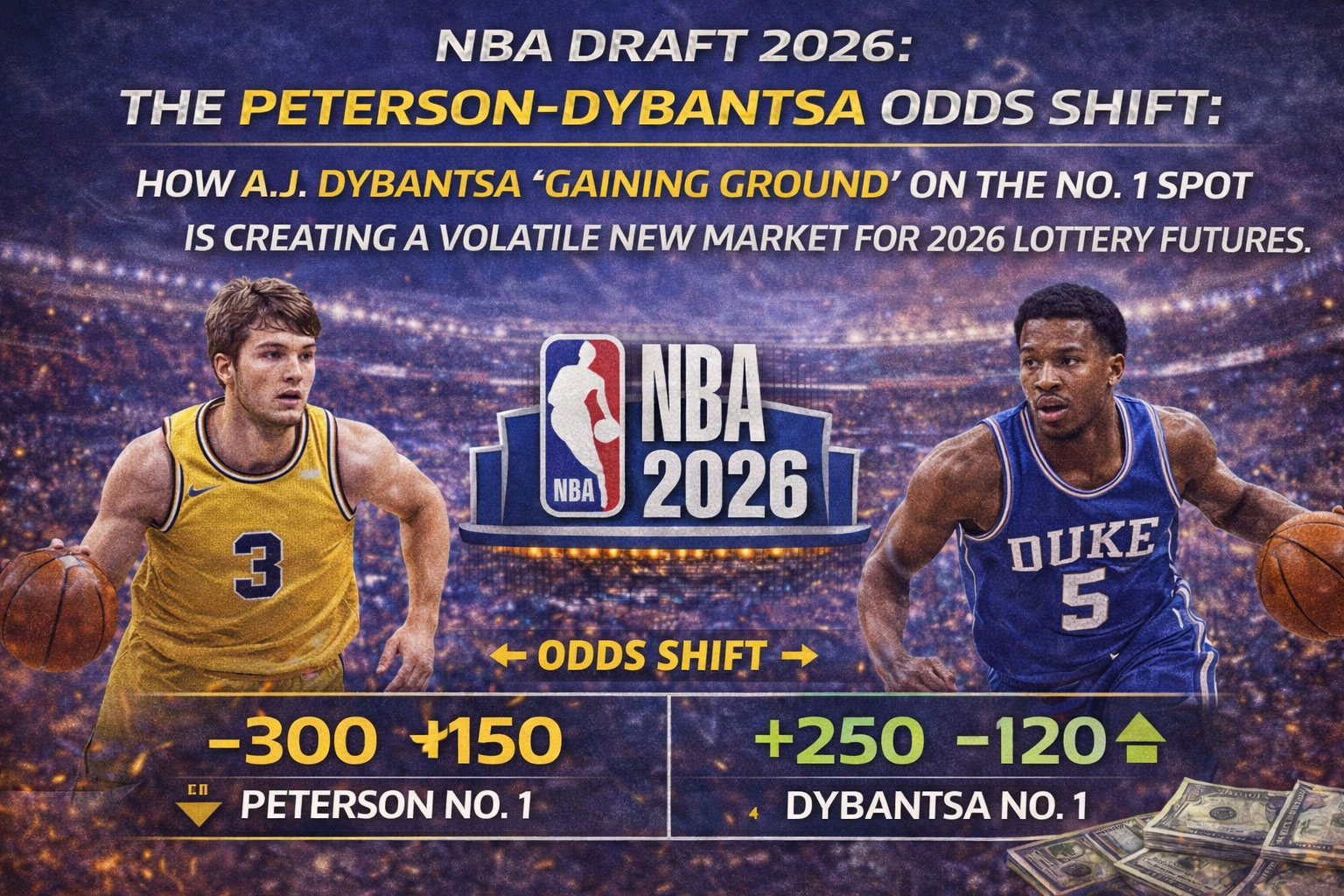
Look, I know what you’re thinking: "Why the hell am I reading about the 2026 NBA Draft when I’ve got Knicks-Sixers player props to hammer tonight?" Fair question. But here’s the thing—while you’re grinding out Jalen Brunson assist totals, the actual sharp money is already positioning on draft futures that won’t settle for another 18 months. And right now, there’s a seismic shift happening at the top of the 2026 class that’s creating the kind of volatility we haven’t seen since Zion’s shoe exploded at Duke. A.J. Dybantsa, the 6’9" wing everyone was sleeping on six months ago, is now legitimately threatening Cameron Peterson’s stranglehold on the No. 1 spot. The odds have moved from +800 to +200 in some books, and if you know anything about market efficiency, that’s not noise—that’s signal.
The market psychology here is textbook—early adopters who locked Peterson at -400 are now sweating, late arrivals are debating whether Dybantsa at +200 is value or a trap, and the books are adjusting lines faster than you can say "LaMelo Ball workouts." This isn’t just about basketball talent anymore; it’s about reading tea leaves, understanding draft capital, and most importantly, finding arbitrage opportunities before the public catches up. So buckle up, because we’re about to break down why this two-horse race is turning the 2026 lottery futures market into the Wild West, and how you can actually make money off the chaos.
Dybantsa’s Closing the Gap on Peterson: Time to Hedge?
Six months ago, Cameron Peterson was the consensus No. 1 pick at basically every major sportsbook—we’re talking -500 to -600 across the board in Ontario, New York, and Jersey. The 6’10" forward out of Chicago had the pedigree, the production, and most importantly, the narrative that scouts and talking heads had already bought into. But then Dybantsa started doing Dybantsa things on the AAU circuit, and suddenly the "lock" everyone hammered in January is looking a lot more like a 50/50 proposition.
The numbers tell the story better than any highlight reel: Dybantsa’s odds have compressed from +800 in December to as low as +200 at some books right now. That’s a massive market correction, and it’s not happening because casual bettors are throwing $20 parlays on a high school junior. This is sharp money—the kind that comes from people with actual NBA front office connections, scouts who’ve seen both kids up close, and analytics nerds who’ve built projection models that would make Daryl Morey jealous. When you see that kind of line movement, you don’t fade it; you figure out what they know that you don’t.
Here’s where it gets interesting from a betting strategy perspective: if you locked Peterson early at -500, you’re now sitting on a position that’s underwater relative to current market value. The smart play? Hedge. You can grab Dybantsa at +200 right now and guarantee yourself a profit regardless of who goes No. 1. Let’s say you dropped $500 on Peterson at -500 (to win $100)—throw $200 on Dybantsa at +200 (to win $400), and you’re looking at guaranteed profit whether Peterson holds or Dybantsa leapfrogs him. That’s not gambling; that’s risk mitigation 101.
Why the 2026 No. 1 Pick Market Is Pure Chaos Right Now
The fundamental problem with draft futures—and why they’re both incredibly fun and incredibly dangerous—is that you’re betting on outcomes that won’t be determined for over a year. You’re not just betting on talent; you’re betting on health, team needs, lottery luck, and about seventeen other variables that could completely torpedo your thesis. The 2026 class is particularly volatile because unlike recent years where we had a clear-cut No. 1 (think Victor Wembanyama), this race is genuinely competitive, and the gap is closing fast.
What’s driving the chaos isn’t just Dybantsa’s improved play—it’s the uncertainty around team needs and draft positioning. Right now, we don’t know which teams will be picking in the top three, which means we don’t know which positional needs will dictate the selection. If a team that desperately needs wing defense lands the No. 1 pick, Dybantsa’s two-way versatility becomes way more valuable than Peterson’s offensive upside. The books know this, the sharps know this, and now you know this. That’s why you’re seeing such wild variance in odds across different sportsbooks—nobody has a clue how to price this thing accurately.
From a pure market efficiency standpoint, this is a goldmine for arbitrage plays. I’m seeing Peterson at -250 on DraftKings, -200 on FanDuel, and Dybantsa ranging from +180 to +220 depending on the book and the day. In Ontario, the spreads are even wider because the regulated market is still developing and lines move slower. If you’ve got accounts across multiple books (and if you’re serious about this, you absolutely should), you can middle these positions and potentially hit both sides if a third candidate emerges. It’s happened before—remember when Cade Cunningham wasn’t even in the conversation until his freshman year?
The other factor nobody’s talking about: recency bias is about to go into overdrive. We’re still 18 months from draft night, which means there’s an entire high school season, an AAU circuit, and potentially a college season (depending on where these kids land) that will influence public perception. Whichever player has the ball last—whoever drops 40 in a televised game or goes viral on Twitter right before the draft—is going to see their odds shift dramatically. The books will overreact to public sentiment, and that’s where the real edge lives. The sharps are betting on talent and projection; the public bets on highlights and hype. Figure out which side you’re on, and bet accordingly.
So where does this leave us? If you locked Peterson early, hedge now while Dybantsa’s odds are still plus-money—that’s free money sitting on the table. If you’re coming in fresh, the value play is probably waiting for more information before committing serious capital, but if you’ve got a strong conviction based on your own scouting (or you’ve got a plug who actually knows these kids), there’s definitely edge to be found here. The 2026 No. 1 pick market is going to stay volatile for the next year-plus, which means there will be multiple opportunities to enter, exit, and hedge positions as new information emerges.
My hot take? Dybantsa actually goes No. 1, and everyone who faded him because "Peterson was the consensus" is going to be big mad come draft night. The two-way wing who can defend multiple positions is always going to be more valuable in today’s NBA than a pure scorer, and Dybantsa’s trajectory over the last six months suggests he’s nowhere near his ceiling. But hey, that’s why they call it gambling—or as I prefer to call it, "high-conviction probabilistic forecasting with capital at risk." Drop your takes in the comments: are you riding with Peterson, jumping on the Dybantsa bandwagon, or waiting for a third horse to enter this race?
WannaBet.com may receive compensation from the sportsbooks mentioned in this post if you sign up using our links. This doesn’t cost you a dime, but it keeps the lights on. Please bet responsibly. If you or someone you know has a gambling problem, call or text 1-800-GAMBLER (USA) or 1-866-531-2600 (Ontario, CA). 21+ only.
