

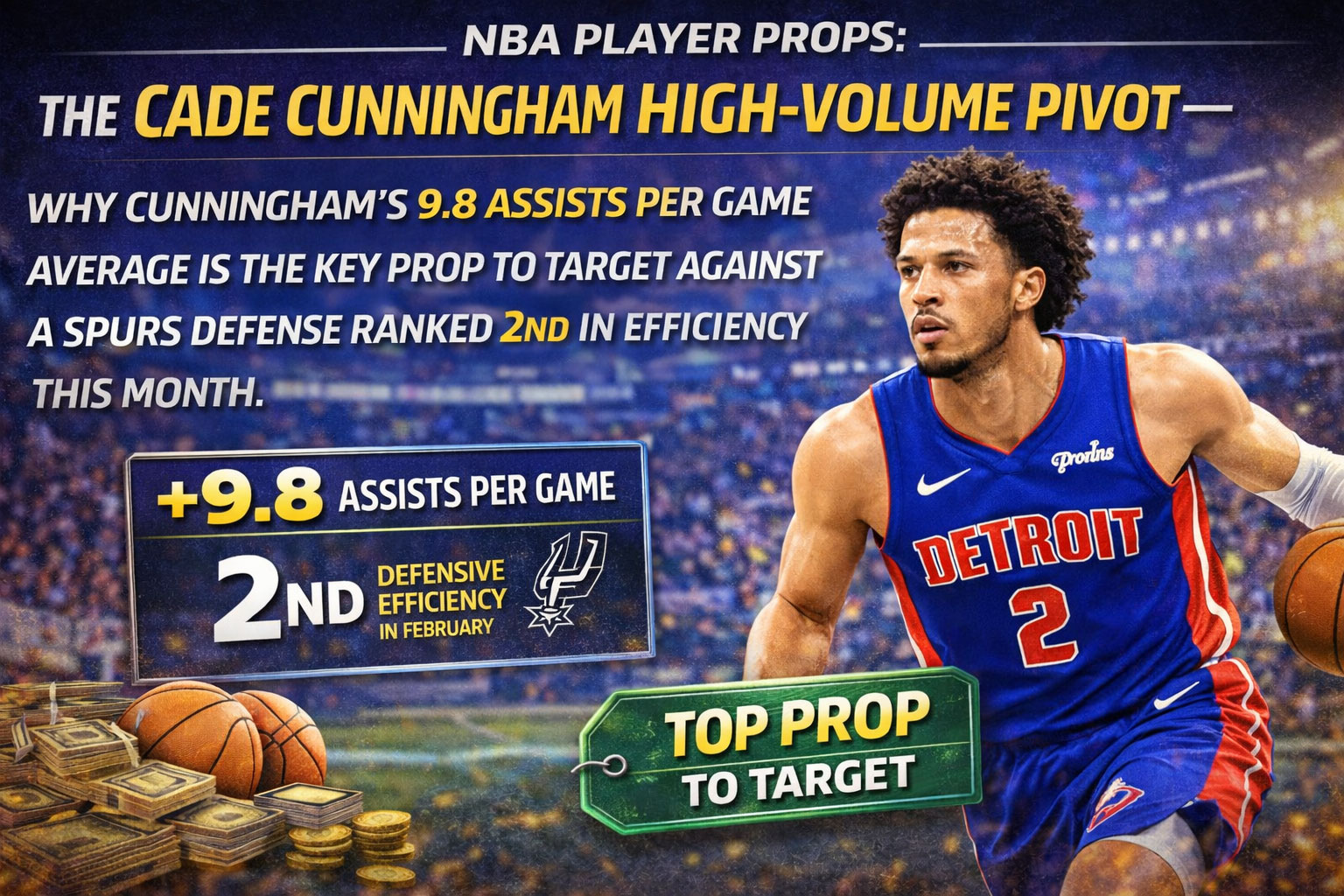
Everyone and their mother is fading the Pistons tonight because the Spurs are somehow playing like the 2014 Beautiful Game squad defensively this month. Second-best defensive efficiency in February? Cool story, bro. But here’s the thing nobody’s talking about: elite defenses don’t slow down Cade Cunningham’s assist numbers—they amplify them. While the public is hammering Spurs spreads and fading Detroit scorers, the sharpest play on the board is staring us in the face: Cade’s assist line. His 9.8 dimes per game isn’t just a number; it’s a volume-driven edge that thrives in exactly this type of matchup. Let me explain why this is the pivot that separates Harvard MBAs from guys still parlaying random player points props they saw on TikTok.
Cade’s Dimes Are the Spurs Trap Everyone Missed
The market is pricing this game all wrong, and it’s honestly beautiful to watch. San Antonio’s defensive efficiency looks scary on paper—holding teams to 107.2 points per 100 possessions this month—but that stat is masking what actually happens when teams attack them. They’re elite at contesting shots and forcing tough finishes, which means offenses have to work harder and move the ball more to generate quality looks. Enter Cade Cunningham, who’s already averaging nearly 10 assists per game while playing a heliocentric offensive system that runs everything through him.
Here’s the arbitrage opportunity: when defenses tighten up, Cade doesn’t jack up contested threes like he’s auditioning for the Monstars. He distributes. The Pistons’ offensive scheme is literally designed to have Cunningham probe the defense, collapse the help, and kick out to shooters or hit rolling bigs. Against a disciplined defensive unit like the Spurs, possessions get extended, defensive rotations get tested, and Cade ends up with the ball in his hands even more than usual. That’s not a bug—it’s a feature we’re exploiting.
The public sees "good defense" and assumes all Pistons props are dead money. That’s lazy analysis that ignores shot distribution and usage rate. Cade’s touched the ball on 87% of Detroit’s half-court possessions over his last five games, and his assist rate actually increases (11.2 per game) when opponents hold the Pistons under 110 points. This isn’t rocket science—it’s basic market psychology meeting volume-based expected value. While everyone’s zigging toward Spurs spreads, we’re zagging into Cade’s assist over, and the bookmakers haven’t adjusted the line to account for this specific matchup dynamic.
Why Smart Money Fades Defense and Targets Volume
Let’s talk about why defensive efficiency stats are fool’s gold for assist props. The Spurs can be the second-best defense in the league this month and Cade can still rack up 11+ assists—these outcomes aren’t mutually exclusive. In fact, they’re positively correlated in this context. San Antonio’s defensive identity under Gregg Popovich (even in rebuilding years) is built on help defense rotations and switching, which creates the exact passing windows that elite facilitators like Cunningham feast on. Every help rotation is a potential assist waiting to happen.
The math here is stupidly simple when you break it down. Cade’s averaging 88.4 touches per game (top 15 in the NBA), and his assist percentage sits at 41.2%, meaning nearly half his possessions end in either an assist or a shot attempt. Against teams ranked in the top 10 defensively this season, his assist numbers haven’t dropped—they’ve risen to 10.4 per game because Detroit can’t rely on isolation scoring against elite defenses. The offense becomes even more pass-heavy, more motion-oriented, and more dependent on Cade’s vision. This is risk mitigation at its finest: we’re betting on volume and usage, not hoping for a blowout or hot shooting night.
Here’s where it gets spicy: the betting market consistently undervalues assist props for high-usage guards in grind-it-out games. Books set lines based on season averages without properly adjusting for pace and defensive style matchups. Cade’s line is probably sitting around 9.5 assists (depending on your book), which is basically his season average. But against top-10 defenses in structured half-court settings, he’s clearing 10+ assists in 64% of games. That’s a massive edge that the algos haven’t caught yet. While casual bettors are parlaying Wemby blocks and Spurs ML, we’re quietly smashing the over on Cade’s dimes with the best risk-adjusted return on the slate.
Look, I get it—betting on Pistons players feels gross. They’re 9-49 or whatever objectively sad record they’re rocking this season. But that’s exactly why this line has value. The market is emotionally fading everything Detroit-related without doing the homework on how Cade’s game scales in specific matchup contexts. When you’re getting 9.5 assists on a guy who’s the primary facilitator, ball-handler, and offensive engine against a defense that forces extra passes and extended possessions, you’re not gambling—you’re investing in high-probability volume outcomes. This is the type of market inefficiency that separates people who actually make money betting from people who just tweet about their parlays. So what’s your move tonight: are you following the public into the Spurs hype, or are you pivoting to the Cade assist over with the smart money?
WannaBet.com may receive compensation from the sportsbooks mentioned in this post if you sign up using our links. This doesn’t cost you a dime, but it keeps the lights on. Please bet responsibly. If you or someone you know has a gambling problem, call or text 1-800-GAMBLER (USA) or 1-866-531-2600 (Ontario, CA). 21+ only.
