

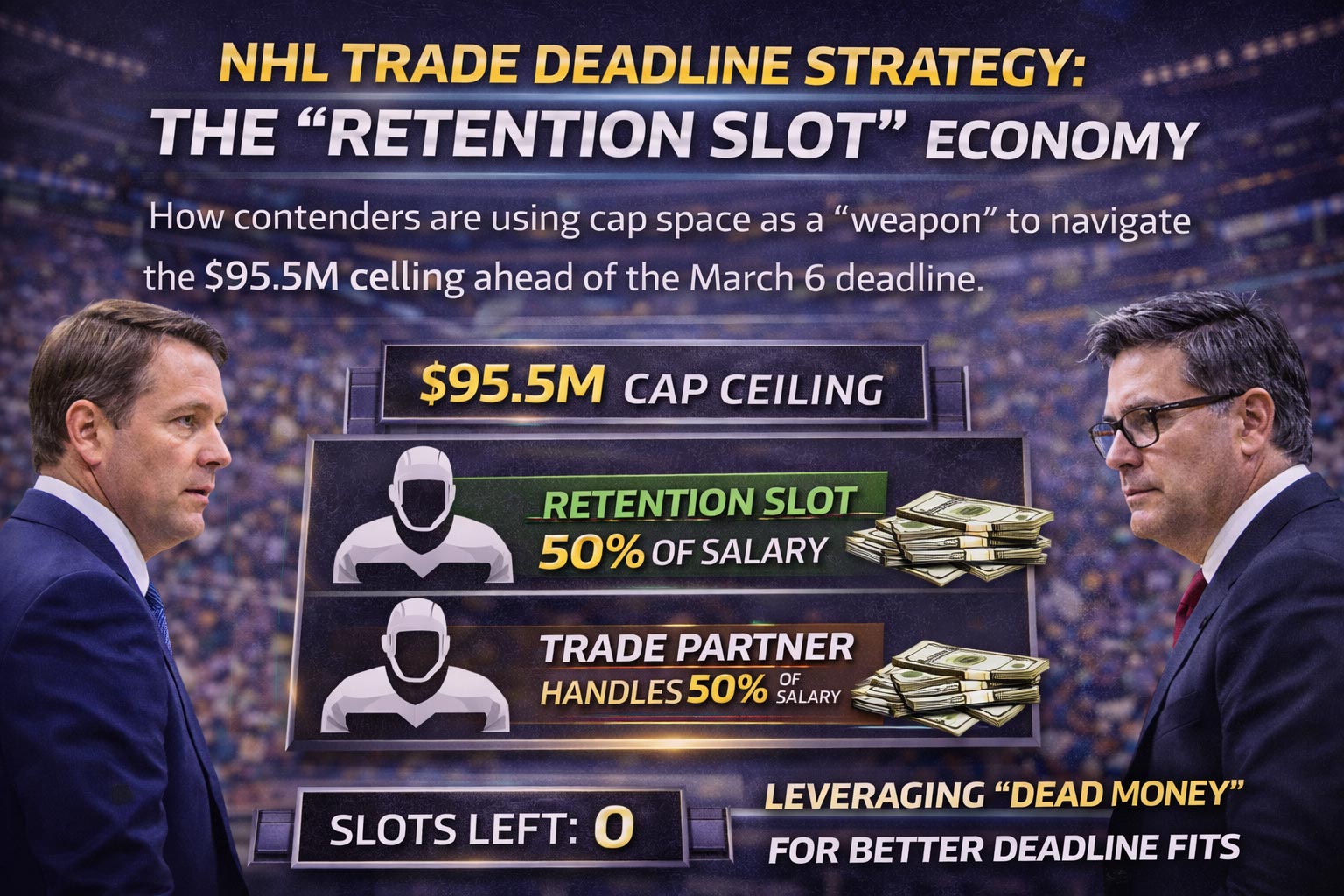
The NHL trade deadline on March 6 is a high-stakes poker game. Cap space has become more valuable than draft picks. Contending teams are weaponizing their balance sheets. This is private equity-level financial engineering happening in real time. It changes how championship windows operate in a hard cap league.
Cap Space as Currency: The New NHL Market Play
The $95.5M salary cap created a liquid secondary market. Teams with cap space turn it into a tradable commodity. They retain salary on players moving to contenders. A rebuilding team retains 50% of a player’s salary, ships him to a contender, and collects a second-round pick. That’s a 100% margin transaction with zero operational risk. You get paid to hold debt you were carrying anyway.
Teams only get three retention slots at any given time. That scarcity made cap space the hottest commodity at the deadline. Contenders now plan moves around which rebuilding teams have slots available. Run out of slots early and you’re locked out of the premium deadline market entirely.
Why Retention Slots Are Worth More Than Picks
A contending team at the cap ceiling has two options. They can overpay in prospects and picks for a player whose salary fits. Or they can pay a premium to a third team for retention and get the player they actually want. The second option consistently delivers higher championship equity. Retention slots are worth more than the picks acquired to use them.
Tampa’s back-to-back Cup runs were masterclasses in this strategy. Legal cap circumvention through LTIR and strategic retention deals. Vegas does it every year. The rulebook allows it. Smart teams exploit the inefficiency until the league closes the loophole.
The Galaxy Brain Retention Move
The sharpest GMs use retention slots on their own traded players. Retain 50% of a $7M player’s salary and he becomes attractive to more teams. That creates a bidding war. The return goes up. You spent cap space — which costs nothing as a rebuilder — to increase the asset’s market value. That’s textbook arbitrage.
Retention can last for years. Some teams still retain salary on deals made three years ago. The best GMs manage cap exposure across multiple seasons. A second-round pick has a 15% chance of becoming an NHL regular. A retention slot that generates three second-round picks across deals delivers a 300% ROI. The expected value isn’t close.
If you’re betting NHL futures, track which contenders have cap flexibility and which rebuilders still have slots open. That predicts who makes the big splash on March 6. For injury context shaking up contender calculations, see our Crosby, Rantanen, and Hedman injury breakdown. For the full Atlantic Division arms race, read our Atlantic Division cap-space analysis.
Who makes the biggest retention-assisted move — Vegas again or does Carolina finally crack the formula? Drop it in the comments.
WannaBet.com may receive compensation from the sportsbooks mentioned in this post if you sign up using our links. This doesn’t cost you a dime, but it keeps the lights on. Please bet responsibly. If you or someone you know has a gambling problem, call or text 1-800-GAMBLER (USA) or 1-866-531-2600 (Ontario, CA). 21+ only.
