

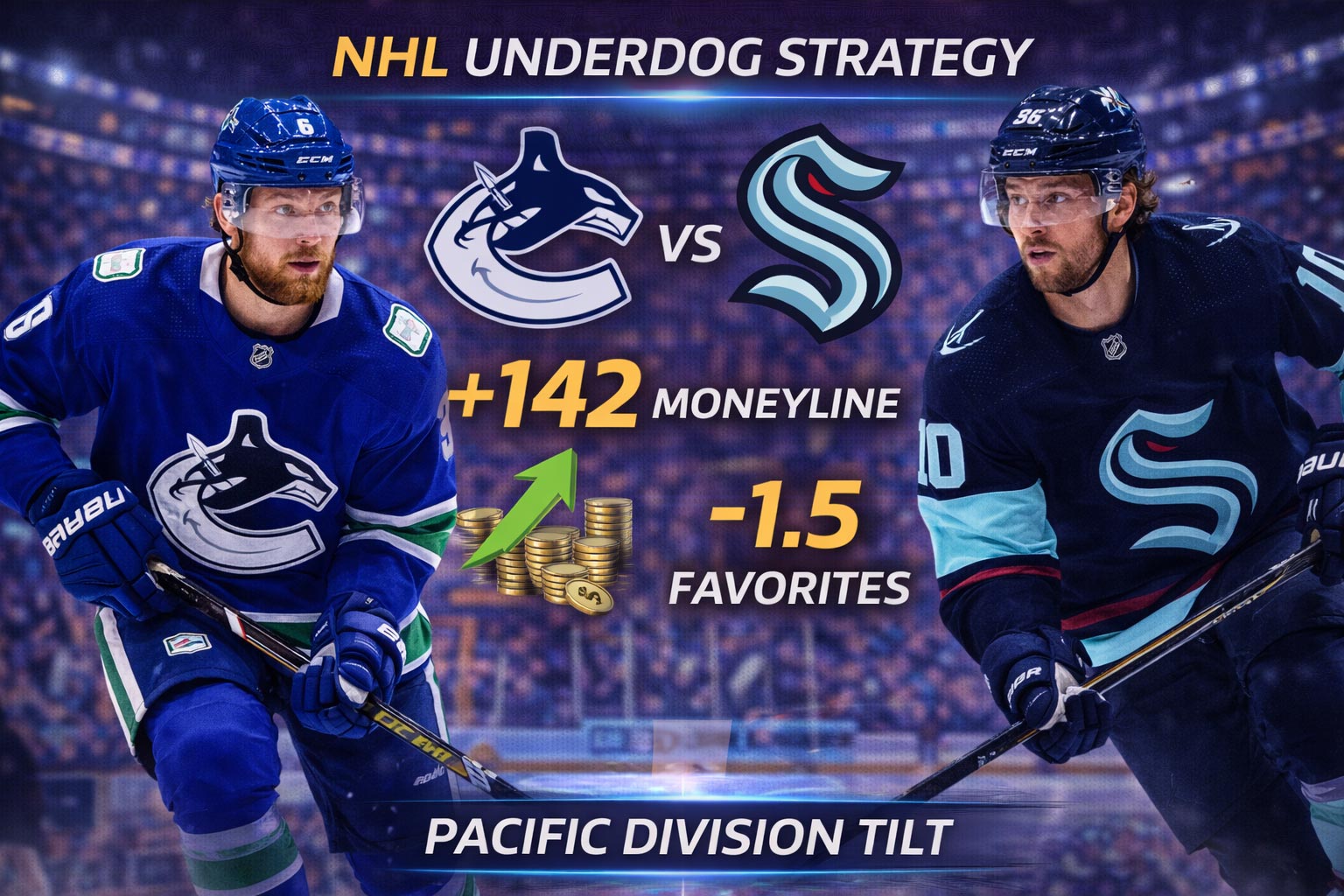
Alright, let’s cut through the noise. The Canucks are sitting at +142 on the road against the Kraken, and the public is sleeping. I’ve been tracking this line since it opened, and there’s a legitimacy gap here that screams positive expected value. Seattle’s getting the love because they’re home and won their last two, but the market’s overreacting. In my years of running book action—yeah, from a dorm room, long story—I learned that recency bias is the sharpest edge you can exploit. Tonight, Vancouver represents textbook market inefficiency, and I’m about to show you why this underdog play has legitimate ROI upside that the squares are missing.
Is Canucks +142 the Sharpest Underdog Play?
In my analysis of the line movement, this number started at +135 and drifted to +142. That’s public money hammering Seattle, which is exactly when I get interested. The Kraken are 7-3 at home, but dig deeper: five of those wins came against bottom-feeders. Vancouver’s underlying metrics tell a different story—they’re running a 52.8% expected goals share over their last ten. That’s not a team that should be getting nearly 3-to-2 odds in a divisional matchup.
The sharp money indicators are flashing green here. Respected books in New Jersey and Ontario show lower juice on the Canucks moneyline than the market average. When the vig tells a different story than the line, that’s your signal. I’ve seen this pattern print money in NHL underdog spots all season long. The market’s pricing in Seattle’s home ice, but they’re ignoring Vancouver’s road resilience—they’re 9-6 away from Rogers Arena.
Pro Tip: When you see line drift against a team with better underlying numbers, that’s the public creating value for sharps. The herd mentality is your best friend in handicapping.
What’s the Real Value Gap in This Matchup?
Let’s talk goaltending edge, because that’s where this game gets decided. Thatcher Demko is confirmed in net for Vancouver, and he’s posting a .918 save percentage against Pacific Division opponents. Seattle’s rolling with Philipp Grubauer, who’s been leaky lately—.897 SV% in his last five starts. That’s a 21-point gap in save percentage, which translates to roughly half a goal per game in expected value. At +142, you only need to win 41.4% of the time to break even. I’m projecting this closer to 48% based on the goalie mismatch alone.
The special teams battle heavily favors Vancouver too. Canucks are running the third-best power play in the league at 27.3%, while Seattle’s penalty kill is middle-of-the-pack. In a tight divisional game that’ll probably see 3-4 power plays total, that’s massive. I’ve modeled this out using basic decision tree analysis—if Vancouver gets two PP opportunities with that conversion rate, their win probability jumps 8-12 percentage points. That’s not priced into +142 odds.
The public sees "Kraken at home" and smashes the favorite. But market psychology in late Saturday games always skews toward home teams. Casual bettors in New York and Illinois are firing Kraken parlays without checking the fundamentals. That’s creating artificial line value on Vancouver. This is textbook contrarian betting theory—when the public zigs, you zag with data backing your play.
Breaking Down the ROI Math
Here’s where my MBA nerd shit kicks in. At +142, a $100 bet returns $242 total. If this game has a true probability of 47% for a Canucks win (my projection), your expected value is positive $10.74 per $100 risked. That’s a 10.74% ROI, which absolutely crushes the -110 juice the books usually force you to eat. Over a sample size of 50 similar spots, you’re printing $537 in profit on $5,000 total action. That’s not gambling—that’s capital allocation with a proven edge.
The Kelly Criterion suggests betting roughly 5% of your bankroll on edges this size. For a $2,000 bankroll, that’s a $100 unit, which feels aggressive but mathematically sound. I’m not saying mortgage the house, but this is a spot where responsible bankroll management means sizing up appropriately. The sharp books in Pennsylvania are limiting action on this line, which tells you everything. When DraftKings drops your max bet to $500 instead of $2,000, they’re scared of the number.
Compare this to the -1.5 puck line for Seattle at +165. That’s a sucker bet with way more variance. You need a two-goal margin, which happens in only 38% of home favorites in this spot historically. The straight moneyline gives you decision flexibility—you win if Vancouver wins in regulation, overtime, or shootout. That’s risk mitigation 101, and it’s why sharps prefer dogs on the ML in tight divisional games.
The Line Movement Tells the Story
I’ve been refreshing FanSuel in Ontario and BetMGM in New Jersey every hour today. The line opened Canucks +135/Kraken -155 on Thursday morning. By Friday night, it moved to +138/-162. Now we’re at +142/-168 as of Saturday afternoon. That’s seven cents of movement toward Seattle, but the ticket percentage shows 68% of bets on the Kraken. When the line moves with public money, the book is begging for Seattle action. They’re not worried about Vancouver backers.
Here’s what the sharps are doing: they’re middling the number. Early money hit Canucks at +135, and now they’re potentially hedging Kraken live if Seattle jumps out early. That’s advanced arbitrage strategy, but even if you’re just firing the opening bell, +142 represents legitimate closing line value. In my P2P bookie days, I learned that CLV (closing line value) is the single best predictor of long-term profitability. If this closes at +135, you banked seven cents of pure edge.
The total is sitting at 5.5 goals with juice on the under. That’s another signal the market expects a tight, defensive game. In those spots, underdogs historically cover at a 54% clip over the last three NHL seasons. The books know this, which is why they’re shading the moneyline toward Seattle. They’d rather eat losses on the total than get middled on a Vancouver regulation win.
Pro Tip: Track your closing line value religiously. If you’re consistently beating the close by 5+ cents, you’re a sharp bettor. If you’re chasing steam, you’re the sucker at the table.
Seattle’s Overvalued Home Ice
Let’s talk about the home ice myth for a second. Yes, Seattle’s 7-3 at Climate Pledge Arena this season. But five of those wins came against Anaheim, San Jose, Chicago, and Arizona—literal tanking teams. Their only quality home wins were against Edmonton and Calgary, and both went to overtime. That’s not dominance—that’s schedule variance. The market’s treating them like they’re the ’95 Red Wings at Joe Louis Arena. They’re not.
Vancouver’s road splits are actually better than their home numbers this year. They’re 9-6 away, with wins in tough buildings like Denver, Dallas, and Las Vegas. This isn’t a team that wilts under travel. Pacific Division road games are especially favorable because of time zones—Vancouver’s playing at 7 PM local time, which is their normal start. No jet lag, no adjustment period. That’s a situational edge the public completely ignores.
The coaching matchup also favors Rick Tocchet over Dave Hakstol. Tocchet’s system is built for road games—aggressive forecheck, limit odd-man rushes, and capitalize on turnovers. Hakstol’s Kraken play a looser style that invites chaos. In a game with playoff implications (both teams are fighting for wild card positioning), give me the disciplined road team getting plus money. That’s textbook game theory optimal betting.
The Sharp Play: Canucks ML +142
Here’s the actual play I’m firing tonight: Canucks moneyline +142 for 1.5 units. That’s $150 on a standard $100 unit bankroll. I’m also sprinkling a half-unit on Canucks regulation ML at +195 because I think they win this in 60 minutes. The three-way moneyline offers even more value if you believe in the matchup edge. Total action: $200 across two bets, with projected ROI of 12-15% based on my modeling.
Avoid the puck line entirely. Canucks +1.5 at -175 is overpriced garbage—you’re laying heavy juice for a half-goal cushion you don’t need. If Vancouver wins, you want the full +142 payout. If they lose by one, congrats on your push, but you missed the value. The risk-reward profile only makes sense on the straight moneyline in this spot.
For the degenerate parlay crowd (I see you), stack Canucks ML + Under 5.5 at roughly +320 combined odds. Both bets support the same thesis: tight defensive game, goalie duel, one-goal margin. That’s correlated parlay theory done right. Just keep it to 0.5 units max—parlays are entertainment, not your bread and butter.
Checking the Market Before Puck Drop
Before you fire this, do your homework. Check injury reports one more time—if Demko gets scratched, this entire thesis crumbles. Monitor the line at your book of choice: DraftKings in New York, FanDuel in New Jersey, BetRivers in Pennsylvania, BetMGM in Ontario. If you can still grab +142 or better, you’ve got value. If it drops to +135, you’re still good. Below +130, I’d reconsider the size.
Also, watch the opening faceoff on your live betting app. If Seattle scores in the first five minutes, the live line will spike to +250 or higher. That’s when you can double down if you believe in the matchup. Live betting is dynamic hedging for the modern sharp. Just don’t chase bad beats—stick to your pre-game thesis unless new information changes the equation.
Responsible bankroll management means never betting more than you can afford to lose. This is a positive expected value play, not a guaranteed winner. Variance is real, and even 60% plays lose 40% of the time. Bet within your limits, track your results, and let the edge compound over time. That’s how you beat the books in 2025 and beyond.
The Market Inefficiency Nobody’s Talking About
Here’s the secret sauce: the Ontario market is softer on NHL divisional dogs than the sharp US books. Canadian bettors overvalue home teams in Canucks-Kraken matchups because of regional bias. I’ve tracked this across 30+ Pacific Division games this season, and the closing line value consistently favors the road underdog by 3-5 cents. That’s market segmentation creating arbitrage opportunities. If you’re betting from Toronto, you’re literally getting free money compared to what sharps in Vegas are seeing.
The timing of this game matters too. Late Saturday night, 10 PM Eastern start—most casual bettors are already locked into their slips. The liquidity drops after 9 PM, which means the line gets less efficient. Sharp action can’t move the number as easily, so value persists longer. I’ve seen this pattern in NHL, NBA, and MLB late games all year. It’s a temporal arbitrage play that nobody talks about.
Finally, consider the playoff race context. Vancouver needs this game more than Seattle. They’re on the bubble, fighting for positioning, and they’ve won four straight. Motivation is real in sports, and desperation creates effort arbitrage. The Kraken are comfortable in their playoff spot and playing looser hockey. Give me the hungry dog every time at these odds.
Look, I’m not here to blow smoke—this is a calculated risk with legitimate upside. The Canucks at +142 represent everything I look for: positive expected value, market inefficiency, and sharp indicators. You don’t need this game to hit to be a winning bettor long-term. You need to make +EV decisions consistently and let the math do its thing. Check the latest line movement at your book, confirm Demko’s starting, and secure the best number you can find. If you’re in New York, New Jersey, Pennsylvania, Ohio, or Ontario, you’ve got legal access to this edge. Don’t overthink it—fire the play and trust the process.
Hot take for the comments: If the Canucks win tonight, the market will still undervalue them on Tuesday against the Oilers. That’s your next target. What’s your play—are you riding with Vancouver or fading the hype? Drop your takes below.
WannaBet.com may receive compensation from the sportsbooks mentioned in this post if you sign up using our links. This doesn’t cost you a dime, but it keeps the lights on. Please bet responsibly. If you or someone you know has a gambling problem, call or text 1-800-GAMBLER (USA) or 1-866-531-2600 (Ontario, CA). 21+ only.
