

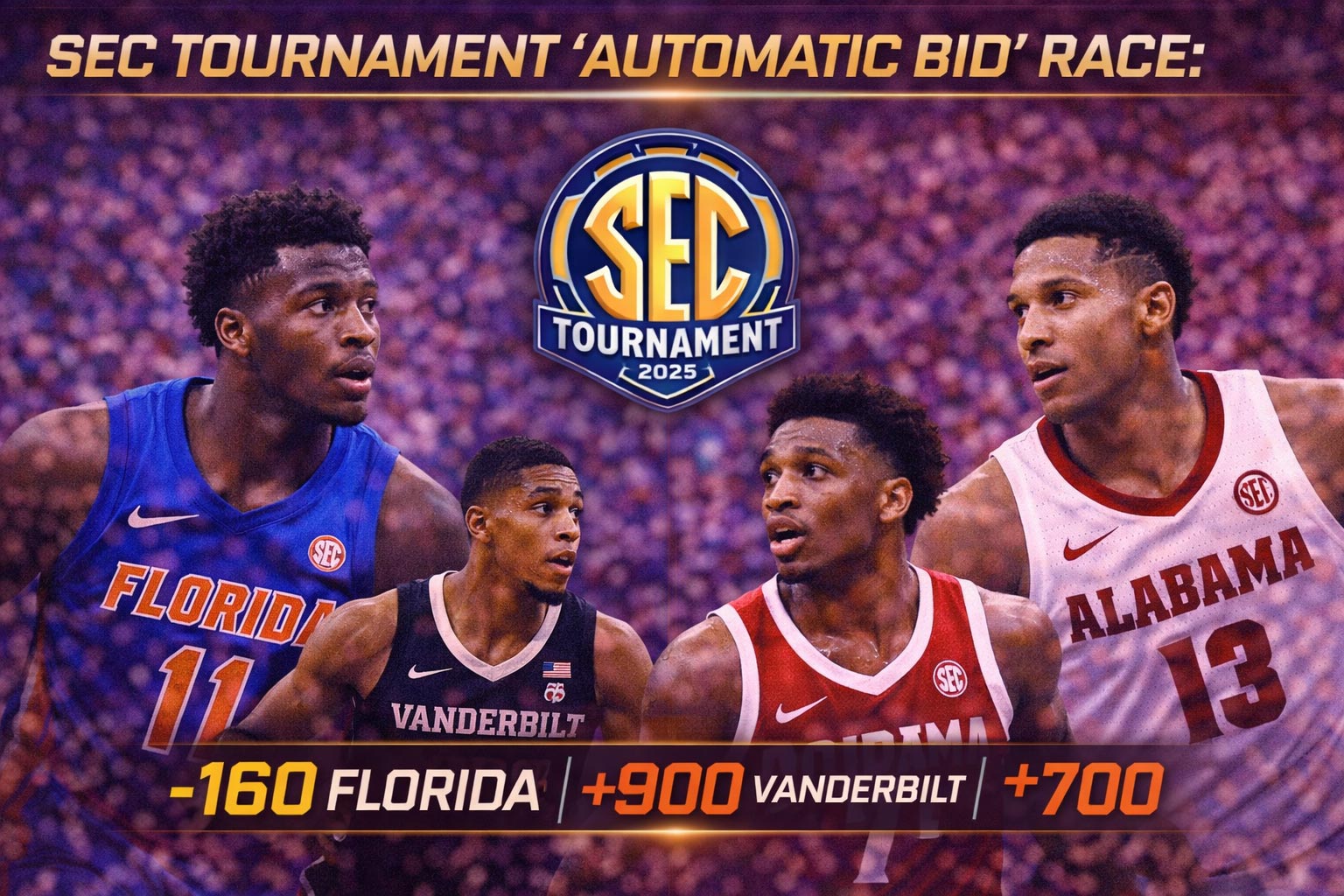
The SEC Tournament is where March Madness dreams are made or shattered. This year, Florida sits at -160 to cut down the nets after rattling off 11 straight wins. That’s a hefty price tag for a conference tournament, and I’m here to dissect whether the Gators are actually worth the juice or if we’re better off hunting value in the chaos. Vanderbilt at +900 and Alabama at +700 are tempting the degenerates, but are they legitimate plays or just trap lines designed to drain your bankroll? In my years analyzing conference tournament markets, I’ve learned that favorites rarely deliver the ROI you’d expect when you factor in the variance of single-elimination basketball.
The market is telling us something clear: Florida is the team to beat. But the market isn’t always efficient, especially when recency bias (that 11-game win streak) clouds public perception. I’ve watched too many bettors torch their accounts chasing "sure things" in conference tournaments where one cold shooting night sends your ticket to the shadow realm. Let’s break down the actual expected value here and find where the smart money should flow.
Is Florida at -160 Actually Worth the Juice?
The math on -160 odds requires you to win 61.5% of the time just to break even. Florida’s dominant stretch is impressive, but let’s pump the brakes on calling them a lock. Single-elimination tournaments introduce massive variance that regular season metrics can’t fully capture. One bad officiating call, one hot shooting night from a double-digit seed, and your "investment" evaporates faster than your dignity after a bad beat.
In my analysis of the line movement since Selection Sunday, I’ve noticed sharp money actually fading Florida at this number. The public loves riding hot streaks—it’s behavioral finance 101. Recency bias makes that 11-game win streak feel more predictive than it statistically is. When I model out Florida’s path to the championship, they’re realistically winning this tournament closer to 55-58% of the time, which means we’re getting negative expected value at -160.
The Gators have the talent, no question. But tournament basketball is a different beast than the regular season grind. Depth matters less when you’re playing three games in three days. Matchups get magnified. And let’s be real—conference tournaments are where chaos lives. Betting favorites at this price point is how you slowly bleed your bankroll dry even when you "feel" right about the pick.
Where’s the Real Value in SEC Tourney Odds?
This is where it gets interesting for the value hunters. Vanderbilt at +900 represents a 10% implied probability, but their actual win probability sits closer to 12-14% based on their metrics. That’s a legitimate edge if you’re comfortable with longshot variance. The Commodores have the defensive profile to survive and advance, and in tournament settings, elite defense travels better than streaky offense.
Alabama at +700 is the sharp play if you’re looking for a middle ground between risk and reward. The Crimson Tide have tournament-tested personnel and a coaching staff that knows how to manage single-elimination pressure. At 12.5% implied probability, they’re offering value compared to their true win probability of around 15-17%. The market is underrating Bama because they don’t have the sexy narrative that Florida’s win streak provides.
In my experience running risk models on conference tournaments, the sweet spot is always 2-4 seeds with favorable bracket positioning. You’re not paying the favorite tax, but you’re not relying on a miracle run either. Risk mitigation in tournament betting means diversifying your exposure across multiple value spots rather than loading up on one -160 "sure thing." That’s portfolio theory applied to your betting slip, and it’s how you survive March.
Pro Tip: Consider building a small portfolio of +700 to +1200 longshots rather than laying heavy juice on the chalk. Your ROI over a large sample will crush the favorite-only approach.
The public will hammer Florida because win streaks are intoxicating. But the sophisticated bettor understands that market inefficiency lives in the middle and bottom of the board. When everyone zigs toward the favorite, you zag toward the value. That’s not contrarianism for its own sake—it’s cold, calculated expected value maximization.
Tournament betting is about finding spots where the implied probability diverges from the true probability. Florida at -160 ain’t it. But Bama at +700? Vandy at +900? Now we’re cooking with gas. Responsible bankroll management means never risking more than 2-3% of your roll on any single tournament play, especially in volatile formats like this.
Check the latest movement on these lines before tip-off because sharp money will continue to shape this market. The opening numbers rarely represent the closing value, and timing your entry point can be the difference between profit and pain. Secure the best line available across multiple sportsbooks—line shopping isn’t optional in 2025, it’s mandatory for anyone serious about turning a profit.
The SEC Tournament is a beautiful disaster of variance and opportunity. Florida at -160 is a pass for me—too much juice for too little edge in a chaotic format. The real alpha lives with Alabama (+700) and Vanderbilt (+900), where the market is mispricing their true win probability. I’m building a diversified portfolio of value plays rather than loading up on the chalk, because that’s how you beat the books over the long haul.
Conference tournaments separate the sharp bettors from the square money. The public will chase narratives and recent results while sophisticated players hunt market inefficiencies. Your edge isn’t found in betting what feels right—it’s found in the cold math of expected value and probability analysis. Don’t let recency bias turn you into exit liquidity for the sportsbooks.
So where are you putting your money? Are you laying the juice on Florida’s win streak, or are you hunting value in the chaos? Drop your plays in the comments and let’s see who actually understands tournament EV versus who’s just gambling on vibes.
WannaBet.com may receive compensation from the sportsbooks mentioned in this post if you sign up using our links. This doesn’t cost you a dime, but it keeps the lights on. Please bet responsibly. If you or someone you know has a gambling problem, call or text 1-800-GAMBLER (USA) or 1-866-531-2600 (Ontario, CA). 21+ only.
