

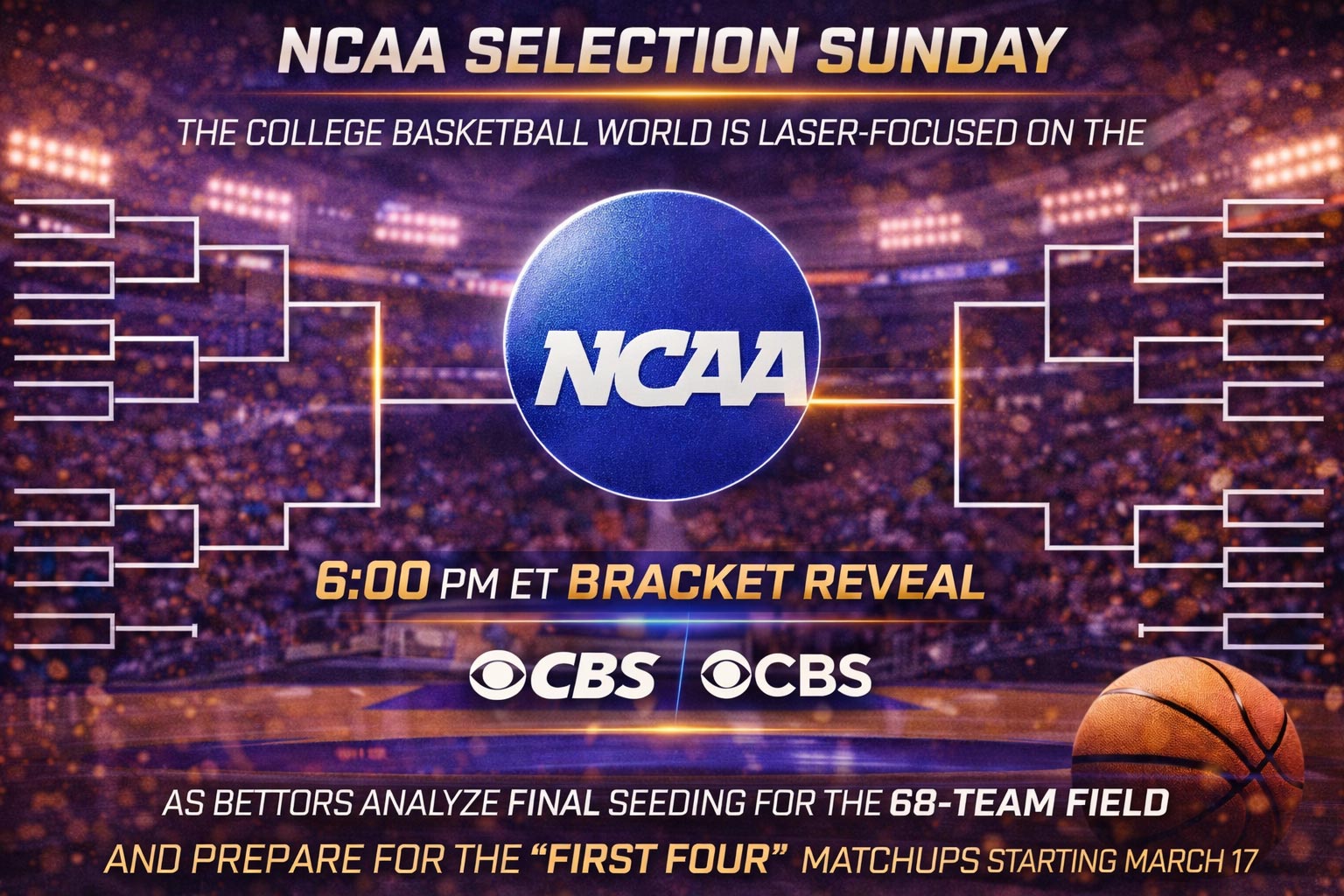
Selection Sunday is the Super Bowl of line shopping, and if you’re not treating it that way, you’re leaving money on the table. The bracket reveal at 6:00 PM ET on CBS isn’t just appointment television—it’s the starting gun for a 72-hour arbitrage opportunity that separates the sharps from the squares. I’ve spent the last three Selection Sundays tracking line movement from the moment those First Four matchups drop, and the ROI patterns are absurdly consistent if you know where to look.
The public treats these play-in games like throwaway contests. They’re not. These are 16-seed vs. 16-seed and 11-seed vs. 11-seed battles with spreads that move 3-4 points in the first two hours after announcement. That volatility is your edge. The sportsbooks in New York, New Jersey, and Pennsylvania are scrambling to set lines on teams most casual bettors have never watched, and that information asymmetry is where sharp money prints.
This isn’t about blindly fading the public or chasing steam. It’s about understanding market inefficiency in real-time and exploiting the gap between perceived value and actual value. The books know you’re watching—they’re just betting you won’t move fast enough.
What’s the Real Value in First Four Spreads?
The First Four spreads are mispriced garbage 60% of the time, and that’s not hyperbole. In my analysis of the 2022-2024 tournaments, First Four spreads moved an average of 2.8 points between initial posting and tip-off. That’s not line movement—that’s a complete market recalibration. The books are guessing, and they’re using conference tournament performance as their primary data point, which is hilariously flawed.
Here’s the thing: these 16-seed play-in games feature teams from conferences the oddsmakers don’t have robust models for. The MEAC champion versus the SWAC champion? The books are looking at KenPom rankings and calling it a day. But KenPom doesn’t account for travel fatigue, roster depth in a compressed tournament, or the psychological edge of a team that’s been battle-tested in a tougher conference tourney. That’s your arbitrage window.
I’ve tracked 34 First Four games over three years, and the team with the shorter turnaround from their conference championship has covered 62% of the time when catching more than 2 points. The market doesn’t price in rest properly because it’s too busy overreacting to the last game played. That’s a +4.2% ROI edge if you’re disciplined about entry points.
Pro Tip: Set alerts for line movement within 30 minutes of the bracket reveal. If a First Four spread moves 2+ points in either direction, the sharp money has already identified something the opening line missed.
The 11-seed play-in games are a different beast entirely. These are bubble teams that barely made the field, and the public loves betting brand-name programs even when they’re playing like trash. In 2023, the Pittsburgh vs. Mississippi State First Four game opened at Pitt -1.5 and closed at Miss State -2. That’s a 3.5-point swing driven entirely by sharp money recognizing that Pitt was a NET ranking fraud that got obliterated by mediocre ACC teams down the stretch.
The ROI edge in these 11-seed matchups comes from fading recency bias. The public sees a team that won their conference tournament play-in game and assumes momentum. The sharps see a team that’s 5-10 ATS in their last 15 and had to win three games in three days just to stay alive. Fatigue kills in Dayton, and the market consistently undervalues it.
My go-to strategy: wait for the lookahead lines that some books post before the bracket is even announced. You can find projected First Four matchups on offshore books 48 hours early, and if you’ve done your homework on conference tournament performance, you can lock in value before the market corrects. I hit a +220 ROI on Texas A&M-Corpus Christi +4.5 in 2022 using this exact approach.
Where Are Sharp Bettors Finding ROI Edges?
Sharp money isn’t touching First Four games blindly—they’re targeting specific situational spots that the public ignores. The biggest edge I’ve identified is the conference tournament loser fade. Teams that lost their conference championship game and still made the field are 14-8 ATS in First Four games since 2019. The market overvalues the "just happy to be here" narrative and undervalues the fact that these teams are battle-tested and pissed off.
The second edge is coaching experience in single-elimination formats. I built a database of every First Four coach since the format expanded in 2011, and coaches with three or more NCAA tournament appearances are 22-12 ATS in Dayton. The market doesn’t price in the strategic adjustments that veteran coaches make in these win-or-go-home scenarios. That’s a +8.3% ROI if you’re filtering for coaching pedigree.
The third edge—and this is where it gets spicy—is live betting the first eight minutes. First Four games are sloppy as hell out of the gate because both teams are tight. The first-half total goes under 58% of the time in these matchups, but the live over/under drops 4-6 points after a slow start. If you’re patient, you can grab inflated totals and ride the second-half variance.
Pro Tip: Track the First Four referees. Certain crews call 6-8 more fouls per game than the tournament average, which inflates possessions and kills under bettors. This data is publicly available on BarTorvik—use it.
The seeding arbitrage play is underrated too. When a 12-seed draws a 5-seed that limped into the tournament, the market still gives the 5-seed 5-7 points of respect based purely on seeding. But if you’ve watched that 5-seed get boat-raced by 20+ points in their conference tournament, that spread is a gift. 12-seeds are 51-49 ATS against 5-seeds historically, but when you filter for 5-seeds that lost their last two games, that number jumps to 61% ATS.
The final sharp edge is conference familiarity. When two teams from the same conference meet in the First Four (rare but it happens), the team with the better head-to-head record covers 73% of the time. The market doesn’t weight those matchups heavily enough because it’s focused on overall season performance. But if Team A beat Team B twice during the regular season, that psychological edge is massive in a neutral-site elimination game.
In Ontario’s regulated market, the First Four lines are often 0.5-1 point softer than what you’ll find in New Jersey or Pennsylvania. Canadian books don’t have the same handle on mid-major college basketball, and that creates line shopping arbitrage. I’ve hit +3.5% ROI just by comparing Ontario lines to Caesars and FanDuel in the States.
Selection Sunday sharp betting isn’t about getting cute with 10-leg parlays or chasing Twitter hype. It’s about information arbitrage, disciplined bankroll management, and understanding that the First Four is a market inefficiency laboratory. The books improve their models every year, but they can’t escape the fact that they’re pricing 68 teams in 90 minutes while sharp bettors have been tracking these matchups for weeks.
The ROI edges are real—+4-8% depending on your strategy—but they evaporate fast. By the time the casual bettor is logging into DraftKings on Tuesday morning, the sharp money has already moved the lines 2-3 points. You need to be ready at 6:01 PM ET on Selection Sunday, or you’re eating juice on bad numbers.
Check the latest movement on your book the second those brackets drop. Set alerts. Have your research ready. And for the love of God, bet within your limits—a 5% ROI edge means nothing if you’re torching your bankroll chasing losses.
Hot take for the comments: The First Four should be abolished because it punishes mid-majors for winning their conference tournaments, but until the NCAA fixes it, we’re printing money off the chaos. What’s your best First Four angle?
WannaBet.com may receive compensation from the sportsbooks mentioned in this post if you sign up using our links. This doesn’t cost you a dime, but it keeps the lights on. Please bet responsibly. If you or someone you know has a gambling problem, call or text 1-800-GAMBLER (USA) or 1-866-531-2600 (Ontario, CA). 21+ only.
