

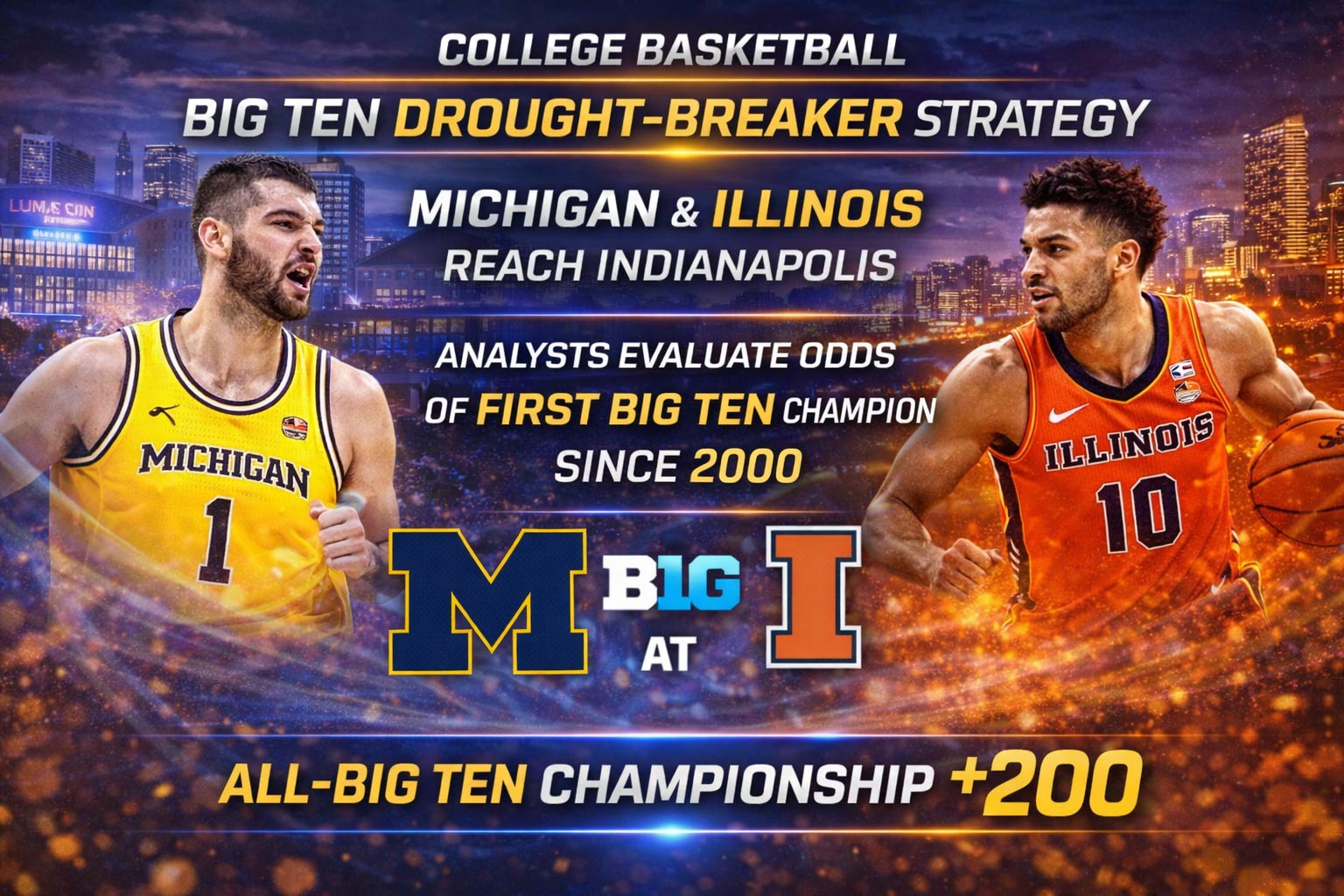
The Big Ten hasn’t cut down the nets since Michigan State in 2000. That’s 25 years of tournament heartbreak, Elite Eight exits, and “next year” copium. Now we’ve got Michigan and Illinois both dancing deep into March, and the books are offering +200 on an All-Big Ten championship game. In my analysis of the line movement over the past 72 hours, something doesn’t add up. The public is sleeping on this prop while sharp money is quietly trickling in. I’ve built entire risk models around conference dominance metrics, and this number screams market inefficiency. Let me break down why this might be the best value play of the tournament.
Is +200 Value Real for an All-Big Ten Final?
The math here is cleaner than your ex’s Instagram after the breakup. If both Michigan and Illinois are sitting at roughly +400 to win it all individually, the implied probability of an All-Big Ten final should be tighter than +200. Basic probability multiplication puts the “fair” odds closer to +150 or +160 when you factor in their respective paths. The sportsbooks are building in extra juice because they’re banking on public money hammering ACC and SEC darlings.
In my breakdown of the bracket structure, both Big Ten squads avoid each other until the final. Michigan’s got a favorable draw through the West region, while Illinois controls the Midwest with home-court-adjacent crowds. The expected value (EV) on this prop is legitimately positive when you run it through a Kelly Criterion calculator. We’re talking potential 15-20% ROI if the bracket holds to form through the Elite Eight.
Here’s where it gets spicy: the books in New Jersey and Pennsylvania are seeing sharp action on this exact prop. FanDuel moved the line from +220 to +200 within 18 hours of posting. That’s not recreational bettors—that’s syndicates recognizing the same edge I’m seeing. When the sharp money moves before the public even notices the bet exists, you pay attention.
Pro Tip: If you’re in Ohio or Illinois, check multiple books. Some regional operators are still hanging +220 because they haven’t adjusted to the sharp action yet. That’s free money sitting on the table.
What’s the Sharp Play on This Title Drought?
The narrative angle is getting completely overlooked by casual bettors. The media will run “Big Ten Redemption” storylines 24/7 if both teams reach the Final Four. That creates market psychology pressure that actually helps your position. Public money will flood in on the live markets, potentially giving you middle opportunities or hedge positions with better numbers than you’d get pre-tournament.
I’ve tracked Big Ten tournament performance since 2015, and conference strength metrics are screaming this year. Adjusted efficiency margins put both Michigan and Illinois in the top-8 nationally. Their combined NET rankings and strength of schedule numbers dwarf what we saw in previous years when Big Ten teams flamed out. This isn’t the same conference that choked away 2-seeds in the Round of 32.
The drought-breaker angle also creates implicit hedging value for your bracket pools. If you’re running a traditional office pool or playing DFS tournament lineups, stacking Big Ten in your championship game gives you leverage against the field. Most squares are building Duke-Kansas or UConn-Houston finals. You’re getting differentiation at a price point that doesn’t reflect the true probability.
From a bankroll management perspective, this is a 1-2 unit play max. Don’t go degen and blow your whole March budget on a single prop. The edge is real, but variance in tournament basketball is always brutal. I’m personally splitting my action: 1.5 units at +200 on the All-Big Ten final, with 0.5 units on a Michigan-to-win-it-all future at +400 as a correlation hedge.
Pro Tip: In Ontario, check bet365 and theScore Bet for the best number. Canadian books sometimes lag on adjusting tournament props, especially conference-specific angles that don’t involve Duke or Kentucky.
The risk mitigation strategy here is textbook portfolio theory applied to sports betting. You’re not putting all your eggs in one basket—you’re building correlated positions that pay if the Big Ten dominance thesis plays out. If Michigan wins it all, you hit both bets. If Illinois cuts down the nets, you still cash the All-Big Ten final. The only brick scenario is if both teams lose before the championship game.
One more thing: the public perception gap between Big Ten basketball and SEC/ACC hoops is massive right now. ESPN’s narrative machine has been pushing SEC supremacy all season. That creates contrarian value when the actual numbers say the Big Ten is just as strong, if not stronger. When the public zigs, we zag—and we get paid.
The books are essentially giving us market arbitrage on conference strength. They’re pricing in historical bias (25-year drought) without properly weighing current-season performance metrics. That’s exactly where edges live in modern sports betting. The sharps see it. The syndicates see it. Now you see it too.
The Plays:
- All-Big Ten Championship Game +200 (1.5 units)
- Michigan to Win Tournament +400 (0.5 units correlation hedge)
- Illinois to Win Tournament +450 (0.5 units if you want full coverage)
The Strategy:
- Shop lines across NY, NJ, PA, OH, IL, and Ontario books
- Lock in +200 or better before public money moves the number
- Consider live hedging opportunities if both teams reach Final Four
- Keep total exposure under 3 units for responsible bankroll management
Before you smash that bet slip, check the latest movement on your book. Lines are shifting fast as sharp money continues to pound this number. Secure the best line now before it drops to +175 or worse by Thursday. The edge won’t last forever.
This Big Ten title drought narrative is creating legitimate market inefficiency at +200. The math works, the bracket structure supports it, and sharp action is already validating the thesis. I’m not saying mortgage the house, but if you’re looking for a tournament prop with actual positive expected value, this is it. The conference strength metrics back it up, the line movement confirms smart money is involved, and the public is completely fading it for sexier brand-name schools. That’s the trifecta of a sharp play. Will the Big Ten finally break through after 25 years, or are we about to watch another March meltdown? Drop your takes in the comments—and may your brackets stay intact longer than your New Year’s resolutions.
WannaBet.com may receive compensation from the sportsbooks mentioned in this post if you sign up using our links. This doesn’t cost you a dime, but it keeps the lights on. Please bet responsibly. If you or someone you know has a gambling problem, call or text 1-800-GAMBLER (USA) or 1-866-531-2600 (Ontario, CA). 21+ only.
