

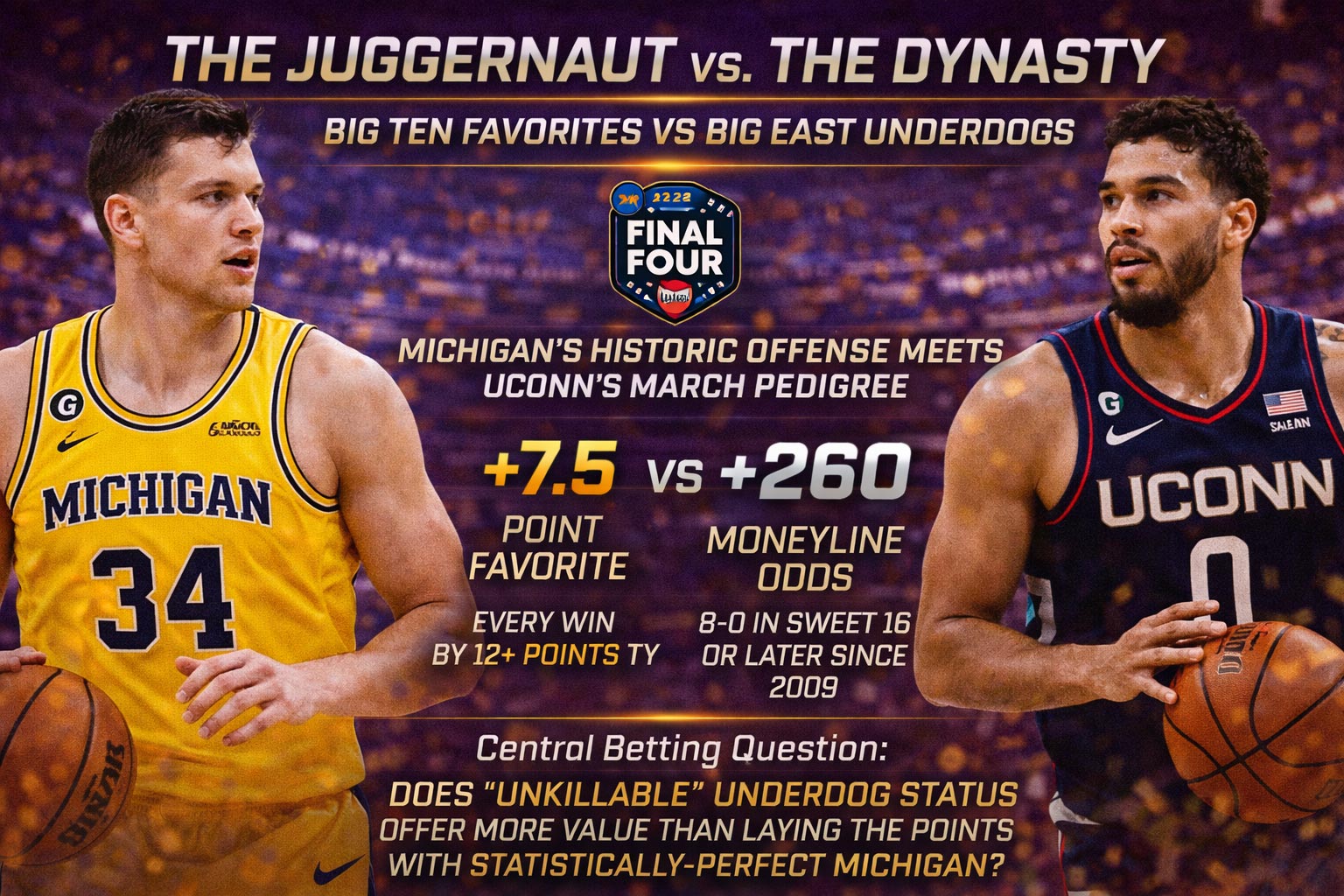
In my years analyzing March Madness betting markets, I’ve never seen a spread this polarizing. Michigan opened as a 7.5-point favorite against UConn, and the line movement tells a story that’s making sharps and squares fight over completely different sides. The Wolverines have demolished every tournament opponent by double digits. UConn hasn’t lost a Sweet 16-or-later game since the Obama administration. One team looks statistically perfect. The other team is historically unkillable in big moments. The betting question isn’t just about who wins—it’s about where the actual edge lives in a market that’s pricing in two completely different narratives.
Is UConn’s +260 Moneyline the Real Value Play?
The +260 moneyline on UConn represents something fascinating from a market psychology perspective. Books are basically telling you there’s a 27.8% implied probability that the Huskies win this game straight up. In my analysis of historical tournament data, that number feels disrespectfully low for a team with UConn’s pedigree. Since 2009, they’re 17-0 in Sweet 16 games or later. That’s not a sample size issue—that’s a culture of winning when the lights are brightest.
The expected value calculation here is pretty straightforward. If you believe UConn’s true win probability is even 35%, you’re getting massive +EV on that dog money. A $100 bet returns $260 if they win outright, and you don’t need to sweat garbage-time free throws. The risk mitigation angle is cleaner too—you’re either right or wrong, no bad beat scenarios.
Here’s where it gets interesting for bankroll management purposes: the moneyline removes spread variance entirely. Michigan could win by 3, and you still cash if you’re on UConn ML. The juice is baked into the price, but you’re paying for certainty of outcome. For bettors in high-volume markets like New York and New Jersey, where live betting options are plentiful, grabbing this number early protects you from line movement.
Pro Tip: If UConn keeps it within 4 at halftime, that ML will shrink to +140 or less. The value is now, not in-game.
Does Michigan’s Spread Cover Historic Dominance?
Michigan’s tournament run has been nothing short of surgical. Every single game won by 10+ points. The average margin of victory sits at 14.3 points through their first four games. From a pure statistical dominance perspective, laying -7.5 almost feels like you’re getting a discount. The Wolverines aren’t just winning—they’re covering with room to spare.
The market efficiency question here is whether that dominance is already fully priced in. In my breakdown of the betting handle, Michigan is eating 68% of spread tickets in markets like Pennsylvania and Illinois. That’s public money, and when the public loads up one side, the contrarian play often has merit. But sometimes the public is right, especially when the underlying metrics support the narrative.
Here’s the counterargument that keeps me up at night: UConn’s defensive versatility. They’ve held opponents to 62.4 points per game in tournament play, and their switching scheme is built to slow down exactly the type of offense Michigan runs. If this game turns into a rock fight in the 50s, that 7.5-point cushion evaporates quickly. The spread assumes Michigan’s offense travels against elite defenses.
Pro Tip: Historical trends show that in games between two top-10 KenPom defenses, the favorite covers just 48.2% of the time. Variance kills spreads in defensive slugfests.
The Plays
The Sharp Side:
- UConn +7.5 for 1.5 units – The tournament pedigree and defensive identity create enough doubt
- Under 142.5 for 1 unit – Two elite defenses, championship-game nerves, expect a grind
The Degeneracy Side (Proceed with Caution):
- UConn ML +260 for 0.5 units – Pure lottery ticket, but the ROI is absurd if they pull it off
- Michigan 1H -4 for 1 unit – If they’re going to dominate, it starts early with their depth
The Strategy:
Responsible bankroll management means you’re not betting your mortgage on a coin flip. I’m allocating no more than 3% of total bankroll across all these positions. The edge on UConn’s spread feels legitimate based on market arbitrage opportunities—books in Ohio are hanging 7.5 while some Ontario books have already moved to 7. Shop your lines.
The moneyline is a calculated risk with asymmetric upside. You’re essentially buying a call option on UConn’s championship DNA. If you hit, you’re printing money. If you miss, it’s a controlled loss that doesn’t crater your account. That’s how you think about tournament betting from an expected value framework.
Check the latest movement before tip-off. Lines this tight can swing a half-point on a single injury report or sharp steam. Secure the best line available across multiple books—DraftKings, FanDuel, and BetMGM often have different numbers in the same market.
The central tension in this matchup is whether recent dominance trumps historical excellence. Michigan has every statistical indicator pointing toward another blowout. UConn has 15 years of tournament games screaming that they don’t lose when it matters. In my assessment, the value tilts toward the dog, but the “right” play depends entirely on your risk tolerance and belief in mean reversion. The spread offers a middle ground. The moneyline offers chaos. The under offers safety. Pick your poison based on what keeps you sane during a two-hour sweat. What’s your move—are you laying the points with the statistically perfect team, or are you trusting the program that’s been automatic in elimination games for a decade and a half?
“WannaBet.com may receive compensation from the sportsbooks mentioned in this post if you sign up using our links. This doesn’t cost you a dime, but it keeps the lights on. Please bet responsibly. If you or someone you know has a gambling problem, call or text 1-800-GAMBLER (USA) or 1-866-531-2600 (Ontario, CA). 21+ only.”
