

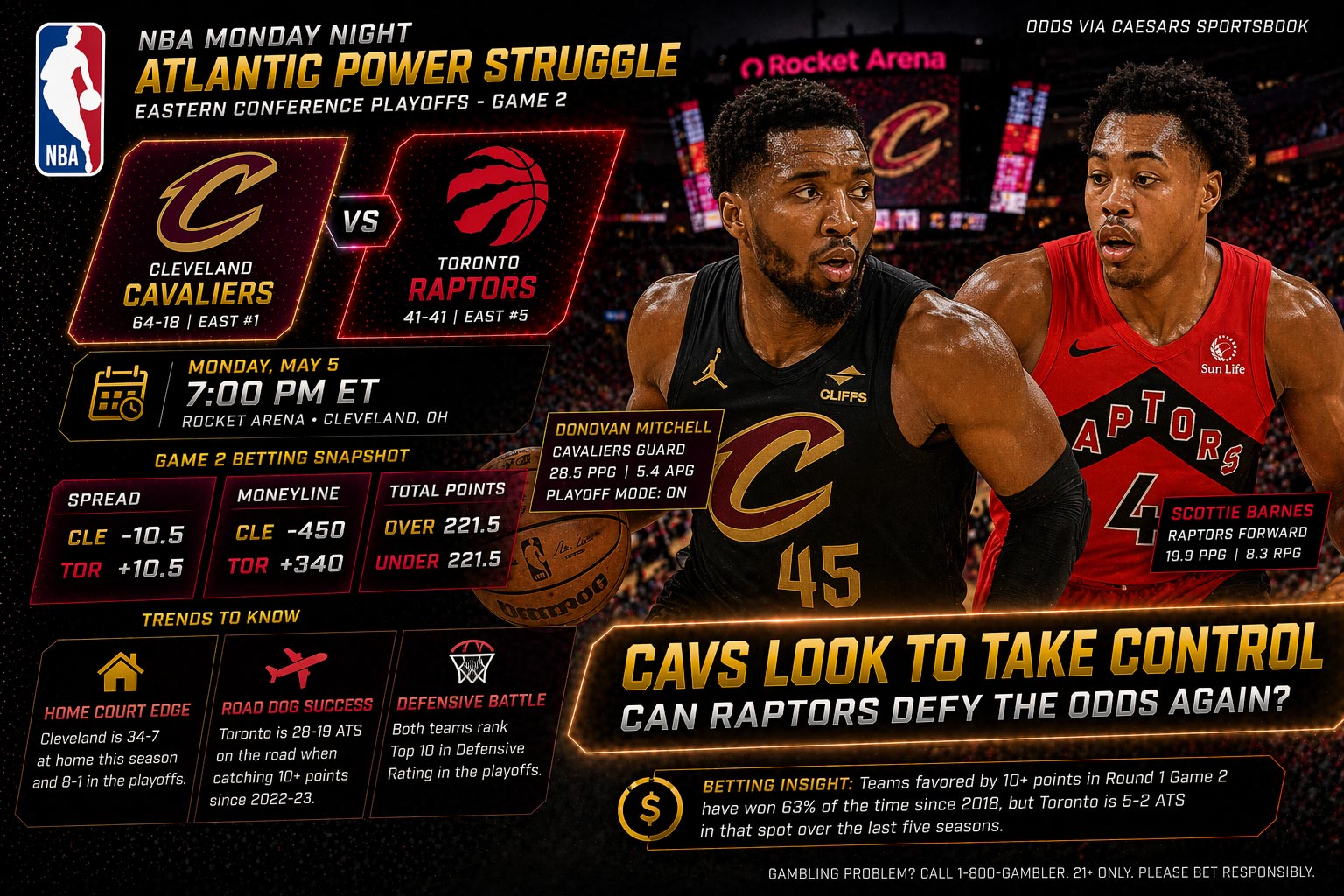
The Cavs-Raptors Game 2 matchup on Monday at 7 PM ET is giving us one of those classic betting scenarios where the surface-level narrative completely contradicts what the sharp money knows. Cleveland’s sitting pretty at home after taking Game 1, and the public’s already writing off Toronto as road kill. But here’s where it gets interesting – the Raptors have this weird historical trend of covering when they’re getting double digits on the road, and oddsmakers are basically daring you to take the bait.
This is exactly the kind of spot where casual bettors get slaughtered. They see a double-digit spread, assume it’s free money on the favorite, and wake up Tuesday morning wondering why their rent money just evaporated. Meanwhile, the guys who actually understand market psychology are quietly hammering the other side while everyone’s busy making LeBron memes (yeah, I know he’s not even in this game anymore, but you get the point).
So let’s break down why this Game 2 spread is basically a masterclass in how oddsmakers exploit cognitive bias. We’re going to talk about why Cleveland’s home-court advantage might be overpriced, why Toronto’s double-digit road record is actually fool’s gold, and where the real edge lives in this matchup.
When the Spread Looks Too Good to Be True
Double-digit spreads in playoff basketball are like that girl at the bar who’s way too interested in you – something’s definitely off. The public sees Cleveland at home, remembers Game 1, and thinks this is a smash spot on the Cavs. But here’s the thing about market efficiency: when something looks obvious to everyone, the line’s already adjusted for that exact sentiment.
Cleveland’s home-court advantage is real, don’t get me wrong. The Rocket Mortgage FieldHouse gets loud, and the Cavs historically perform well there. But oddsmakers aren’t idiots – they’ve already baked that 3-4 point home-court bump into the spread. When you’re laying double digits, you’re not just betting on Cleveland to win; you’re betting on a blowout against a playoff-caliber team that’s desperate to even the series.
The expected value calculation here is brutal. Even if you think Cleveland wins this game 70% of the time, that doesn’t mean they cover a 10+ point spread 70% of the time. You need a wire-to-wire domination, no garbage-time comeback, and probably some foul trouble on Toronto’s end. That’s a lot of dominoes that need to fall perfectly, and each one shaves points off your actual win probability.
Why Toronto’s Double-Digit Record Is Fool’s Gold
Now here comes the trap from the other side – and this is where most "sharp" bettors actually become the fish. Toronto’s historical record as a double-digit road underdog looks sexy on paper, but context is everything. These aren’t randomly distributed games; they’re specific matchups where the Raptors were either completely written off or facing teams looking ahead.
The recency bias here is doing heavy lifting. Bettors remember one or two games where Toronto got disrespected and came out swinging, and suddenly they’re convinced it’s a pattern. But if you actually break down the tape, most of those covers came in regular season spots where motivation was asymmetric – Toronto fighting for playoff positioning while the favorite was coasting.
This is Game 2 of a playoff series. The motivation is completely symmetrical. Cleveland knows they need to go up 2-0 before heading to Toronto, and the Raptors know they’re cooked if they go down 0-2. The historical trends that bettors are leaning on simply don’t apply in this context. You’re basically using regular season data to predict playoff variance, which is like using your high school SAT scores to predict your success in an MBA program – the variables have completely changed.
The Real Edge (And Why I’m Staying Away)
Here’s where the Harvard part of my brain kicks in: the actual edge in this game isn’t on the spread at all. Both sides have compelling narratives, which means the market’s probably pretty efficient. When you’ve got public money on Cleveland and "sharp" money on Toronto, the real winner is the sportsbook collecting juice on both sides.
If I’m forced to find value here, it’s in the total or specific player props where the market’s less efficient. Cleveland’s pace in Game 1 was slower than expected, and if that trend continues, the under might have more value than either side of the spread. But even that requires trusting a one-game sample size, which is sketchy at best.
The smartest play? Probably sitting this one out and waiting for a clearer edge in Game 3 or 4 when we have more playoff data. I know that’s not the sexy answer you wanted, but risk mitigation is knowing when the juice isn’t worth the squeeze. Sometimes the best bet is no bet, and this feels like one of those spots where everyone’s trying to be clever and nobody’s actually finding value.
Look, I get that you probably came here wanting me to tell you which side to hammer. But the truth is, this Game 2 spread is exactly the kind of trap that separates long-term winners from broke degenerates. Cleveland’s home-court advantage is real but overpriced, and Toronto’s double-digit road record is a statistical mirage that doesn’t apply to playoff basketball. When both narratives have holes you can drive a truck through, the market’s probably pretty damn efficient.
If you absolutely need action on this game – and let’s be honest, Monday night NBA playoff basketball is hard to resist – at least be smart about your bet sizing. This isn’t a spot to risk 5% of your bankroll because some Reddit thread convinced you it’s a "lock." Maybe sprinkle a unit on a player prop or live bet it once you see how the first quarter flows.
Final thought: the real winners in spots like this are the guys who can recognize when there’s no edge and have the discipline to pass. But where’s the fun in that, right? Drop a comment and tell me which side you’re riding – I promise I won’t judge (much).
WannaBet.com may receive compensation from the sportsbooks mentioned in this post if you sign up using our links. This doesn’t cost you a dime, but it keeps the lights on. Please bet responsibly. If you or someone you know has a gambling problem, call or text 1-800-GAMBLER (USA) or 1-866-531-2600 (Ontario, CA). 21+ only.
