

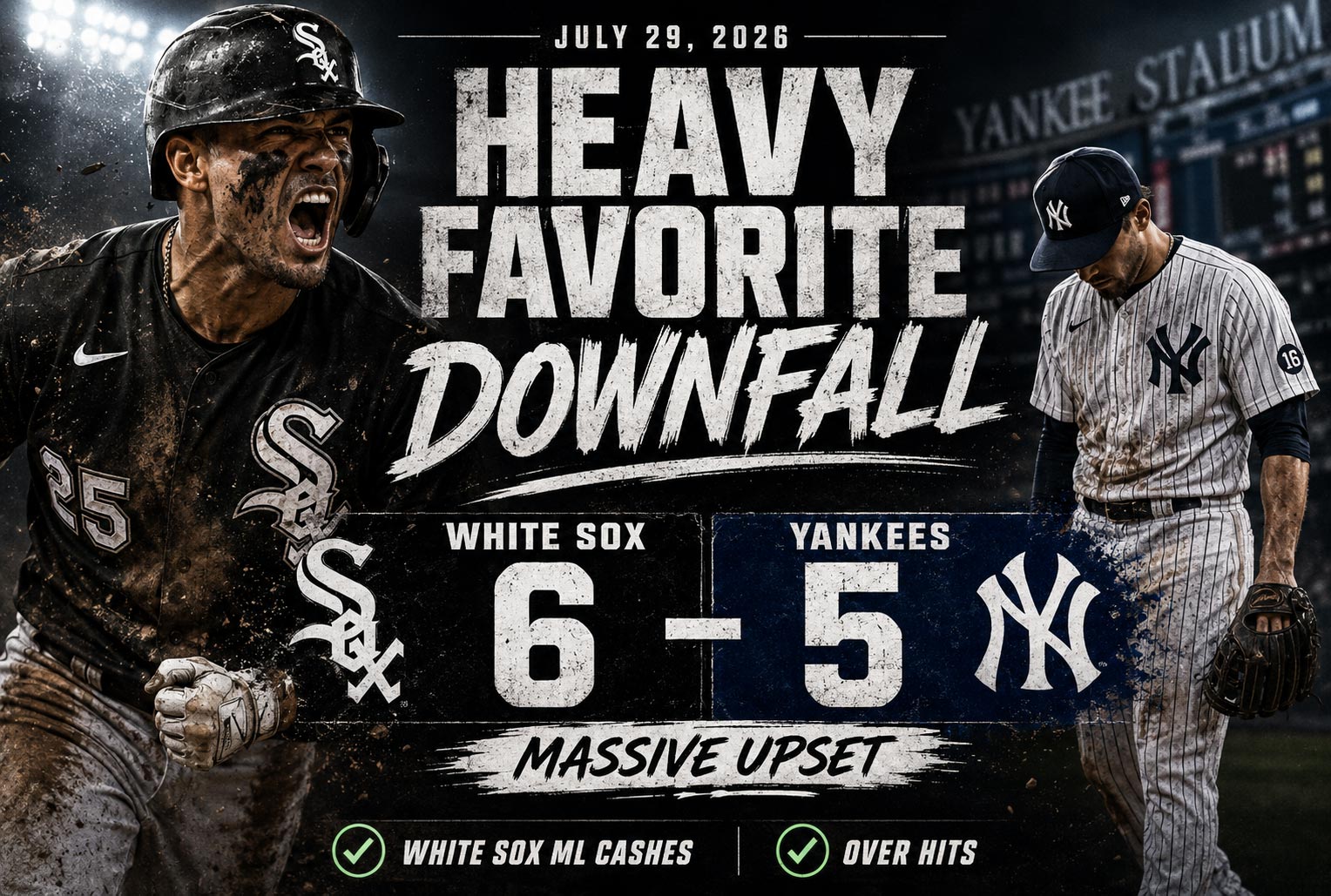
Wednesday night baseball turned into an absolute bloodbath for parlay cards across every major book from DraftKings to FanDuel. The Yankees—sitting at around -280 on most lines—were supposed to be the easiest money you’d make all week against a White Sox team that’s basically auditioning for a 30 for 30 about organizational failure. Instead, Chicago pulled off the 6-5 upset and sent thousands of three-leg parlays straight to the graveyard. If you had New York as your "lock" leg alongside a couple NBA Summer League plays or random tennis picks, congrats—you just learned an expensive lesson about why heavy favorites are the silent bankroll killers in this game.
White Sox Ruin Parlay Cards in Yankee Upset
The setup looked too good to be true because, well, it was. The Yankees rolled into this matchup as one of the chalkiest plays on the entire Wednesday slate, with public betting percentages reportedly north of 75% on both the moneyline and run line. Every casual bettor and their roommate was jamming the Bronx Bombers into parlays as the "safe" anchor leg, treating a -280 favorite like it was a Treasury bond.
The White Sox had other plans, and honestly, good for them. Chicago scratched across 6 runs against a Yankees pitching staff that was supposed to cruise, turning what should’ve been a stress-free sweat into a nail-biter that ended with parlay cards getting torched nationwide. Sharp bettors who grabbed the White Sox at +230 or better were laughing all the way to withdrawal requests, while the rest of us watched our "can’t lose" three-leggers die in real time.
Here’s the thing about these massive upsets: they’re not black swan events—they’re just variance doing variance things. The implied probability on a -280 favorite is roughly 73.7%, which means even "lock" plays fail more than one out of every four times. When you’re stacking three or four of these heavy favorites together in a parlay, you’re compounding that failure risk exponentially, and eventually, the math catches up with you in the cruelest way possible.
Why Heavy Favorites Are Killing Your Bankroll
Heavy chalk plays feel safe because our lizard brains love certainty, but they’re actually EV (expected value) nightmares when you factor in the juice. Laying -280 on the Yankees means you’re risking $280 to win $100, and even if they win 75% of the time (generous estimate), your long-term ROI is barely break-even after accounting for the times they randomly lose to a team with a .280 win percentage. It’s the illusion of security wrapped in terrible risk-reward math.
The parlay trap is even worse because sportsbooks aren’t dumb—they know degenerates love building "safe" parlays around heavy favorites. The correlation between legs matters way less than most bettors think, and the compounding juice on multi-leg parlays creates a house edge that would make a Vegas pit boss blush. You’re essentially paying a premium for the privilege of turning three 70% probability events into one 34% probability payout, and books are more than happy to let you do it.
Market psychology also plays a huge role here: when everyone and their mother is piling onto the same side, you’re getting the worst possible number. By Wednesday afternoon, sharp money had already moved on from the Yankees or was actively fading them, while public squares kept jamming that -280 thinking it was free money. Line movement is information—when a line doesn’t move despite lopsided public action, that’s the market screaming "trap game" in your face.
The bankroll management angle is critical too. If you’re betting $50 to win $18 on a -280 favorite, you need to win roughly 15 times just to recover from one loss. That’s a brutal grind that requires an unsustainably high win rate, and one bad night—like Wednesday’s White Sox upset—can wipe out weeks of slow, painful accumulation. Heavy favorites don’t build bankrolls; they erode them through death by a thousand paper cuts (and the occasional knockout punch).
So what’s the play moving forward? Stop using heavy chalk as parlay anchors and start thinking about risk-adjusted returns. A +130 underdog that wins 42% of the time is mathematically superior to a -280 favorite that wins 75% of the time when you factor in sample size and variance. Look for spots where the public is overreacting to brand names (Yankees, Dodgers, Lakers) and fade them when the number gets bloated beyond reasonable value.
Also, consider live betting as an alternative to pregame parlays—you can often get better numbers on favorites after they fall behind early, or cash out on underdogs when they jump ahead. Wednesday’s White Sox game was a perfect example: if you grabbed Yankees live at plus-money when they were trailing, you at least had a shot at a middle or a more favorable exit point. Pregame parlay bettors were just along for the ride to Loserville, population: everyone who thought the Yankees were a lock.
The Yankees-White Sox upset is your quarterly reminder that heavy favorites are parlay poison and the house always gets its cut eventually. Sure, chalk wins more often than not, but "more often than not" doesn’t mean "always," and in a negative-EV game like parlays, you need to be right way more than the market implies just to break even. Next time you’re tempted to throw a -300 favorite into your three-legger because it "feels safe," remember Wednesday night and all those dead tickets. The smartest play isn’t always the obvious one—sometimes it’s fading the public and taking the team nobody wants to touch. What’s your threshold for laying chalk on favorites? Drop it in the comments, because I’m genuinely curious if anyone out there is still riding with heavy favorites after this bloodbath.
"WannaBet.com may receive compensation from the sportsbooks mentioned in this post if you sign up using our links. This doesn’t cost you a dime, but it keeps the lights on. Please bet responsibly. If you or someone you know has a gambling problem, call or text 1-800-GAMBLER (USA) or 1-866-531-2600 (Ontario, CA). 21+ only."
