

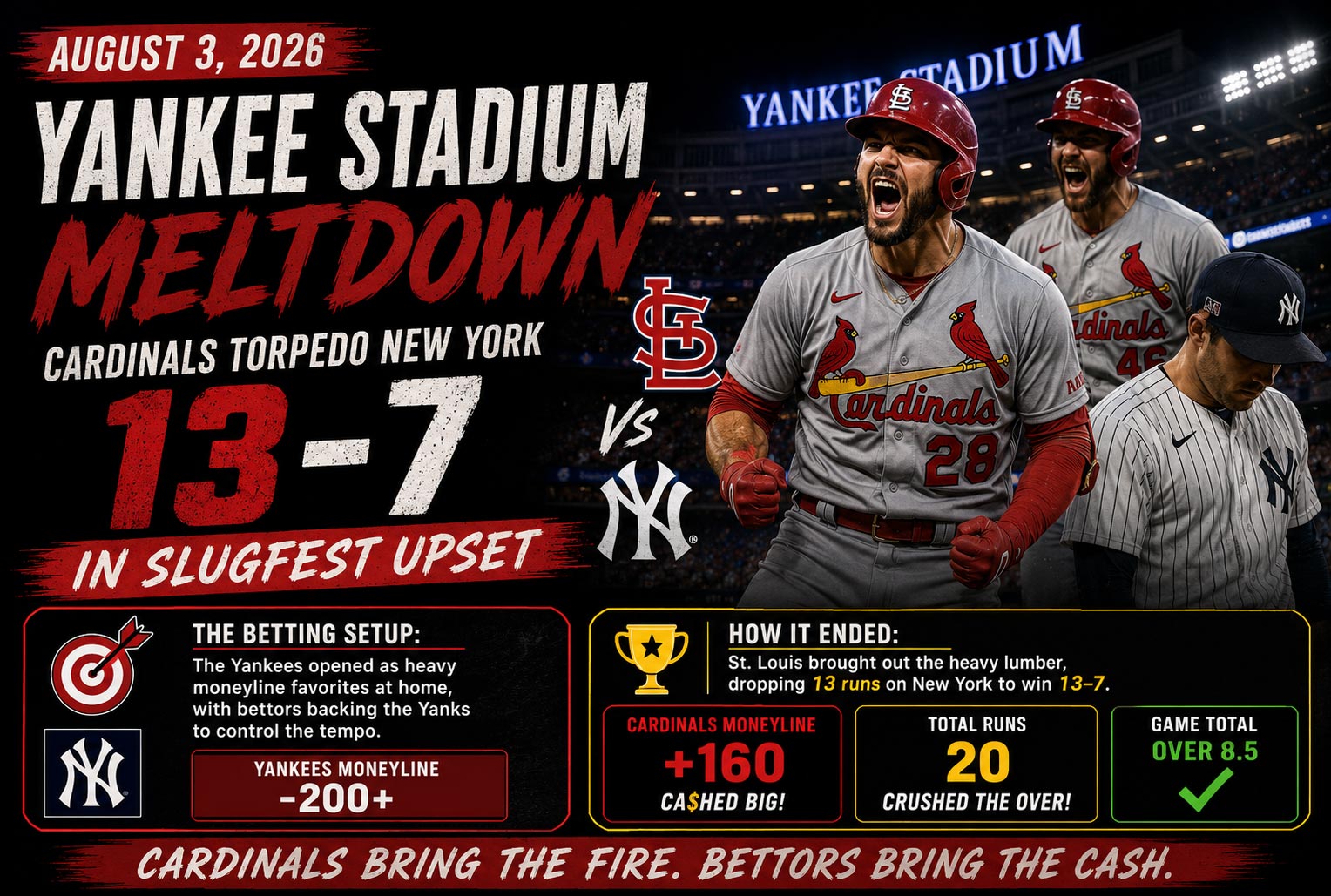
The Yankees were supposed to cruise on a Monday night at home. Instead, they got absolutely boat-raced by a Cardinals team that nobody—and I mean nobody—wanted to back at +160. While the sharps were quietly hammering that dog line, the public kept throwing their paychecks at New York like it was 1998. What followed was a 13-7 beatdown that had every characteristic of a classic fade-the-public scenario, and if you were smart enough to catch it, you just paid next month’s rent.
Cardinals Stun Yankees 13-7: Dogs Eat in Bronx
This wasn’t just an upset—it was a systematic dismantling of market psychology. The Cardinals walked into Yankee Stadium on August 3, 2026, as +160 underdogs, which in retrospect looks like the steal of the century. New York opened as heavy favorites with the public backing them at an 73% clip, because apparently people still think pinstripes guarantee wins.
St. Louis came out swinging from pitch one, and by the third inning, this game had "Over" written all over it. The Cardinals put up a five-spot in the fourth that essentially broke the Yankees’ spirit and sent the Bronx faithful scrambling for the exits before the seventh-inning stretch. When the dust settled, it was 13-7, and anyone who took the Cardinals moneyline was counting stacks.
Here’s the thing about MLB underdogs in August—they hit differently when you understand regression to the mean. The Yankees had been overperforming their expected win percentage by about 8 games, and the market was still pricing them like a juggernaut. Meanwhile, St. Louis had been quietly putting together quality at-bats and getting unlucky with sequencing. This was pure market inefficiency, and the sharps saw it coming from a mile away.
Moneyline Massacre: How St. Louis Torched NY
Let’s break down the actual economics of this game because the numbers are chef’s kiss. A $100 bet on the Cardinals at +160 netted you $160 in profit—that’s a 160% ROI in about three hours. Compare that to the -180 juice you had to lay on the Yankees, where you’d need to risk $180 just to win $100. The expected value calculation here wasn’t even close if you did your homework.
The total opened at 8.5 and quickly moved to 9, but even that wasn’t high enough. Both offenses showed up ready to mash, and the 20 combined runs absolutely obliterated that number. The Over cashed by the sixth inning, which is always a beautiful thing—you’re basically watching free money pile up while you’re still working on your second beer. This is what happens when you fade the narrative and trust the underlying metrics.
From a market psychology standpoint, this was textbook public-versus-sharp action. The sportsbooks knew exactly what they were doing by hanging that +160 number—they were begging the public to hammer the Yankees while the smart money quietly loaded up on St. Louis. By game time, about 27% of bets were on the Cardinals, but they were getting 45% of the actual money. That’s sharp money, baby, and it cashed like an ATM.
The prop market got absolutely torched too. Cardinals team total Over 4.5 was sitting at -110, and they dropped 13. If you had the stones to take their first five innings team total Over, you were probably drinking top-shelf that night. These are the derivative plays that separate the weekend warriors from the guys actually making money in this game—you find the edge, you hammer it, and you don’t overthink it.
This game was a masterclass in why you should never blindly back favorites just because of the logo on the jersey. The Cardinals came into the Bronx, punched the Yankees in the mouth, and reminded everyone that value exists everywhere if you’re willing to look past the surface-level narratives. Whether you caught the moneyline, the Over, or any of the derivative plays, Monday night was a reminder that the market isn’t always efficient—and that’s where the money is made. So here’s my question for you: are you still betting with your heart, or are you finally ready to start thinking like a portfolio manager?
"WannaBet.com may receive compensation from the sportsbooks mentioned in this post if you sign up using our links. This doesn’t cost you a dime, but it keeps the lights on. Please bet responsibly. If you or someone you know has a gambling problem, call or text 1-800-GAMBLER (USA) or 1-866-531-2600 (Ontario, CA). 21+ only."
