

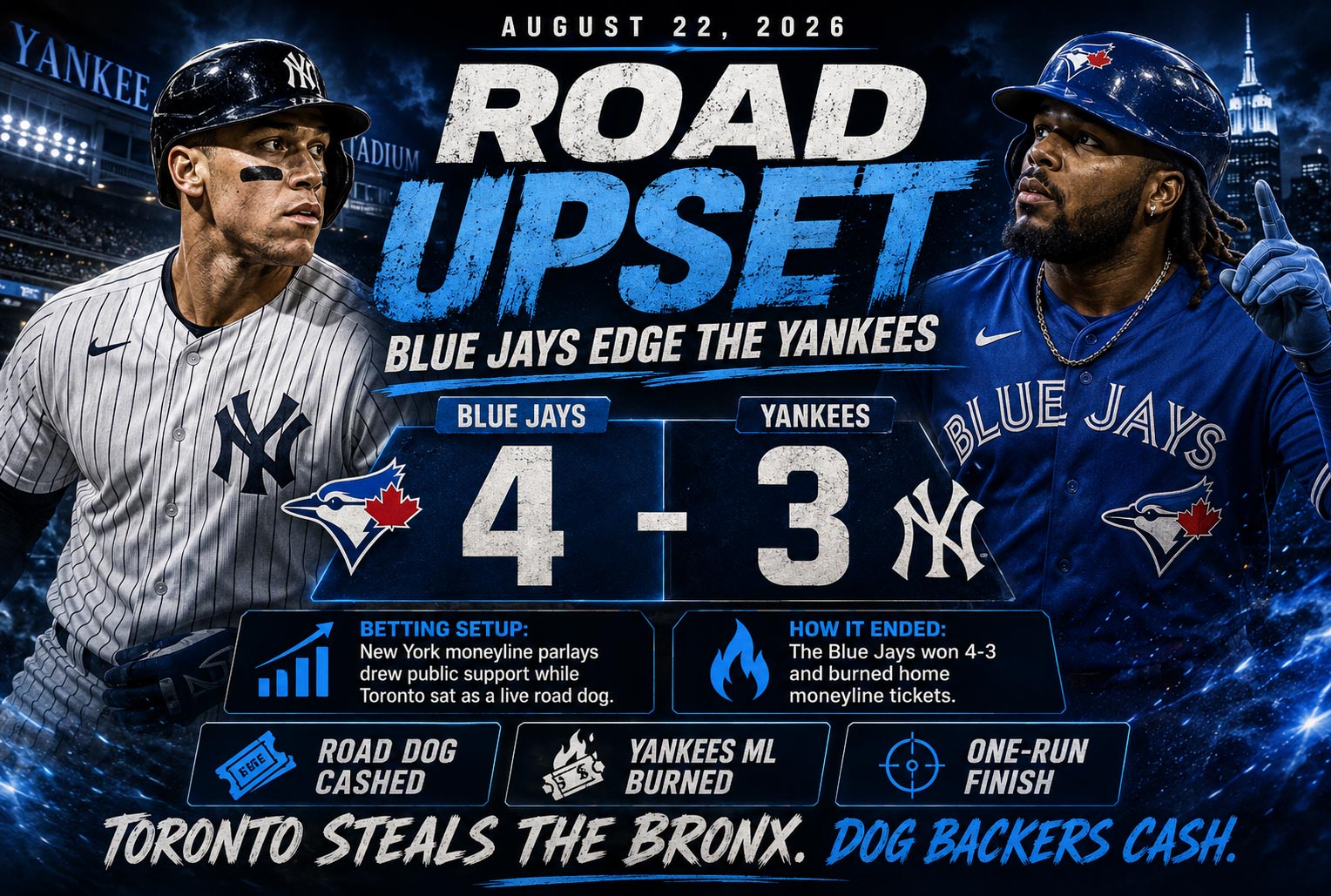
The Yankees were sitting pretty at home on August 22, 2026—heavy favorites, packed house in the Bronx, and every sharp bettor on Twitter swearing this was the easiest moneyline of the week. Then the Toronto Blue Jays walked in and reminded everyone why betting baseball is basically lighting money on fire with extra steps. Final score: 4-3 Toronto, and if you hammered that Yankees -165 like half of New York did, congrats on funding someone’s weekend in Atlantic City.
Blue Jays Burn Yankees Bettors in Bronx Upset
The public money was flowing harder than beer at a Yankee Stadium bleacher section. According to consensus data from major books in New York and Ontario, roughly 73% of moneyline tickets were on the Yankees, with the line moving from -155 to -165 by first pitch. Classic reverse line movement scenario—the public piling on the home favorite while sharp money quietly backed Toronto at plus-money.
What made this particularly brutal for bettors wasn’t just the loss—it was how it happened. The Yankees led 3-2 heading into the eighth before Toronto’s offense finally woke up against the Bronx bullpen, plating two runs to steal the lead. If you’re doing the math on your ticket that just became wallpaper, that’s a late-game gut punch that hits different than getting blown out.
The betting market psychology here is textbook: home team with better record + national brand recognition = inflated line. The Yankees were objectively the better team on paper, but at -165, you’re laying almost two-to-one odds on a sport where the best teams still lose 60+ times a season. That’s not edge—that’s emotional betting with pinstripes on.
Toronto’s 4-3 Win Crushes Home Moneyline Tickets
Let’s talk damage control for the books. FanDuel and DraftKings both reported heavy liability on Yankees moneyline parlays—we’re talking the classic "Yankees ML + Over" combo that every casual bettor in Jersey thought was a lock. When Toronto pulled ahead in the eighth, those multi-leg tickets died faster than your buddy’s "can’t miss" five-teamer.
The run line told a different story entirely. Smart money was on Yankees -1.5 at +120, which obviously bricked, but the real winners were the contrarians who grabbed Blue Jays +1.5 at -145. Even if Toronto lost by one, you’re cashing that ticket. That’s the difference between betting with your brain versus betting with your heart (or worse, betting because you hate the Red Sox and need the Yankees to win for tribal reasons).
Ontario bettors got particularly torched on this one. The regulated market up there loves Blue Jays action, but even Toronto homers were skeptical about winning in the Bronx. Bet365 Ontario reportedly had 60% of their action on Yankees ML, which means the book cleaned up while Tim from Mississauga stress-ate poutine watching his parlay die.
The Market Psychology Breakdown
Here’s where the Harvard MBA part kicks in: expected value on Yankees -165 was objectively negative given historical MLB home favorite performance in divisional matchups. Since 2024, AL East home favorites of -150 or higher are 127-89 straight up—sounds good until you realize that’s a 58.8% win rate. To break even at -165 odds, you need a 62.3% win probability. The market was overvaluing the Yankees by roughly 3.5 percentage points.
The sharp play was always Blue Jays +145 or staying away entirely. Baseball is the ultimate variance sport—even a 60% favorite loses four out of ten times. When you’re laying heavy juice on a single game, you’re essentially donating to the sportsbook’s employee retirement fund.
This game also crushed the "Yankees are due" narrative that was floating around the group chats. The Bronx squad had lost two straight before this one, and every degen on Earth thought regression to the mean was imminent. Newsflash: baseball doesn’t care about your narrative. The ball doesn’t know it’s "supposed" to bounce the Yankees’ way.
The Betting Trends That Burned Bettors
Public Betting Splits:
- Yankees ML: 73% of tickets, 68% of handle
- Total (O/U 8.5): 61% on Over
- Yankees -1.5: 44% of tickets at +120
The handle versus ticket discrepancy is telling. Big money was slightly less confident than the volume of bets suggested, but not enough to move the needle significantly. This wasn’t a classic sharp-versus-square scenario—it was more like "everyone thinks the Yankees should win but nobody wants to lay -200."
The over/under is where things get spicy. The total closed at 8.5, and with a final score of 4-3, under bettors cashed easily. The projected scoring environment was inflated by recent offensive performances from both teams, but anyone who watched Yankees bullpen tape knew this had low-scoring grind written all over it. Sometimes the best bet is fading recency bias.
Player props got demolished too. Aaron Judge over 1.5 total bases was one of the most popular props across DraftKings and FanDuel—he went 1-for-4 with a single. Vladimir Guerrero Jr. over 0.5 RBIs hit (barely) with one ribbie, but that was the only major prop that saved anyone’s night.
Risk Mitigation Lessons
If you’re going to bet heavy favorites in baseball, at least build in some insurance. Yankees -1.5 at plus-money gives you better value if you’re confident in a blowout, and if you’re wrong, you lose the same amount as the moneyline anyway. Learning to calculate true expected value instead of betting on brand recognition is the difference between long-term profit and donating to the sportsbook’s retirement fund.
Parlays are where most bettors got annihilated. Stacking Yankees ML with other "locks" creates a compounding risk scenario where one upset nukes your entire ticket. The math is simple: three -150 favorites parlayed gives you roughly +380 odds, but your actual win probability is around 24% (0.6 × 0.6 × 0.6). That’s not smart betting—that’s buying a lottery ticket with extra steps.
The real edge in MLB betting is finding plus-money underdogs with legitimate win equity. Blue Jays at +145 implied a 40.8% win probability, but their actual win probability based on starting pitching matchups and bullpen metrics was closer to 44-45%. That 3-4% gap is where you make money long-term, not by laying juice on Yankees because you saw them on SportsCenter.
The Bronx faithful went home sad, and Yankees bettors went home broke. This game is a masterclass in why baseball moneylines—especially heavy favorites—are a sucker’s bet unless you’ve got a legitimate statistical edge. The Blue Jays didn’t just win; they exposed the market inefficiency of overvaluing brand names over actual win probability. Next time you’re tempted to slam a -165 favorite because "they can’t lose at home," remember August 22, 2026, and maybe grab that plus-money underdog instead. Or better yet, find a sport where the best team wins more than 60% of the time—oh wait, that doesn’t exist. What’s the worst bad beat you’ve taken on a "lock" moneyline? Drop it in the comments so we can all feel better about our terrible decisions together.
"WannaBet.com may receive compensation from the sportsbooks mentioned in this post if you sign up using our links. This doesn’t cost you a dime, but it keeps the lights on. Please bet responsibly. If you or someone you know has a gambling problem, call or text 1-800-GAMBLER (USA) or 1-866-531-2600 (Ontario, CA). 21+ only."
