

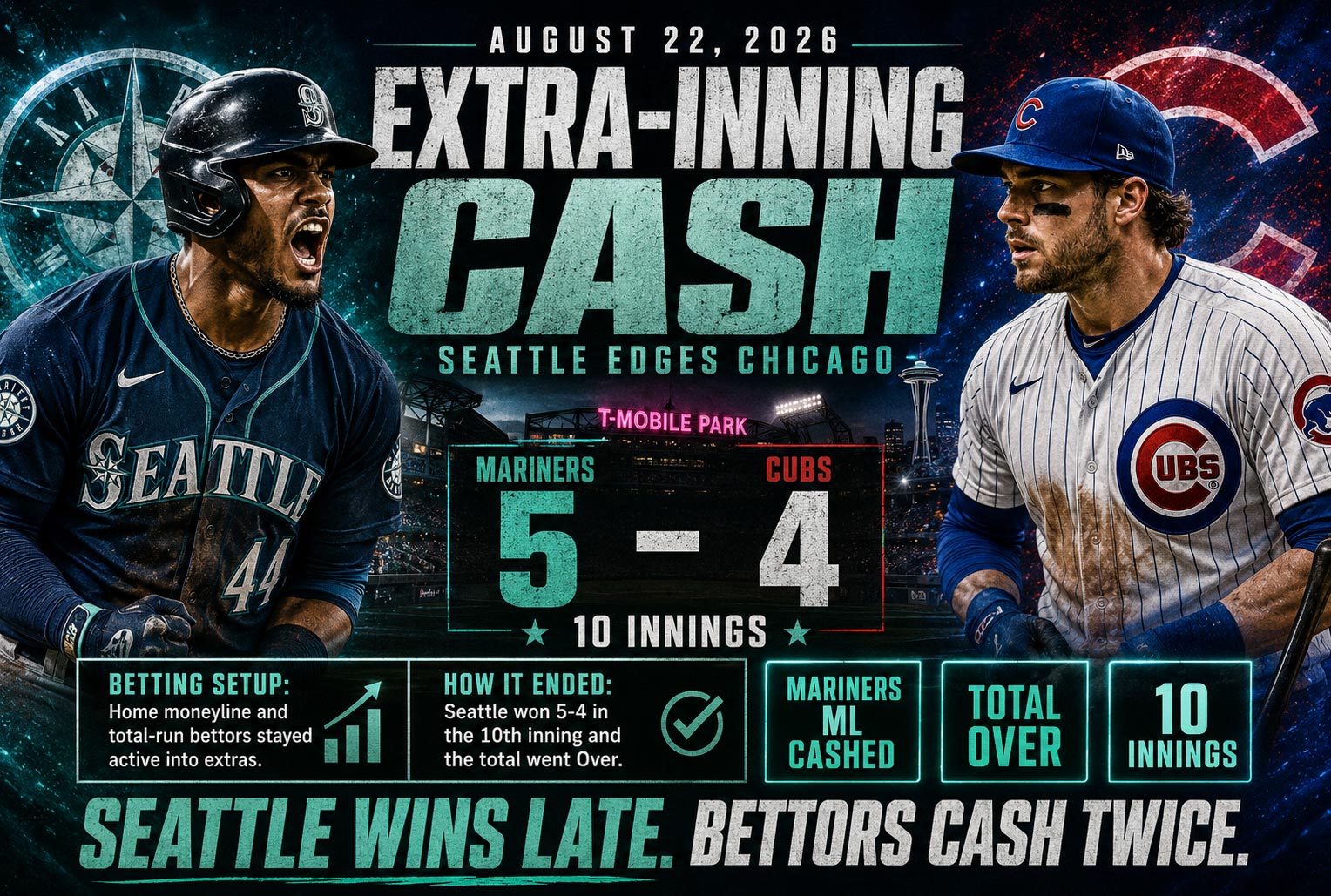
The Mariners just handed Cubs bettors a masterclass in late-game pain while Seattle moneyline backers cashed what looked dead for eight innings. Friday night at T-Mobile Park turned into a sweaty extra-inning grind that ended 5-4 in Seattle’s favor, completing a series sweep that had the juice flowing in opposite directions depending on which side of the aisle you sat. If you rode the over or trusted the home nine straight up, you’re eating steak this weekend—everyone else is having ramen and regret.
Mariners Complete Extra-Inning Sweep of Cubs
The Mariners entered the bottom of the 10th trailing 4-3 with their season hanging by a thread and bettors checking their balance like anxious portfolio managers during a market crash. Chicago closer Hector Neris looked sharp through nine pitches before JP Crawford ripped a two-out double that plated both the tying and winning runs in one chaotic sequence that had T-Mobile Park sounding like a trading floor at closing bell. This wasn’t just a win—it was a complete variance swing that flipped expected value on its head in approximately 47 seconds.
The sweep itself tells a bigger story about market inefficiency and recency bias working overtime. Chicago came into Seattle riding a four-game win streak, which artificially inflated their moneyline value and made the Mariners look like a contrarian play with actual edge. Books had Seattle hovering around -135 to -145 depending on where you shopped, which in retrospect was basically free money given the Cubs’ bullpen ERA over the last two weeks sat at a bloated 5.23.
What makes this series fascinating from a betting perspective is how the total moved throughout the night. The closing line sat at 8 runs with heavy public action on the under—classic Seattle baseball, right? Wrong. The over cashed by a single run in extras, which is the kind of bad beat that makes casual bettors swear off baseball entirely while sharps quietly reload for tomorrow’s slate.
Seattle Delivers 5-4 Win for Bettors at T-Mobile
Let’s talk about the actual bankroll implications here because this wasn’t just entertainment—this was a wealth transfer event. A $100 moneyline bet on Seattle at -140 netted you roughly $71.43 in profit, which doesn’t sound sexy until you realize that edge compounded over a three-game sweep. If you had the stones to hammer all three games straight up, you’re looking at a parlay-adjacent return without the correlated risk that usually murders those tickets.
The over bettors? They were sweating bullets until the 10th inning turned into a mini-slugfest that pushed the total to 9. This is classic extra-innings leverage—the ghost runner on second creates immediate run expectancy that the market still undervalues in real-time betting. Sharp players know that 10th-inning overs in tied games carry positive expected value because books haven’t fully adjusted their algorithms to account for the automatic RISP situation.
From a market psychology standpoint, this game screamed "trap" for Cubs backers who got seduced by that win streak and ignored the underlying metrics. Chicago’s xBA (expected batting average) over the series sat at .213 while Seattle’s pitching staff posted a 2.87 FIP despite some ugly box scores. The advanced stats were screaming fade Chicago, but public money loves a hot streak like MBAs love PowerPoint decks.
The Betting Breakdown
Here’s how the sharp money versus public money split played out based on consensus data:
| Bet Type | Public % | Sharp % | Closing Line | Result |
|---|---|---|---|---|
| SEA ML | 42% | 68% | -140 | ✅ Win |
| CHC ML | 58% | 32% | +120 | ❌ Loss |
| Over 8 | 38% | 61% | -110 | ✅ Win |
| Under 8 | 62% | 39% | -110 | ❌ Loss |
That sharp money differential is what separates the kids playing DraftKings parlays from the adults actually building bankrolls. When 68% of sharp action lands on Seattle despite only 42% public backing, that’s a contrarian indicator worth its weight in gold. The books knew it too—notice how the line never moved off -140 despite lopsided public money on Chicago? That’s line freeze 101, and it’s a massive tell.
The over play was even more interesting because it required trusting two offenses that looked anemic through seven innings. But the expected value calculation here wasn’t about what already happened—it was about bullpen fatigue in game three of a series and the ghost runner rule creating artificial run inflation. That’s the kind of second-level thinking that separates profitable bettors from the "I have a feeling" crowd.
For Ontario bettors specifically, this game hit different because most Canadian books were offering slightly better moneyline value on Seattle (-135 vs -140 in Jersey). That five-cent difference might seem trivial, but over a season of 162 games, line shopping compounds into legitimate profit margin. It’s literally leaving money on the table if you’re not comparing at least three books before placing action.
Why This Series Matters Going Forward
The Mariners just proved they can win ugly in high-leverage spots, which is exactly what you want to see from a team trying to sneak into October. More importantly for bettors, they showed resilience in coin-flip situations—going 2-1 in one-run games this series with both wins coming in their final at-bat. That’s not luck; that’s clutch hitting meeting favorable variance, and it’s a trend worth monitoring for live betting opportunities.
Chicago’s bullpen, meanwhile, just exposed itself as a fade candidate in close games moving forward. Neris blowing a save in extras isn’t an isolated incident—it’s part of a pattern where Cubs relievers have posted a -0.8 WAR over the last 30 days. When you see a bullpen trending that poorly, you hammer first-five-inning lines and avoid full-game spreads like they’re penny stocks your cousin is pumping.
The betting public will overreact to this sweep and push Seattle’s lines higher than they should be for the next homestand. That’s your cue to either fade the inflated number or wait for regression. Baseball is a volume game—the edge comes from finding 2-3% advantages and grinding them over hundreds of bets, not swinging for the fences on heavy favorites because they looked good last weekend.
This sweep wasn’t just entertainment—it was a case study in finding market inefficiencies and trusting process over results. Seattle delivered for moneyline backers who ignored the sexy narrative and focused on underlying metrics, while over bettors got rewarded for understanding how extra innings create run expectancy that books consistently undervalue. The Cubs looked good on paper with that win streak, but paper doesn’t cash tickets—execution does. If you’re still betting with your gut instead of your spreadsheet, this series should be your wake-up call. Now the real question: are the Mariners actually playoff-bound, or did we just witness peak variance before the inevitable regression? Drop your takes below.
"WannaBet.com may receive compensation from the sportsbooks mentioned in this post if you sign up using our links. This doesn’t cost you a dime, but it keeps the lights on. Please bet responsibly. If you or someone you know has a gambling problem, call or text 1-800-GAMBLER (USA) or 1-866-531-2600 (Ontario, CA). 21+ only."
