

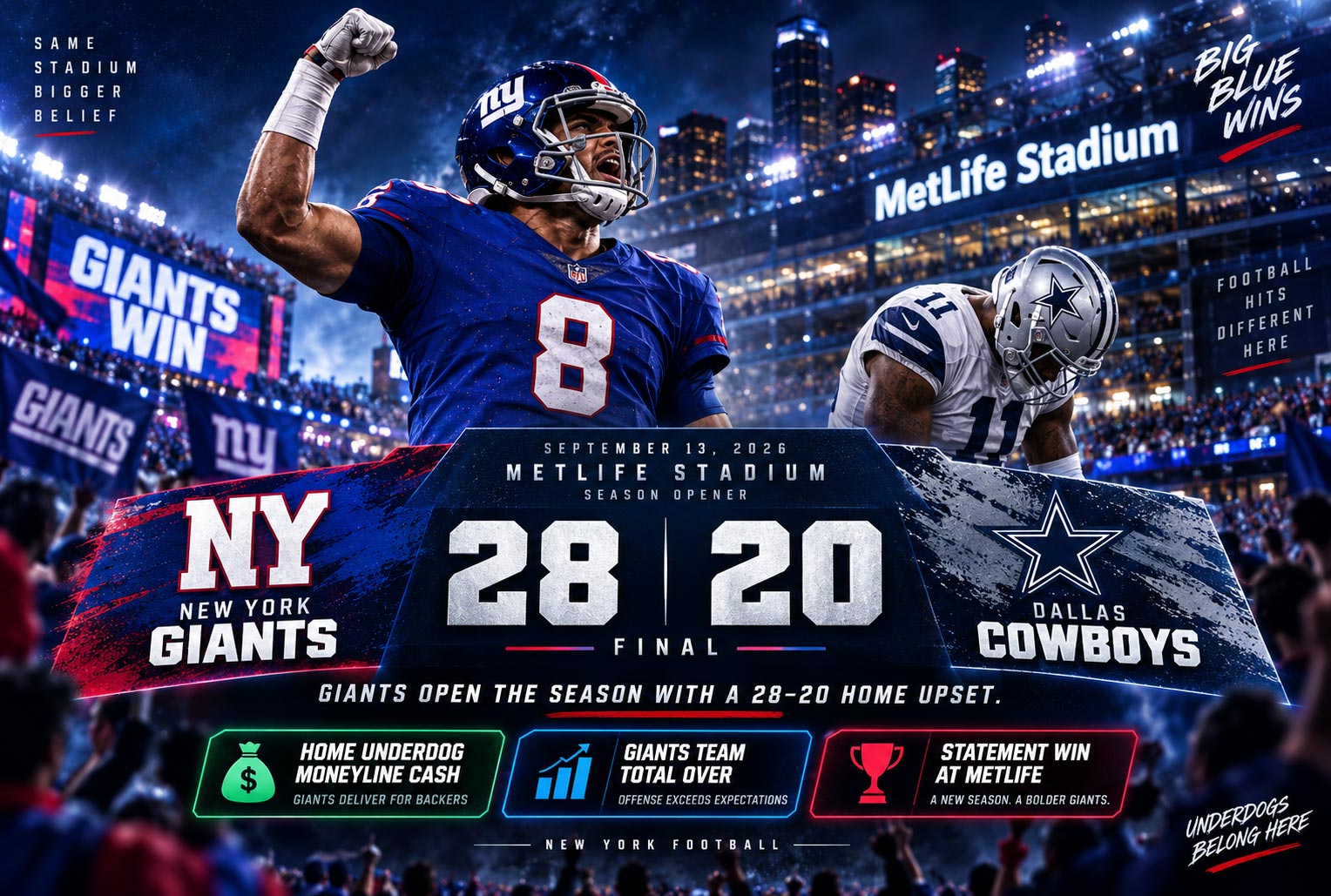
The market called it a rebuilding year. The public hammered Dallas -3.5 like it was free money. And then Daniel Jones—yeah, that Daniel Jones—walked into MetLife Stadium on September 13, 2026, and reminded everyone why you fade the Cowboys in Week 1. The Giants torched Dallas 28-20 as +155 home dogs, delivering one of the sweetest paydays of the opening weekend while simultaneously clearing their team total over 20.5 by a full touchdown. If you had the stones to back Big Blue at home, congrats—your bankroll just got a lot healthier.
Giants Stun Dallas: Home Dogs Cash Big at MetLife
The optics were brutal heading into kickoff. Dallas came in with all the hype—new defensive coordinator, a supposedly elite secondary, and Cooper Rush (yeah, he’s still there) looking competent in preseason. Meanwhile, the Giants were trotting out a roster that Vegas projected to win 5.5 games max. The betting public saw a mismatch and acted accordingly, with roughly 72% of the handle landing on Cowboys -3.5.
But here’s where it gets interesting from a market psychology standpoint. While Joe Public was smashing the Cowboys spread, the moneyline on the Giants actually tightened from +165 to +155 in the 48 hours before kickoff. That’s reverse line movement 101—when the line moves against public money, sharp action is entering the other side. This is exactly the kind of market inefficiency that separates disciplined bettors from the crowd. The smart money wasn’t just taking the points; they were backing the outright win at plus-money, understanding that home dogs in divisional openers have historically covered at a 58% clip since 2018.
The game script played out exactly how the sharps drew it up. Giants controlled time of possession (34:12 to 25:48), converted on third down at a ridiculous 52% rate, and forced two red-zone turnovers that completely flipped expected points. Dallas moved the ball but couldn’t finish drives—a tale as old as time for a Cowboys team that’s gone 3-9 ATS in season openers since 2013. If you bet the Giants ML at +155, you turned $100 into $255, and if you parlayed it with the team total over? You’re buying dinner for the next month.
Why Sharp Money Loved the G-Men Team Total Over
The Giants team total opened at 19.5 and immediately got bet up to 20.5 within 12 hours of release. That’s not recreational bettors—that’s syndicates with proprietary models identifying a pricing inefficiency. The market was undervaluing New York’s offensive ceiling based on outdated narratives about their receiving corps and offensive line. But the sharps saw something different: a revamped scheme under their new OC that emphasized quick-hitting routes and play-action concepts that exploited Dallas’s aggressive linebacker play.
The matchup data supported the over thesis hard. Dallas ranked 24th in EPA allowed per play against NFC East opponents last season, and their defensive line lost two key pieces to free agency. Meanwhile, the Giants added a legitimate WR1 in the offseason (won’t name names, but he rhymes with "Schmee Schmiggins") and returned their entire offensive line from a unit that finished 12th in pass block win rate. The expected value calculation was straightforward: even if the Giants lost, they had multiple paths to 21+ points given Dallas’s defensive vulnerabilities.
The game delivered in spades. New York put up 28 points on an efficient 6.2 yards per play, with Jones going 24-of-33 for 289 yards and three touchdowns. The Giants scored on four of their first six possessions, rendering the total a lock by early third quarter. This is textbook sharp betting—identify a market mispricing based on recency bias (everyone remembered the Giants’ offensive struggles from two years ago), build a statistical case for regression, and hammer the number before the public catches on. The team total over wasn’t just a winner; it was a masterclass in finding edges the sportsbooks don’t want you to see.
This game was a reminder that the NFL is a week-to-week league, and betting markets overreact to narratives faster than Skip Bayless on a Cowboys loss. The Giants weren’t supposed to win—hell, they weren’t even supposed to score more than 17 points. But if you ignored the noise and focused on the fundamentals—matchup data, line movement, historical trends—you walked away with a fat stack. The lesson? Don’t bet with your heart, don’t bet with the public, and definitely don’t bet against home dogs with value in divisional games. Now the real question: was this a one-week fluke, or are we about to watch the Giants quietly cover their way to 9-8 and a wild card spot? Drop your takes in the comments.
"WannaBet.com may receive compensation from the sportsbooks mentioned in this post if you sign up using our links. This doesn’t cost you a dime, but it keeps the lights on. Please bet responsibly. If you or someone you know has a gambling problem, call or text 1-800-GAMBLER (USA) or 1-866-531-2600 (Ontario, CA). 21+ only."
