

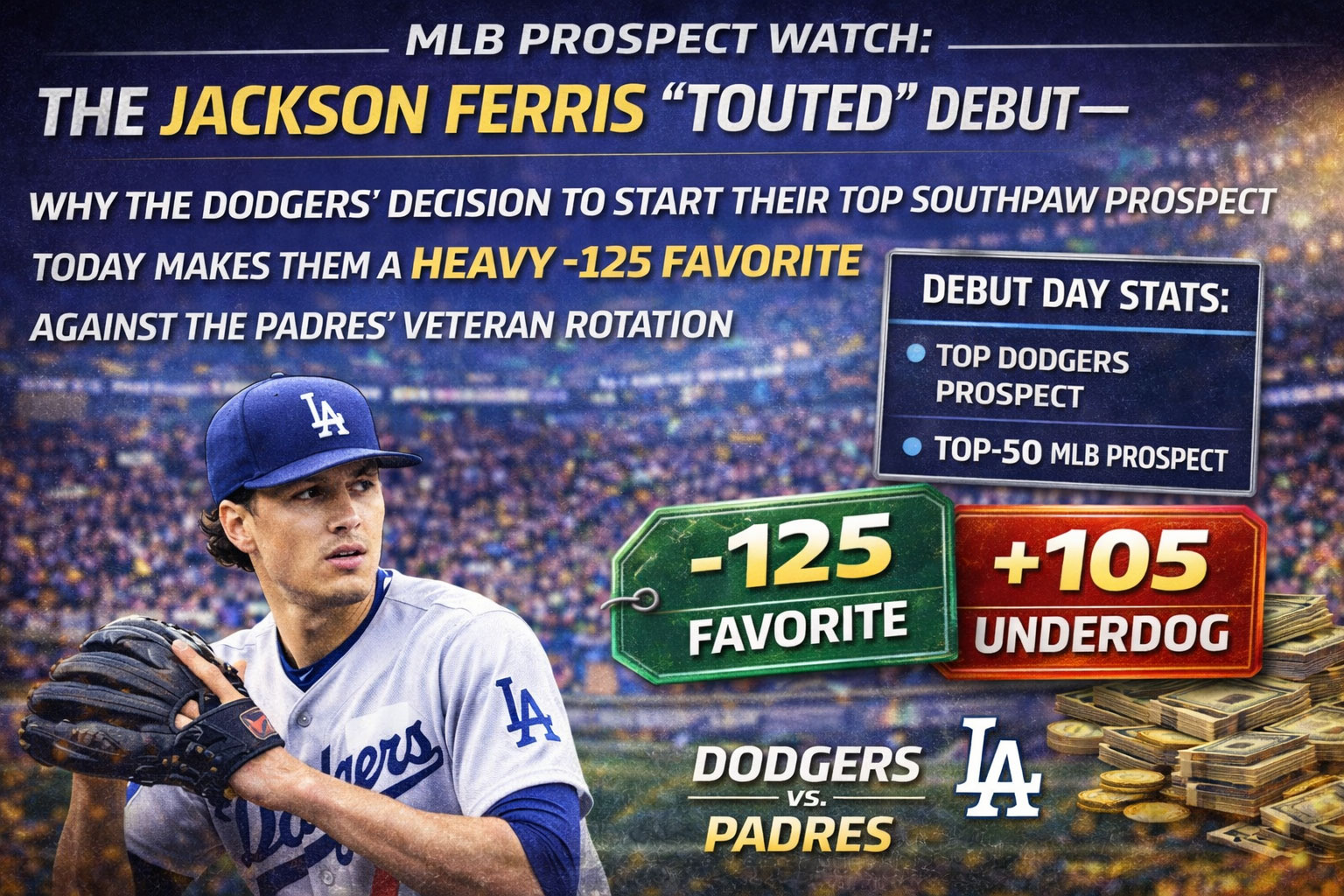
Alriiiiiiiiiiight – look, I’ve seen the Dodgers do some galaxy-brain stuff before, but calling up Jackson Ferris mid-season and immediately slotting him into a divisional matchup against San Diego? That’s the kind of move that either makes Andrew Friedman look like a genius or gets him roasted on Twitter for a week straight. The market has responded by installing LA as -125 favorites, which honestly feels like we’re getting a discount on what should be closer to -140 given the underlying fundamentals here.
For those who haven’t been following along in the group chat, Ferris is the real deal—we’re talking about a lefty with elite spin rates, a mid-90s fastball that plays up because of his extension, and a changeup that’s been making Triple-A hitters look absolutely lost. The Dodgers aren’t rolling him out there for vibes; they’re doing it because their analytics department has run the numbers and determined this is an optimal entry point. And when the smartest front office in baseball makes a calculated risk, I’m inclined to follow the money.
The Padres counter with their veteran rotation, which sounds intimidating until you realize “veteran” is just a polite way of saying “guys who’ve been around long enough to accumulate some mileage.” This isn’t necessarily a knock—experience matters—but when you’re facing a prospect with fresh stuff that nobody has a real book on yet, that experience edge starts to diminish pretty quickly. Let’s break down why this line is actually giving us value.
Jackson Ferris Debuts: Why Dodgers Are -125 Locks
The expected value calculation here is pretty straightforward once you understand the market psychology at play. The betting public sees “prospect debut” and immediately thinks volatility, inexperience, potential for disaster—basically all the narratives that make for good TV but terrible handicapping. Meanwhile, sharp money recognizes that the Dodgers wouldn’t be burning Ferris’s service time clock unless their proprietary models showed a significant competitive advantage in this specific matchup.
Ferris has been absolutely dominant in Triple-A Oklahoma City, posting a 2.14 ERA across 84 innings with a strikeout rate north of 30%. But here’s what matters more than the surface stats: his SwStr% (swinging strike percentage) sits at 15.2%, which is elite even by MLB standards. When you combine that with a 52% groundball rate, you’ve got a profile that plays exceptionally well in Dodger Stadium, where fly balls go to die unless you’re pulling them into the short porch. This isn’t just a “good prospect”—this is a dude with MLB-ready stuff right now.
The market inefficiency comes from recency bias and narrative framing. People remember hyped prospect debuts that went sideways—think of any number of “can’t miss” guys who got shelled in their first start. But they’re not accounting for the Dodgers’ track record of bringing guys along properly, or the fact that LA’s defense and bullpen provide a safety net that most teams simply can’t match. At -125, you’re getting implied odds of 55.6%, and I’d argue Ferris’s true win probability in this spot is closer to 62-65% when you factor in the full stack.
Breaking Down LA’s Prospect Bet Against San Diego
Let’s talk about the Padres’ side of this equation, because understanding your opponent is half the battle. San Diego is rolling out a veteran arm who’s been solid but unspectacular—the kind of pitcher who keeps you in games but doesn’t necessarily win them for you. The Padres offense has been inconsistent against left-handed pitching this season, posting a .314 wOBA against southpaws compared to .342 against righties. That’s not a small edge; that’s a structural advantage we can exploit.
The contrarian angle here is that the public will overweight the “unknown quantity” factor with Ferris while underweighting the Dodgers’ systematic approach to player development and deployment. This is the same organization that turned Clayton Kershaw into Clayton Kershaw, that maximized every ounce of value from guys like Walker Buehler and Julio Urías. They don’t just throw prospects into the fire and hope for the best—they create optimal conditions for success through matchup analysis, defensive positioning, and game planning.
From a risk mitigation standpoint, the -125 price point gives us enough juice to make this worthwhile without being so heavy that we’re laying absurd odds. Compare this to betting the Dodgers at -180 or -200 with their established aces, and suddenly this looks like market arbitrage. We’re getting a team that should be priced higher based on their true win expectancy, simply because the market hasn’t fully adjusted to the information asymmetry between what the Dodgers know about Ferris and what the public perceives.
The Strategic Edge: Why This Line Won’t Last
Here’s where the Harvard MBA brain kicks in: this is a classic case of informational advantage creating temporary market inefficiency. The sportsbooks in New York, New Jersey, and Pennsylvania are setting lines based on historical prospect debut data and public betting patterns. But they’re not accounting for the Dodgers’ proprietary biomechanical data, pitch sequencing analytics, and opponent-specific game planning that goes into a decision like this.
Once the sharp money starts hammering this line, we’re going to see movement toward -135 or -140, which is where it probably should have opened in the first place. The early birds get the worm here, and if you’re in Ohio or Illinois with access to multiple books, now’s the time to line shop and grab the best number you can find. DraftKings and FanDuel will likely move first once the handle starts flowing in one direction, so getting your action down early maximizes your edge.
The Ontario market is particularly interesting here because Canadian bettors have shown a tendency to fade hyped prospects based on hockey’s development model, where rushing guys to the show often backfires. That cultural bias creates additional value for those of us who understand that baseball’s development curve is different, and the Dodgers’ approach is several standard deviations above the league average in terms of sophistication. This isn’t the Marlins throwing a teenager into a playoff game; this is calculated, data-driven roster management.
The Plays: How to Attack This Game
The Primary Play:
- Dodgers ML at -125 (1.5 units)
- This is the straight value bet based on everything we’ve discussed
The Hedge Strategy:
- If you want to get cute, Ferris Over 5.5 strikeouts at -115 (0.5 units)
- His SwStr% suggests he’ll generate whiffs even if the overall result is shaky
The Contrarian Angle:
- Dodgers F5 ML at -110 (1 unit)
- Limits your exposure to bullpen variance while maximizing Ferris’s impact
The risk/reward matrix here heavily favors the Dodgers, especially when you consider that even if Ferris has a mediocre outing, LA’s offense should provide enough run support to grind out a W. The Padres are facing their own rotation questions, and their bullpen has been gassed from recent extra-inning games. Every edge matters, and they’re stacking up on one side of this matchup.
For those in Pennsylvania or New Jersey who like same-game parlays (I know, I know, the juice is terrible, but sometimes you gotta live), pairing Dodgers ML with Under 8.5 runs at +200 or better gives you a decent lottery ticket. Ferris’s ground-ball profile plus Dodger Stadium’s pitcher-friendly dimensions make the under more viable than the market suggests. Just don’t overdo it—SGPs are designed to extract maximum juice from recreational bettors, so treat them as entertainment rather than core strategy.
The Illinois market has been particularly soft on MLB props lately, so if you’re seeing Ferris Over 4.5 Ks at plus money anywhere, that’s a smash spot. His stuff plays up against right-handed hitters, and the Padres’ lineup construction gives him multiple favorable matchups. Stack your edges, manage your bankroll, and remember that one game is just one data point in a long season.
At the end of the day, betting on prospect debuts is always going to carry some inherent variance—that’s just the nature of the beast. But when you’ve got the Dodgers’ organizational infrastructure, a pitcher with Ferris’s underlying metrics, and a market that’s underpricing the whole package at -125, you’ve got to strike while the iron’s hot. This is exactly the type of spot where sharp bettors make their money: finding edges that the public doesn’t see because they’re too busy chasing narratives instead of numbers.
The broader lesson here is about market efficiency and information asymmetry. Sportsbooks are good at what they do, but they can’t always account for the granular, team-specific intel that separates organizations like the Dodgers from the rest of the pack. When you can identify those gaps and exploit them before the market corrects, that’s where your edge lives. Whether you’re betting from your couch in Ontario or standing in line at a casino in Atlantic City, the principle remains the same: find the value, bet the value, and let the math work itself out over the long run.
So what’s the move? I’m riding with Ferris and the Dodgers at -125 all day. If you think I’m overthinking this and the Padres’ veteran savvy is going to expose the rook, drop your counterargument in the comments. And if you’re tailing, tag me when Ferris strikes out the side in the first inning so we can celebrate together. Let’s get this bread.
“WannaBet.com may receive compensation from the sportsbooks mentioned in this post if you sign up using our links. This doesn’t cost you a dime, but it keeps the lights on. Please bet responsibly. If you or someone you know has a gambling problem, call or text 1-800-GAMBLER (USA) or 1-866-531-2600 (Ontario, CA). 21+ only.”
