

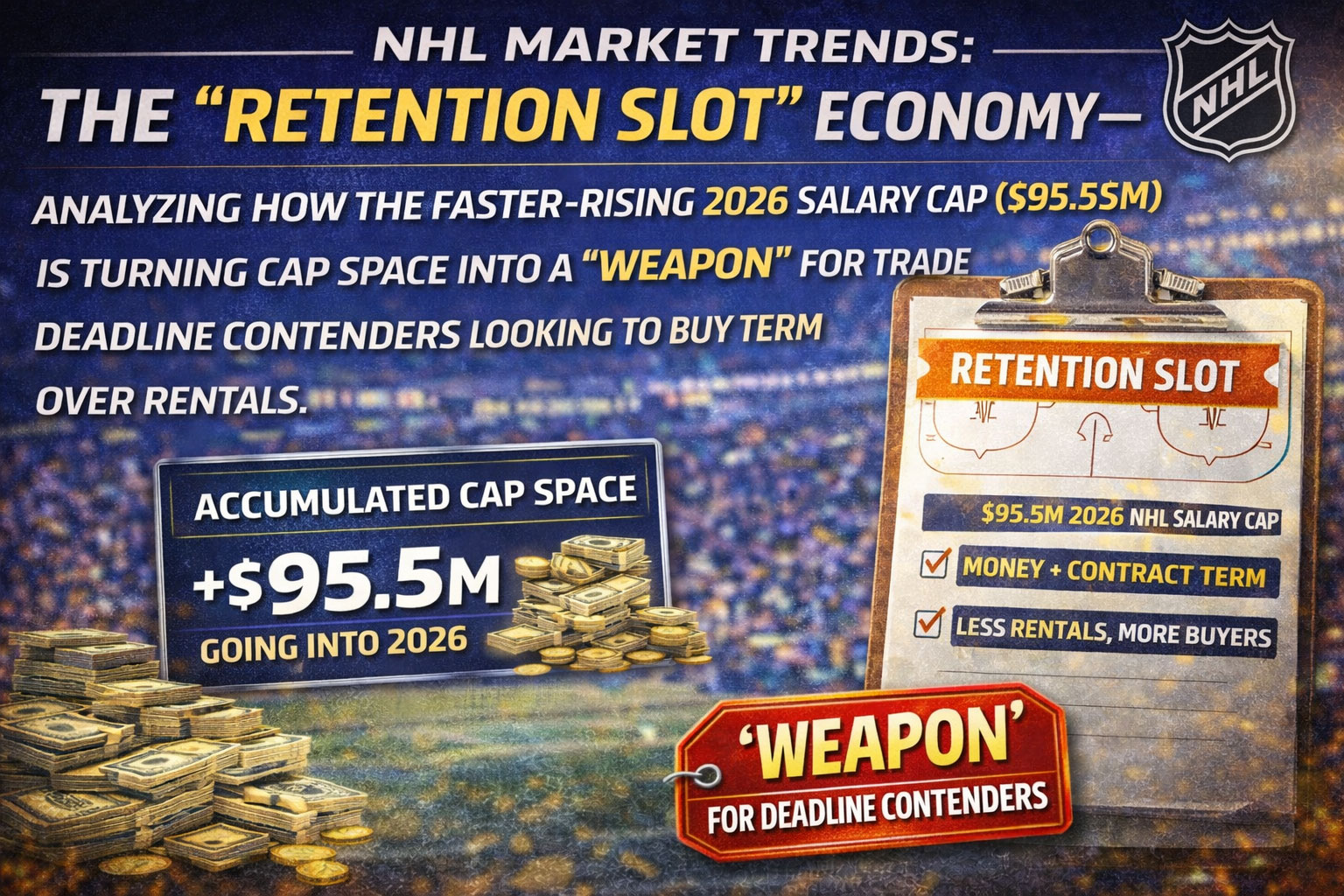
Alright, let’s talk about the NHL’s version of market efficiency—and trust me, this is way more interesting than it sounds. The 2026 salary cap is jumping to $95.5M, and suddenly every GM with cap space is acting like they’re sitting on Bitcoin in 2015. We’re watching a fundamental shift in deadline economics: teams aren’t just buying rentals anymore, they’re weaponizing their balance sheets to acquire players with term, and it’s turning the trade market into a three-team retention circus. If you understand this trend, you’re not just watching hockey—you’re watching a masterclass in leveraging future value against present-day competitive windows.
Cap Space Is the New Currency at the Deadline
The NHL’s cap landscape is undergoing what I’d call a "liquidity event." With the cap projected to hit $95.5M in 2026 (up from $88M this season), teams with flexibility are suddenly holding the most valuable asset at the deadline—and it’s not draft picks. It’s the ability to absorb salary without retention, which creates a cascading effect where cap-strapped contenders can actually land impact players with multiple years left on their deals. Think of it like having dry powder during a market correction—everyone wants to make moves, but only the teams with space can actually execute.
Here’s where it gets spicy: retention slots are becoming more valuable than second-round picks. Teams can only retain salary on three contracts at a time, which means clubs like Arizona (RIP) and now teams like Chicago or Anaheim are basically running a payday loan business for contenders. They’re the middlemen who take on 50% of a contract, flip the player to a contender, and collect draft capital for providing financial infrastructure. It’s market arbitrage at its finest—finding inefficiencies and getting paid to facilitate transactions.
The math is simple but the implications are wild. If you’re a contender and you can absorb a $7M player without retention while your rival needs two retention slots to make it work, you just gained a massive competitive advantage. You’re not just getting the player—you’re preserving your own retention slots for another move, and you’re keeping assets that would’ve gone to retention brokers. Cap space isn’t just useful anymore; it’s a straight-up weapon that separates the strategic front offices from the ones still playing 2019 hockey.
Why Contenders Are Buying Term, Not Rentals
The rental market is dead, and honestly, it’s been on life support since Tampa started hoarding assets and running it back. Contenders are realizing that trading premium picks for 20 games of a pending UFA is negative expected value when you can get 2-3 years of a comparable player for marginally more cost. The rising cap means those extra years aren’t the albatross they used to be—they’re actually cost-controlled relative to what free agents will command in 2026. It’s like buying a house before interest rates spike; you’re locking in value before market conditions change.
Look at how Vegas operates—they’re the blueprint for this strategy. They don’t do rentals; they acquire players with term and figure out the cap gymnastics later because they know the rising cap will bail them out. When you buy term, you’re not just making a deadline push—you’re building sustainable competitive advantage for multiple playoff runs. The public still thinks in terms of "rental or bust," but sharp GMs are playing a different game entirely. They’re thinking about 2026 cap space the way VCs think about exit strategies.
The risk mitigation here is actually better with term than rentals. With a rental, you’re going all-in on one playoff run with zero residual value if it doesn’t work out. With term, you spread that risk across multiple seasons, and if the player doesn’t work out, you can flip them again or buy them out when the cap is higher. It’s portfolio theory applied to roster construction—diversify your timeline, reduce variance, and maximize optionality. The teams still chasing rentals are the ones who’ll be wondering why they’re getting bounced in Round 2 while the term buyers are making Conference Finals runs for three straight years.
So what’s the play here for us degens? Start tracking which contenders have cap flexibility heading into next year’s deadline—those are your teams to back in futures markets right now, before the odds adjust. The NHL betting public is still pricing teams like it’s 2019, but the smart money understands that cap space is creating a competitive moat that’ll show up in April and May. Teams like Dallas, Carolina, and Jersey who can weaponize their cap situations are getting undervalued in long-term markets because casual bettors don’t understand balance sheet advantages. Are we about to see a dynasty built on cap strategy rather than raw talent? Drop your takes in the comments—and if you think I’m wrong, I’ll see you at the window when these teams are hoisting Cups.
WannaBet.com may receive compensation from the sportsbooks mentioned in this post. For the deeper tactical breakdown of retention slots and how contenders are using them right now, read our full retention slot strategy guide. And to see how the NHL injury fallout from the Olympics is reshaping deadline priorities, see our Crosby, Rantanen, and Hedman injury impact analysis. if you sign up using our links. This doesn’t cost you a dime, but it keeps the lights on. Please bet responsibly. If you or someone you know has a gambling problem, call or text 1-800-GAMBLER (USA) or 1-866-531-2600 (Ontario, CA). 21+ only.
