

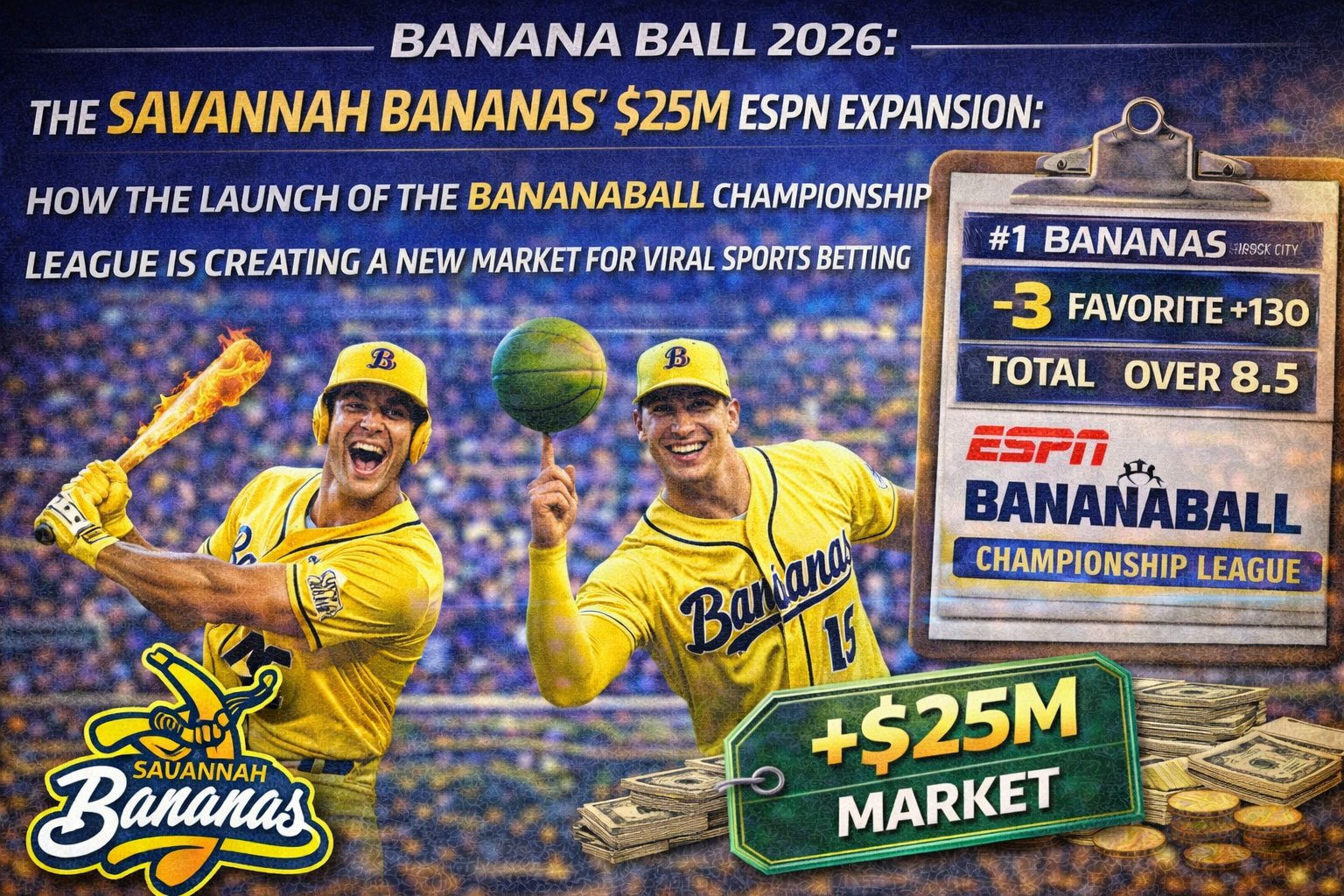
Okay, so hear me out—the Savannah Bananas just secured a $25M deal with ESPN to launch the Banana Ball Championship League in 2026, and this isn’t just some cute viral moment anymore. We’re talking about a legitimate sports property with actual broadcast infrastructure, which means the sportsbooks are about to create an entirely new vertical that didn’t exist six months ago. The same team that made baseball fun again by letting fans catch foul balls for outs and playing to a two-hour time limit is now becoming a regulated betting market, and if you understand market inefficiency, you know exactly what that means for early adopters.
Bananas Going Mainstream: ESPN’s $25M Bet
The Savannah Bananas went from selling out minor league stadiums with TikTok-friendly antics to securing one of the biggest sports media deals of 2024, and ESPN didn’t write that check for charity. They saw what we all saw—a product that generates organic engagement at a rate that makes traditional baseball look like C-SPAN, with 8 million social media followers and a waitlist of 3 million people trying to get tickets. The $25M investment is essentially ESPN buying a call option on Gen Z sports viewership, betting that Banana Ball’s controlled chaos (games capped at two hours, batters stealing first base, showdown tiebreakers) can translate television ratings in an era where traditional sports are hemorrhaging young viewers.
Here’s where it gets interesting from a market psychology perspective: ESPN isn’t just broadcasting exhibition games—they’re structuring this as a legitimate eight-team championship league with a playoff format, which is the critical infrastructure needed for sportsbooks to justify building out betting markets. You need consistent scheduling, standardized rules, and broadcast transparency for regulators to approve wagering, and suddenly the Bananas have all three. The league launches in spring 2026, perfectly positioned between March Madness and the NBA playoffs when sportsbooks are desperate for content that isn’t NHL or baseball’s opening month (sorry, but April baseball is a grind for betting handle).
The comp here isn’t minor league baseball—it’s what the UFC did when Spike TV gave them mainstream distribution in 2005, or how the WNBA betting markets exploded once Commissioner’s Cup games got real broadcast slots. The Bananas already have better brand recognition than half the Triple-A baseball teams in America, and now they’re getting the legitimacy infrastructure that turns viral content into a regulated betting vertical. If you think DraftKings and FanDuel aren’t already in rooms with Banana Ball executives discussing exclusive betting partnerships, you haven’t been paying attention to how aggressively books are diversifying beyond the Big 4.
Why Viral Sports = Untapped Betting Gold
The thesis here is stupidly simple: viral content creates engagement, engagement creates viewership, and viewership creates betting handle—but most importantly, new viral sports create market inefficiency because the oddsmakers don’t have historical data and the public doesn’t have sharp opinions yet. When a Banana Ball game drops on ESPN and 2 million people tune in because they saw a highlight on their For You page, a meaningful percentage of those viewers are going to open their sportsbook app out of pure curiosity, which is exactly how betting markets get built. The books don’t even need massive handle initially—they just need proof of concept that people will bet on it, and then the juice machine starts printing.
Look at what happened with F1 betting when Drive to Survive turned Formula 1 from a niche European sport into American water-cooler content. DraftKings reported that F1 betting handle increased 350% between 2020 and 2023, not because the racing got better, but because Netflix manufactured emotional investment in drivers that American bettors previously didn’t give a shit about. The Bananas already have the personality infrastructure—players with actual followings, storylines that feel more WWE than MLB, and a format designed for highlight-reel moments that algorithms love. You’re essentially getting a pre-packaged betting product that comes with its own marketing department via social virality.
The real edge for early adopters is that sportsbooks are going to wildly misjudge lines for at least the first season because they’re modeling Banana Ball like it’s baseball, when it’s actually closer to basketball in terms of variance and pace. Traditional baseball betting is a grind of pitcher matchups and bullpen management, but Banana Ball is designed for offensive explosions and momentum swings—games where a team can score 5 runs in the final inning because the rules literally encourage chaos. If you understand expected value, you know that market inefficiency is where money gets made, and there’s no more inefficient market than one where the oddsmakers are still figuring out what the hell they’re pricing.
The Banana Ball Championship League launching in 2026 represents something we rarely see in sports betting—a completely new market being created in real-time with mainstream distribution infrastructure already in place. ESPN’s $25M investment isn’t just validation that the Bananas are entertainment; it’s the regulatory and broadcast framework that turns viral content into a legitimate betting vertical, and the books are absolutely going to capitalize on it. Whether you’re someone who thinks this is the future of baseball or just a gimmick that’ll fade after one season, the smart money recognizes that new markets = inefficient lines = opportunity for anyone willing to do the homework before the public catches up.
The question isn’t whether you should bet Banana Ball when it launches—it’s whether you’re going to be sharp enough to exploit the market before the books figure out what they’re actually pricing. So here’s my question for the comments: are you treating this as a legitimate betting opportunity or just another entertainment product you’ll scroll past? Because I guarantee the books are already building the infrastructure to take your money either way.
"WannaBet.com may receive compensation from the sportsbooks mentioned in this post if you sign up using our links. This doesn’t cost you a dime, but it keeps the lights on. Please bet responsibly. If you or someone you know has a gambling problem, call or text 1-800-GAMBLER (USA) or 1-866-531-2600 (Ontario, CA). 21+ only."
