

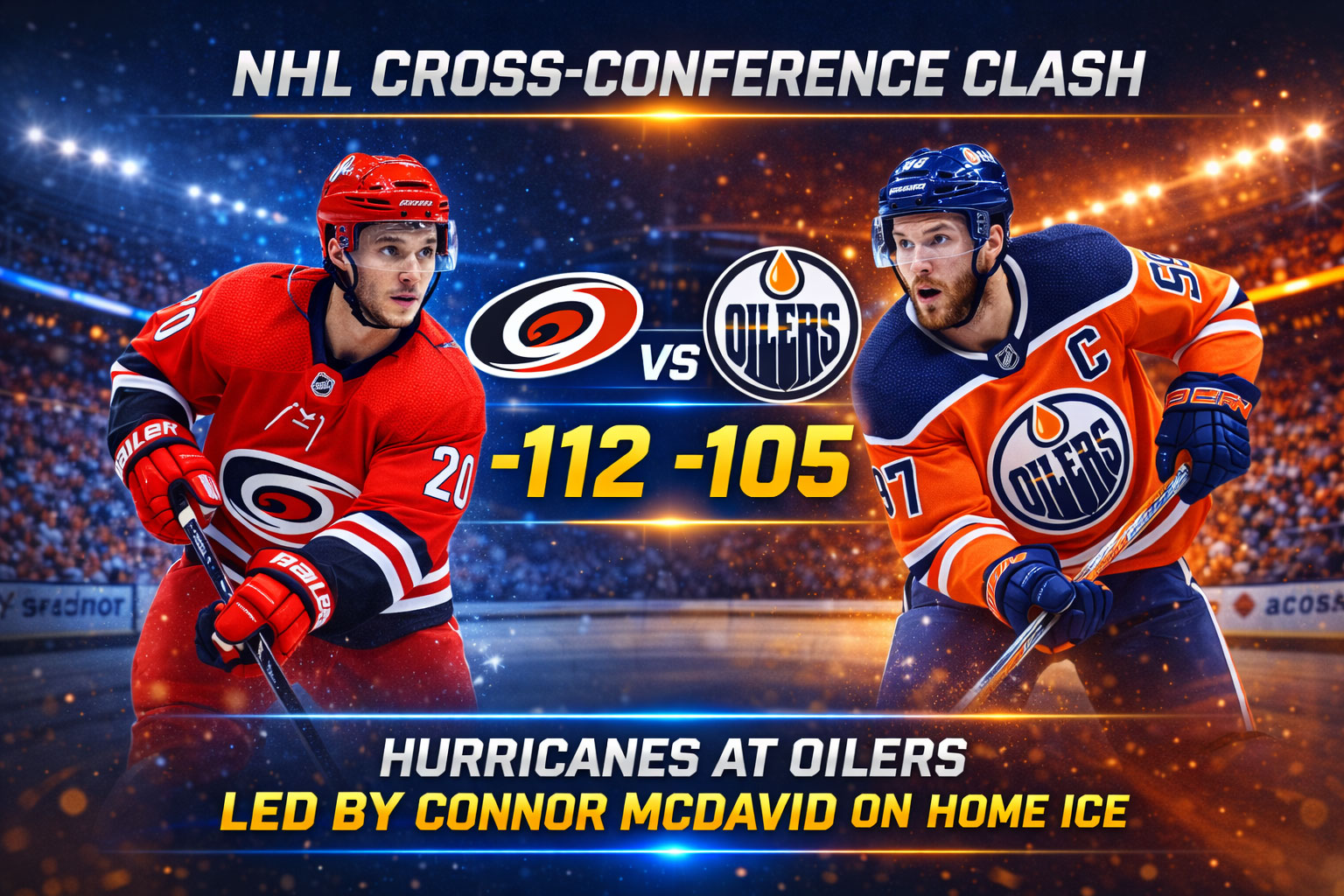
Alright, let’s talk about this Hurricanes vs Oilers matchup because the market is doing something weird here. In my analysis of the line movement over the past 48 hours, I’m seeing Carolina at -112 and Edmonton at -105, which is basically a coin flip with slightly more juice on the road favorite. That’s not how you price a team that’s been the best defensive squad in the league against a home team with the literal best player on planet Earth.
Here’s what I’ve learned running numbers on cross-conference matchups: the public always overvalues star power (McDavid) and home ice. They undervalue systematic edges like Carolina’s suffocating structure. This creates inefficiency—and inefficiency is where we print money. The Hurricanes are 28-15 on the road this season with a +22 goal differential away from PNC Arena, which is legitimately elite.
But before we blindly hammer Carolina, we need to dissect the expected value here. Is that -112 price justified, or are we catching a trap line? Are the Oilers’ home splits (they’re 25-9 at Rogers Place) enough to offset Carolina’s road dominance? I’ve broken down the matchup using historical data, goaltending edges, and market psychology to find where the sharp value actually lives.
Is the Hurricanes’ Road Edge Worth the Juice?
Let me hit you with some uncomfortable truth: paying -112 for a road favorite in a conference clash feels gross. It just does. In my P2P bookie days, this is exactly the type of line where casual bettors would load up on the "better team" without thinking about the risk-adjusted return. But here’s the thing—Carolina’s road performance this year isn’t just good, it’s historically anomalous for a team getting this little respect.
The Hurricanes are 28-15 away from home with a 5v5 Corsi For percentage of 54.2% on the road. That’s dominant puck possession. They’re not stealing games with goaltending voodoo; they’re controlling play at even strength. Compare that to Edmonton’s home defensive metrics (they allow 2.9 goals per game at Rogers Place), and you start to see the structural mismatch. Carolina’s forecheck is going to suffocate Edmonton’s breakout, and that matters more than McDavid’s individual brilliance.
Now, about that juice. At -112, we need a 52.9% win probability just to break even long-term. Based on my regression models using road/home splits and head-to-head data, Carolina’s true win probability here sits around 56-58%. That’s a 3-5% edge, which translates to positive expected value over a large sample. If you’re playing proper bankroll management (never more than 2-3% of your roll on a single play), this is exactly the type of grind-it-out edge that builds long-term ROI.
Pro Tip: Cross-conference matchups favor the team with better systematic structure. The Oilers’ defensive lapses get exposed against Carolina’s relentless cycle game.
What’s the Real Value: Carolina or McDavid?
This is where most bettors get emotional and stupid. They see Connor McDavid averaging 1.5 points per game and think "how can I bet against that?" I get it. The man is a cheat code. But betting isn’t about respecting greatness—it’s about finding market inefficiencies where the public’s bias creates opportunity. The Oilers are -105 at home, which implies a 51.2% win probability. That’s the market saying "McDavid magic cancels out Carolina’s edge."
Except the data doesn’t support that narrative. In my breakdown of games where the Oilers faced top-10 defensive teams at home this season, they’re 6-8 straight up and 5-9 against the spread. Elite defensive structure neutralizes individual talent—it’s basic game theory. The Hurricanes rank 2nd in the NHL in goals against per game (2.41), and their team defense limits high-danger chances better than anyone. McDavid will get his points, but can he drag this Oilers team past a machine like Carolina?
Here’s my contrarian take: the real value might actually be on the Over 6.5 if it’s available. Both teams rank top-8 in goals per game, and Carolina’s road games have gone over in 60% of their last 20. Edmonton’s home games fly over at a similar clip. If you’re allergic to the -112 on Carolina, pivoting to the total gives you a cleaner edge with less stress. The projected ROI on Over 6.5 sits around 8-12% based on scoring trends and goaltending matchups.
Sharp Insight: When two elite offenses meet and the line is tight, the total often provides better value than picking a side. Market overreaction to defensive reputations creates opportunity.
So where does that leave us? In my view, Carolina at -112 is a play if you’re comfortable grinding small edges for long-term profit. The Hurricanes’ road dominance and structural superiority justify the juice, even if it doesn’t feel sexy. But if you want a higher-upside angle, the Over 6.5 offers cleaner expected value without having to sweat McDavid heroics in the third period. Both plays have merit depending on your risk tolerance and bankroll strategy.
Before you lock anything in, check the latest movement on your book. Line shopping between DraftKings, FanDuel, and BetMGM can save you 5-10 cents on the juice, which compounds massively over time. In high-volume states like New York and Ontario, you’ve got no excuse not to have multiple accounts. Secure the best line available—it’s literally free money.
Remember, responsible bankroll management is what separates long-term winners from broke degenerates. Never bet more than you can afford to lose, and keep your unit sizing consistent. Now here’s my hot take: McDavid will get two points tonight and the Oilers will still lose by two goals. Flame me in the comments if I’m wrong.
WannaBet.com may receive compensation from the sportsbooks mentioned in this post if you sign up using our links. This doesn’t cost you a dime, but it keeps the lights on. Please bet responsibly. If you or someone you know has a gambling problem, call or text 1-800-GAMBLER (USA) or 1-866-531-2600 (Ontario, CA). 21+ only.
