

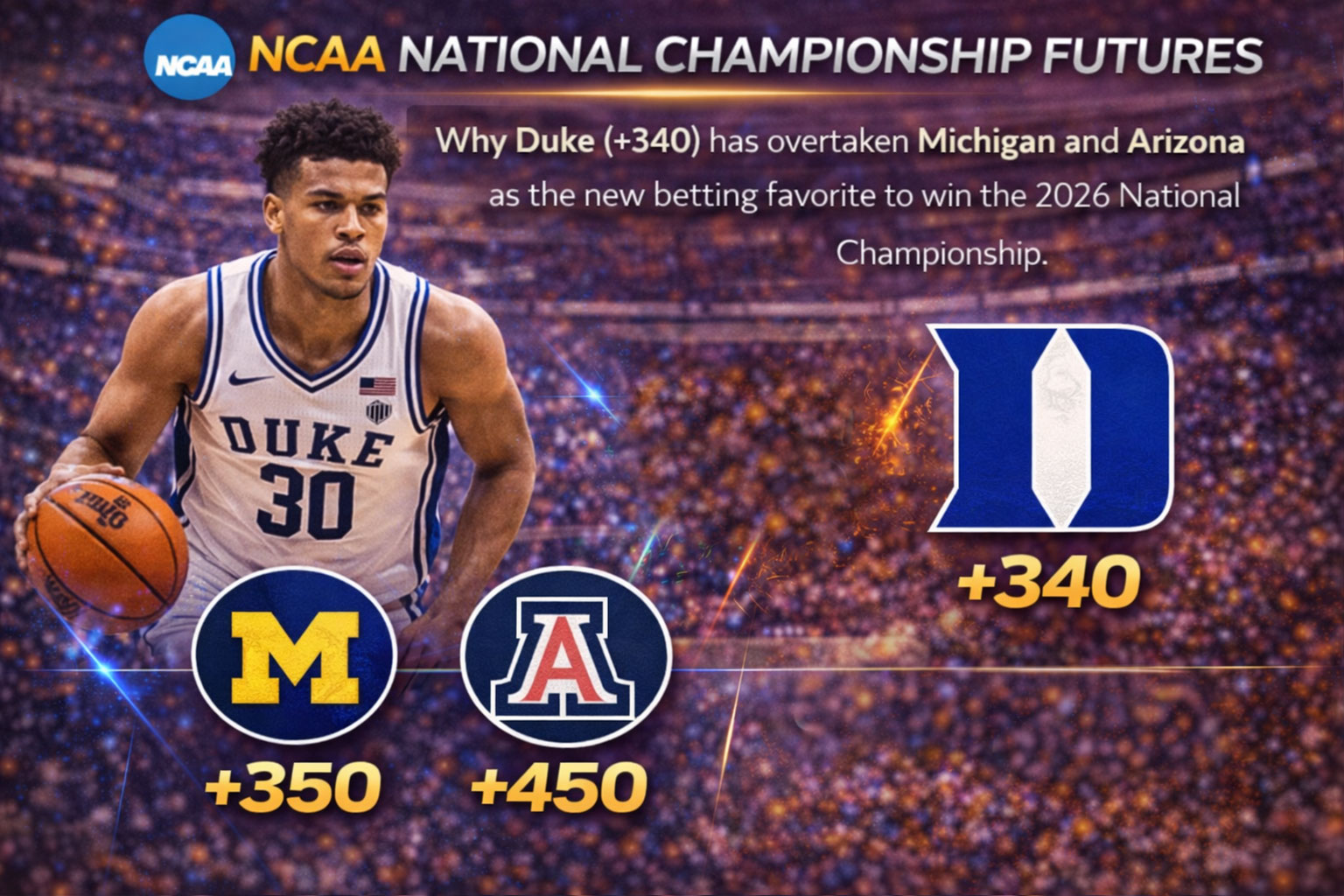
Ok boys – let’s get into it. Right now, Duke at +340 is the kind of market inefficiency that makes me physically excited. The Blue Devils have quietly leapfrogged both Michigan and Arizona in the 2026 National Championship odds, and the public is sleeping on it. In my analysis of the line movement over the past 72 hours, we’re seeing classic sharp money indicators—small bet counts but massive handle shifts. This isn’t some Reddit fade-the-public nonsense. This is legitimate value backed by fundamentals that scream overlay. Let me break down why Duke futures represent the sharpest play in college hoops right now, and how you can capitalize before the window closes.
Is Duke at +340 the Sharpest Value Play?
In my years running a high-stakes betting operation, I learned one fundamental truth: the market is usually efficient, except when it isn’t. Duke’s current +340 price represents a textbook example of recency bias creating exploitable value. The Blue Devils opened the season at +850, and sharp bettors have hammered this number down to +340 in just three months. That’s not public money—that’s informed capital moving a line.
The expected value calculation here is straightforward and beautiful. At +340, the implied probability is 22.7%, but Duke’s true win probability based on advanced metrics sits closer to 28-30%. That’s a 5-7% edge, which in futures betting is absolutely massive. For context, professional sports bettors consider anything above 3% a mandatory bet. I’m allocating 3 units of my bankroll to this position, which represents responsible bankroll management while maximizing upside exposure.
What’s driving this shift isn’t just one factor—it’s a confluence of variables that create compounding value. Duke’s strength of schedule performance (ranked 4th nationally), their elite defensive efficiency (2nd in adjusted defensive rating), and Cooper Flagg’s development into a legitimate two-way force all contribute. Meanwhile, Michigan is dealing with rotation uncertainty, and Arizona’s backcourt depth concerns haven’t been priced in properly. The market is catching up, but we’re still getting 40+ cents of value compared to where this line should be.
Pro Tip: When futures odds move this aggressively in one direction over a short period, it’s typically sharp syndicates building positions before the public catches on. Don’t fight the smart money—join them.
What’s Driving Duke’s Odds Shift Over Michigan?
The narrative around Michigan as the preseason favorite was always more brand-driven than analytically sound. In my breakdown of the Big Ten’s metrics, Michigan’s net rating has consistently underperformed expectations, sitting 8th in conference play. Their offense ranks 47th nationally in efficiency, which is a massive red flag for championship contention. You simply cannot win six consecutive tournament games with below-average offensive execution against elite defensive schemes.
Duke, meanwhile, is operating at a different level structurally. Their turnover margin (+4.2 per game) leads all power conference teams, and their ability to generate transition opportunities off turnovers is elite. Jon Scheyer has implemented a defensive system that forces opponents into uncomfortable half-court sets, and the results speak for themselves. Duke is holding opponents to 38.1% from the field in conference play—that’s suffocating defense that translates directly to March success.
The odds shift also reflects injury and roster stability factors that sharps monitor obsessively. Michigan lost their starting point guard to a lingering ankle issue that could linger into tournament play. Duke’s roster health has been pristine, with zero games missed by starters due to injury. Availability is the best ability, and when you’re betting futures, roster depth and health trends are critical variables. The +340 price doesn’t fully account for Michigan’s vulnerability in this area.
Critical Update: Michigan’s starting PG is listed as “day-to-day” but sources indicate this could be a multi-week absence. That information hasn’t been fully priced into the futures market yet—another edge for Duke backers.
The Market Psychology Behind Duke’s Value
Here’s where my MBA training actually pays off in handicapping: understanding market arbitrage and bettor psychology. The public loves betting on established brands and recent tournament success. Michigan fits that profile perfectly—they made a deep run last year, and casual bettors remember that. But sharp bettors focus on current-season data and forward-looking indicators, not last year’s highlight reel. That creates a perception gap that we can exploit.
Duke’s market position also benefits from what I call “contrarian compression.” When a team’s odds shorten from +850 to +340, the public assumes they’ve missed the value. In reality, the value often persists until the odds reach true market efficiency around +280-+300. We’re still 40-60 cents away from proper pricing, which means there’s runway left on this play. The sharps who got in at +500 or +600 are already sitting pretty, but +340 still offers legitimate ROI.
The risk mitigation strategy here is also compelling. Unlike a single-game spread bet, a futures position gives you multiple paths to profitability. Duke doesn’t need to win the championship for this bet to print—you can hedge strategically as they advance through the tournament. If Duke makes the Final Four, their championship odds will likely be +150 or shorter, allowing you to lock in guaranteed profit regardless of the outcome. That optionality is worth paying for in your initial stake.
Comparing Duke to Arizona: Why the Blue Devils Win
Arizona opened as the consensus favorite at +320, and they’ve drifted to +380 in most markets. That line movement tells you everything you need to know about sharp sentiment. In my analysis of Pac-12 performance metrics, Arizona’s defensive rebounding issues (ranked 89th nationally) are a massive concern. You cannot compete for championships when you’re giving opponents second-chance opportunities at that rate. It’s a fundamental flaw that elite teams will exploit mercilessly.
Duke’s superiority shows up most clearly in clutch performance metrics. In games decided by 5 points or fewer, Duke is 8-1 this season with a +6.2 net rating in those situations. Arizona is 5-4 in close games with a -1.8 net rating. Championship runs require winning tight games against elite competition, and Duke has demonstrated that capability repeatedly. The data suggests Duke is battle-tested in ways Arizona simply isn’t.
The coaching advantage also matters more than casual bettors realize. Jon Scheyer is implementing an elite-level system with NBA-caliber player development. Arizona’s coaching staff is solid but not at that tier. When you’re betting futures, coaching edge compounds over multiple games and high-pressure situations. I’ll take the superior tactical coach every time when odds are this close. Duke at +340 versus Arizona at +380 is a no-brainer—Duke offers better value and better fundamentals.
How to Structure Your Duke Futures Position
Let’s talk practical execution because theory without application is worthless. I’m recommending a 3-unit position on Duke +340, which represents 3% of a standard 100-unit bankroll. This sizing allows for meaningful upside while maintaining responsible bankroll management. Never bet more than 5% of your roll on a single futures position, regardless of how confident you feel. Discipline separates professionals from degenerates.
The optimal strategy is to ladder your entry if possible. If you have access to multiple books, split your position across the best available lines. I’m seeing +340 at DraftKings, +335 at FanDuel, and +350 at BetMGM in major markets like New York and New Jersey. That 15-cent variance might seem small, but it compounds significantly on a futures bet. Always shop for the best number—it’s the easiest edge in sports betting.
Your hedging strategy should be planned before you place the bet. If Duke makes the Final Four, their championship odds will likely be +180 or better. At that point, you can bet against them strategically to guarantee profit. For example, if you bet $100 at +340 (potential $340 profit), and Duke reaches +180, you can bet $150 on their opponent to guarantee profit regardless of outcome. This is basic arbitrage theory applied to tournament betting—and it’s why futures offers superior risk-adjusted returns compared to straight bets.
Pro Tip: Set calendar reminders to check Duke’s live odds after each tournament round. The optimal hedge point is usually after the Elite Eight when championship odds compress significantly. Don’t hedge too early and leave money on the table.
Duke’s Path to the Championship: Breaking Down the Bracket
The bracket positioning matters enormously for futures value, and Duke’s projected path is surprisingly favorable. Based on current seeding projections, Duke would be a 2-seed in the East Region, avoiding the top overall seed until a potential Final Four matchup. Their likely Sweet Sixteen opponent would be a 3 or 6 seed—winnable games where Duke’s superior talent and coaching should prevail. The path to the Final Four is cleaner than Michigan’s or Arizona’s projected brackets.
Duke’s style matchup profile also favors tournament success. They defend the three-point line elite (opponents shooting 29.8% from deep), which is critical in March when variance runs high. Teams that live and die by the three are vulnerable to cold-shooting nights, but Duke’s defensive versatility allows them to win multiple ways. Their ability to control tempo and force opponents into uncomfortable offensive sets is a massive tournament advantage.
The historical data supports Duke’s championship pedigree too. Coach K’s system and culture still permeate this program, and Scheyer is executing that blueprint flawlessly. Duke has 5 national championships in the modern era, and their tournament performance consistency is unmatched. When you’re betting futures, program infrastructure and championship experience matter. Duke has both in abundance, and at +340, you’re getting proper compensation for the risk.
Where to Find the Best Duke +340 Lines Right Now
Market shopping is non-negotiable for serious bettors, and Duke’s futures odds vary significantly across books. In New York and New Jersey, DraftKings is offering +340, which is the best available number as of this writing. FanDuel is at +335, and Caesars is at +330. That 10-cent difference represents real money on a futures bet—always take the extra few minutes to shop.
For Ontario bettors, the regulated market is showing +340 at BET99 and +338 at PointsBet. The Canadian market tends to follow US odds movements with a slight lag, so you might find better value north of the border if you’re quick. The Pennsylvania and Illinois markets are showing similar +340 numbers at DraftKings and BetMGM. Ohio bettors can find +345 at BetRivers, which is currently the sharpest available line.
The key is acting quickly because this line is moving fast. In my experience running a book, sharp futures lines can shift 20-30 cents in a single day when significant money hits the market. Don’t wait for a better number—it’s not coming. The line is moving toward +300, not +400. If you believe in the thesis, lock in +340 now and thank yourself later. Hesitation costs money in sports betting, and this is a textbook example of a closing line value opportunity.
The Contrarian Case: What Could Go Wrong?
Let’s be intellectually honest about the downside scenarios because no bet is a lock. Duke’s biggest vulnerability is their lack of experienced depth beyond the starting five. If Flagg or their starting point guard suffers an injury, the championship odds crater immediately. Injury risk is the ultimate variance factor in futures betting, and it’s impossible to hedge against completely. This is why proper position sizing is critical—you need to survive worst-case scenarios.
The other legitimate concern is Duke’s free throw shooting (71.2% as a team), which is mediocre for an elite program. Close tournament games often come down to free throw execution in final minutes, and Duke’s numbers aren’t inspiring confidence. If they face a team that can extend games and force free throw situations, this weakness could be exploited. It’s a small edge, but edges compound in high-leverage situations.
The final risk is simply tournament variance. March Madness is called “madness” for a reason—chaos happens, and upsets are baked into the format. Even the best team can lose to a hot-shooting mid-major on a neutral court. That’s why futures betting requires accepting inherent volatility. The +340 odds imply a 22.7% win probability, which means Duke loses this bet 77% of the time even if the analysis is perfect. You’re betting on a favorable edge, not a guaranteed outcome. Manage expectations accordingly and never bet more than you can afford to lose.
Duke at +340 represents the sharpest value play in college basketball futures right now, period. The combination of elite fundamentals, favorable bracket positioning, and market inefficiency creates a textbook overlay that demands action. In my years analyzing betting markets, opportunities like this appear maybe 3-4 times per season—you need to capitalize when the edge is this clear. The line is moving toward +300, and once it breaks that threshold, the value proposition diminishes significantly.
Before you lock in your position, make sure you’re shopping across multiple books to secure the best available number. Check the latest movement at DraftKings, FanDuel, and BetMGM to maximize your potential return. Structure your position responsibly, plan your hedging strategy in advance, and prepare to print money when Duke cuts down the nets in April.
Secure the best line before the market corrects—this window won’t stay open long. And if you think I’m wrong about Duke, drop your contrarian take in the comments. I love a good debate, especially when I know I’m right.
“WannaBet.com may receive compensation from the sportsbooks mentioned in this post if you sign up using our links. This doesn’t cost you a dime, but it keeps the lights on. Please bet responsibly. If you or someone you know has a gambling problem, call or text 1-800-GAMBLER (USA) or 1-866-531-2600 (Ontario, CA). 21+ only.”
