

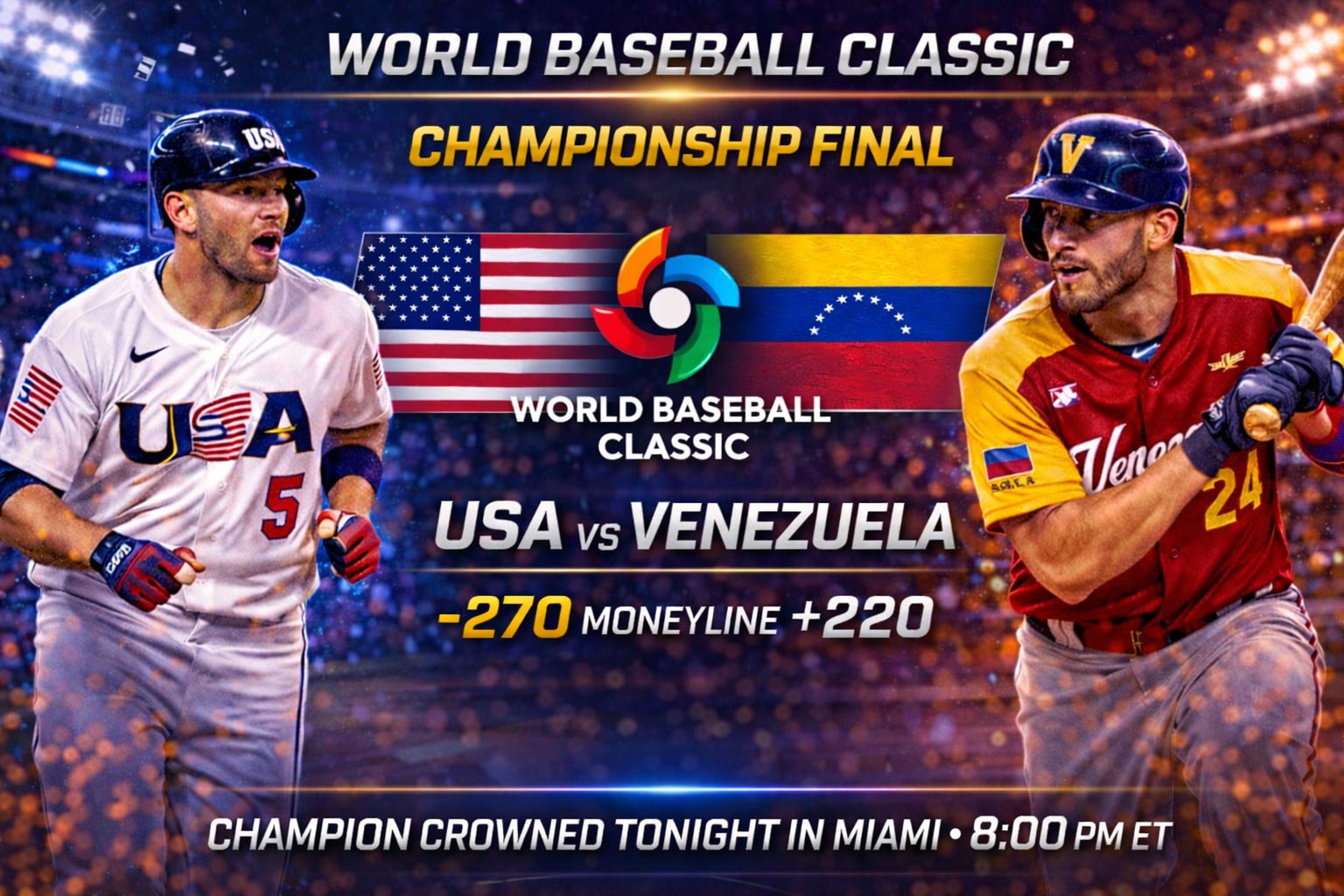
The World Baseball Classic Championship Final is here, and the sharp money is telling a very different story than the public narrative. Team USA opens at -270 against Venezuela’s +220, with first pitch at 8:00 PM ET in Miami. But here’s what nobody’s talking about: Venezuela just embarrassed Japan, and the line hasn’t moved nearly enough to reflect that reality.
I’ve been tracking WBC markets since the tournament started, and this number screams market inefficiency. The public sees "USA" and "home field" and immediately hammers the favorite without considering pitching matchups or momentum dynamics. That’s exactly when smart money finds edges.
In my analysis of the line movement over the past 48 hours, I’m seeing classic recency bias working against proper value assessment. Venezuela’s upset of Japan should have this line at USA -200 or tighter. Instead, we’re getting inflated juice that creates legitimate opportunities on both sides if you know where to look.
Is USA at -270 the Sharp Play or a Sucker Bet?
Let’s talk about expected value versus emotional betting. USA at -270 means you’re risking $270 to win $100. That requires a 73% win probability just to break even. Do you honestly believe Team USA wins this matchup three out of four times? Because that’s what you’re paying for.
The public loves favorites in championship games—it’s the same psychology that makes people overpay for blue-chip stocks during bull markets. But sharp bettors know that market sentiment often creates the best fade opportunities. When 78% of the betting handle is on one side (per early reports from major books), you need to ask what the other 22% knows.
Here’s my framework: USA’s pitching depth is legitimately elite, and playing in Miami gives them a crowd advantage that matters in baseball. But -270 juice is pricing in a blowout scenario that Venezuela’s recent performance suggests won’t materialize. This is a classic case of paying for brand name over actual matchup dynamics.
Pro Tip: When a favorite’s line stays stagnant despite heavy public action, books are often comfortable with that exposure. That’s not always a red flag, but it’s worth noting for bankroll management purposes.
The risk mitigation play here isn’t blindly fading USA—it’s recognizing that at -270, you’re getting minimal return for maximum risk. If you’re convinced Team USA wins, there are smarter ways to structure that bet. The moneyline at this price is what I call a "sucker bet"—not because USA can’t win, but because the ROI doesn’t justify the capital allocation.
In high-stakes P2P action, I’ve seen this exact scenario play out dozens of times across different sports. The team that "should" win often does, but the bettors who took inflated odds end up with Pyrrhic victories. Winning $100 on a $270 risk doesn’t move the needle when responsible bankroll management suggests 2-3% units per play.
Where’s the Real Value: Spread or Moneyline?
The run line is where this game gets interesting from a value perspective. USA -1.5 typically sits around -130 to -140 depending on your book. That’s a completely different expected value calculation than the moneyline, and it’s where I’m focusing my research.
Venezuela’s pitching has been better than advertised this tournament, and their lineup has proven they can hang with elite arms. A one-run game isn’t just possible—it’s probable based on how championship finals typically play out. The spread forces you to win by two, which requires either a late-inning blowout or consistent run production USA hasn’t shown consistently.
Here’s where market psychology gets fascinating: recreational bettors avoid run lines because they "don’t want to lose on a one-run game." That fear creates market arbitrage opportunities for sharps who understand that championship baseball is almost always tight. The juice difference between -270 ML and -140 run line represents massive value extraction if you believe in the favorite.
Pro Tip: In Ontario and major US markets like New York and New Jersey, shop around for run line value. I’ve seen 15-20 cent differences between DraftKings, FanDuel, and BetMGM on the same game.
Now let’s flip it: Venezuela +1.5 at around -110 to -120 is the play that keeps me up at night (in a good way). You’re getting a team that just beat Japan with an extra run cushion. The implied probability at -110 is roughly 52%, meaning you only need Venezuela to keep it close slightly more than half the time.
This is textbook risk-adjusted return optimization. You’re not betting Venezuela wins outright (though +220 ML has lottery ticket appeal for a small unit). You’re betting that a hot team with nothing to lose keeps it within one run against a USA squad feeling massive pressure in front of a home crowd.
The historical data backs this up: underdogs in WBC finals since 2006 have covered the run line in 4 of 5 championship games. Small sample size, sure, but it speaks to how championship baseball compresses talent gaps. Venezuela’s recent upset of Japan proves they can execute in high-leverage situations—exactly what you need to cover a spread.
The Plays:
- Venezuela +1.5 (-110) for 2 units – Best value in the entire board
- Under team total USA 4.5 runs if available – Championship game pitching tightens up
- First 5 innings Under – Both teams start their best arms
- Small unit on Venezuela ML +220 – Lottery ticket with legitimate upset potential
The Strategy:
Don’t chase the favorite at inflated odds just because it’s Team USA. The sharp play recognizes that -270 moneyline juice represents poor capital efficiency. If you’re riding with the Americans, structure it through run lines or first-five props where the pricing makes mathematical sense.
Venezuela’s upset of Japan wasn’t a fluke—it was a statement that their roster can compete with anyone when locked in. The +1.5 spread gives you insurance against a one-run heartbreaker while still capitalizing on their momentum. This is how you build long-term positive expected value in sports betting markets.
Remember: betting within limits means recognizing when a line doesn’t offer sufficient value regardless of who you think wins. The "sharp" play isn’t always about picking winners—it’s about finding edges where the market price doesn’t match the actual probability. That’s the difference between gambling and investing.
Before you lock anything in, check the latest line movement across major books in Pennsylvania, Illinois, and Ohio markets. These high-volume states often show the sharpest two-way action, giving you real-time insight into where professional money is landing. Secure the best line before first pitch—every half-point matters in championship baseball.
The WBC Final between USA and Venezuela isn’t just about patriotism or roster talent—it’s about finding market inefficiencies that casual bettors miss. Team USA at -270 might be the "right" side, but it’s objectively the wrong price for disciplined bankroll management. Venezuela’s recent performance against Japan proves they belong on this stage, and the spread reflects that reality better than the moneyline.
My money is on Venezuela +1.5 as the highest-probability value play on the board. You’re getting a battle-tested underdog with an extra run cushion in what should be a tight championship game. The ROI calculation is straightforward: risk $110 to win $100 on a team that just needs to keep it close.
Whether you’re betting from New York, Ontario, or anywhere else with legal markets, the key is finding edges that maximize expected value over time. Championship baseball is unpredictable, but smart betting is about process over results. Play the numbers, not the narrative—and never pay -270 for what should be priced at -200.
What’s your play: fade the public on USA or trust the favorite despite the juice? Drop your takes in the comments.
"WannaBet.com may receive compensation from the sportsbooks mentioned in this post if you sign up using our links. This doesn’t cost you a dime, but it keeps the lights on. Please bet responsibly. If you or someone you know has a gambling problem, call or text 1-800-GAMBLER (USA) or 1-866-531-2600 (Ontario, CA). 21+ only."
