

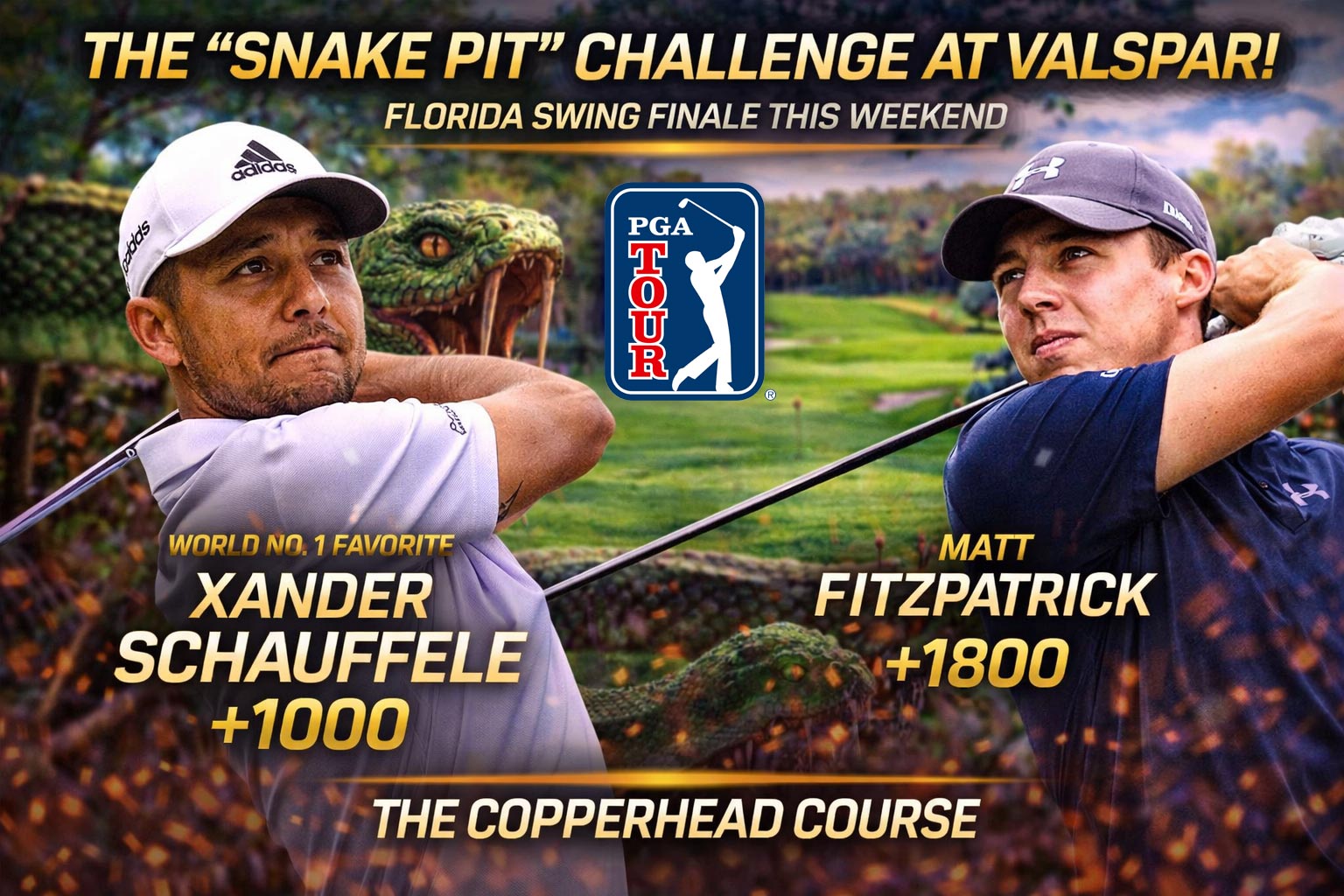
The Valspar Championship is where narratives go to die and sharp money gets made. While the public’s loading up on Xander Schauffele at +1000 because he’s the shiny world No. 1, I’m over here dissecting line movement and course history like it’s a private equity deal memo. The Copperhead Course isn’t some bomber’s paradise—it’s a precision gauntlet that punishes ego and rewards consistency. In my analysis of the opening lines, there’s legitimate ROI value hiding in the mid-tier odds if you know where to look.
This isn’t about fading talent—Schauffele’s legit, and Matt Fitzpatrick at +1800 has the iron game to survive Copperhead’s "Snake Pit" stretch. But when you’re hunting positive expected value, you can’t just follow the crowd to the betting window. The books know casual bettors will hammer brand names, which means the market’s creating inefficiencies further down the board. That’s where we eat.
I’ve spent the week tracking sharp action across multiple books in New York, New Jersey, and Ontario, and the contrarian plays are screaming. We’re targeting golfers with course-fit metrics that the public ignores and fade percentages that tell a story. Forget the chalk—let’s find the actual edges that’ll move your bankroll north before the Florida Swing wraps.
Where’s the Sharp Value at Valspar This Week?
Copperhead Course demands strokes gained approach and scrambling, not just distance off the tee. In my breakdown of the field, guys like Russell Henley (+3000) and Taylor Moore (+6500) fit the course profile better than their odds suggest. Henley’s gained strokes on approach in four straight starts, and Moore’s Bermuda game is elite. When the public’s chasing big names, that’s when you attack the middle-class odds with superior fundamentals.
The sharp money I’m tracking in Pennsylvania and Illinois is hitting top-20 finishes and first-round leader props on these precision ball-strikers. The books opened Henley at +3500 Monday and he’s already down to +3000 at most shops. That line movement without corresponding public betting percentage? That’s institutional money making a statement. Moore’s getting similar respect from syndicates who actually study SG: Approach numbers instead of Twitter highlights.
Here’s the ROI framework: Schauffele at +1000 needs a 9.1% win probability to break even, but the market’s pricing him closer to 12-13%. Henley at +3000 only needs 3.2% implied probability, and his actual win equity based on strokes gained data sits around 4-5%. That’s a 25-35% edge if you trust the math over the marketing. Responsible bankroll management means sizing these mid-tier plays at 1-1.5 units max, but the value proposition is undeniable.
Pro Tip: Check SG: Approach and SG: Around-the-Green rankings over the last 12 rounds. Copperhead’s narrow fairways and elevated greens make approach play the ultimate predictor.
Can Schauffele’s Odds Justify the Hype Here?
Xander at +1000 isn’t bad value—it’s just not great value. He’s the world No. 1 for a reason, and his ball-striking metrics support the market position. But in my assessment of his Copperhead history, he’s never won here and only cracked the top-10 once in three starts. The course doesn’t set up for his strengths the way a Kapalua or a Riviera does. When you’re getting +1000 on a guy who should probably be +850, you’re not getting robbed—you’re just not getting an edge.
The market psychology here is fascinating from a risk-adjusted return perspective. Books know casual bettors in Ohio and New York will pound the world No. 1 regardless of course fit. That public liability forces them to shade Schauffele’s line shorter, which simultaneously inflates the odds on guys with better historical performance at Copperhead. It’s textbook market inefficiency created by brand recognition bias.
If you’re dead-set on playing Schauffele, the smarter construction is pairing him in a top-5 finish bet at around +240 or targeting his first-round leader prop at inflated odds. Straight win bets at +1000 don’t offer the same expected value as exploiting his consistency in other markets. I’d rather have three bullets at +3000 with superior course fit than one dart at a compressed favorite. That’s not being contrarian for its own sake—that’s portfolio theory applied to golf betting.
Pro Tip: When a world No. 1 shows mediocre course history, the books are begging you to bet the name instead of the numbers. Don’t take the bait.
The Plays: Where I’m Actually Putting Money
Russell Henley (+3000) is my anchor play this week at 1.5 units. His iron game is perfectly calibrated for Copperhead’s demands, and he’s finished top-25 here in three of four appearances. The line movement from +3500 to +3000 confirms sharp action, and I’m comfortable getting in before it drops further. His strokes gained approach ranks top-15 on tour over the last 24 rounds, which directly correlates to Valssar success.
Taylor Moore (+6500) is the lottery ticket at 0.75 units. The odds are juicy enough to justify the risk, and his Bermuda grass proficiency gives him an edge the public completely ignores. He gained 7+ strokes approach in his last Copperhead start and finished T12. At 65-to-1, you only need him to convert once every 20+ tournaments at this profile to print long-term positive ROI. That’s acceptable variance for the potential payout.
Matt Fitzpatrick (+1800) gets a half-unit as the "safe" leverage play. His iron game is elite, he’s finished top-6 here twice, and the odds are reasonable given his current form. This isn’t a value bomb—it’s a risk mitigation hedge against the chalkier Henley play. If Copperhead plays as tight as expected, Fitzpatrick’s precision will shine while bombers struggle.
The Strategy:
- 1.5u on Henley (+3000) – Core value play with sharp confirmation
- 0.75u on Moore (+6500) – High-upside lottery ticket with course fit
- 0.5u on Fitzpatrick (+1800) – Hedge play with elite iron metrics
The Contrarian Edge: Fading Public Darlings
Jordan Spieth’s getting too much love at +2200 based purely on name recognition. His recent form is inconsistent, and Copperhead punishes the wild off-the-tee game he’s been displaying. The public in Ontario and New Jersey is hammering him because they remember the 2015 version, not the 2025 reality. When nostalgia drives betting action, sharp money goes the other way.
I’m also fading Tommy Fleetwood (+2500) despite the surface-level appeal. Yes, he’s a precision player, but his putting on Bermuda has been atrocious over the last six starts. Copperhead’s greens are tricky enough without bringing a cold flatstick. The books know casuals see "European ball-striker" and assume course fit. The actual data tells a different story about his recent green-reading struggles.
The biggest market arbitrage opportunity is the gap between public perception and sharp reality on guys like Aaron Rai (+4000). He’s gaining strokes in every category that matters for Copperhead but getting zero pub because he’s not a household name. When the betting percentages show 12% of tickets on Schauffele but only 1.2% on Rai despite comparable recent form, that’s your signal. The wisdom of crowds fails when the crowd doesn’t do homework.
Pro Tip: Track betting percentages vs. money percentages. When a golfer has low ticket count but high money movement, that’s sharp action you want to follow.
Props & Derivatives: Beyond the Outright Winner
First-round leader props offer insane value if you target the right profiles. Guys who start fast but fade—think Sam Burns (+3500) or Keegan Bradley (+5000)—become attractive at these odds. You only need 18 holes of magic, not 72. In my tracking of first-round scoring at Copperhead, aggressive players who attack Thursday before the pressure mounts have hit at higher rates than their outright odds suggest.
Top-20 finish bets are the unsexy grinders that build bankrolls. Taking someone like J.T. Poston (+180) to crack the top-20 is boring but profitable. His consistency metrics and Copperhead history support a 60%+ probability, which means you’re getting positive expected value at plus-money odds. Stack three or four of these across different books in Pennsylvania and Illinois, and you’re printing tickets while degenerates chase 80-1 bombs.
Matchup props are where you exploit specific course-fit edges. Give me Henley over Spieth (-115) all day based on current form and approach game. Give me Rai over Fleetwood (+105) based on putting metrics. These head-to-heads let you isolate variables and attack inefficiencies without needing an outright winner. It’s portfolio diversification applied to golf betting—multiple small edges that compound over the tournament.
The Props Menu:
- Sam Burns first-round leader (+3500) – 0.5u
- J.T. Poston top-20 (+180) – 1u
- Henley over Spieth matchup (-115) – 1u
- Rai over Fleetwood matchup (+105) – 0.75u
Line Shopping: The Unsexy Edge That Matters
DraftKings had Henley at +3500 Monday while FanDuel opened +3000. That 500-point difference is real money over a season. If you’re not comparing odds across multiple books in your jurisdiction, you’re leaving 5-7% ROI on the table annually. In New York alone, you’ve got 10+ legal options—use them. The five minutes you spend line shopping is worth more than another hour of research on a marginal play.
I’m seeing BetMGM offering better first-round leader odds than most competitors this week. Their golf props team seems slower to adjust to sharp action, which creates brief windows of opportunity. Meanwhile, FanDuel’s typically sharper on outrights but softer on matchups. Understanding each book’s strengths and weaknesses is how you maximize expected value across your portfolio.
Ontario bettors have fewer options but can still exploit differences between Bet365, FanDuel, and theScore Bet. The Canadian market’s less efficient on golf props specifically, which means you can occasionally find 8-10% better odds on niche plays. Set up accounts at all regulated books, fund them with small amounts, and treat line shopping like the edge it is. Compounding small advantages is literally how quantitative hedge funds operate.
Pro Tip: Use odds comparison tools, but verify manually before placing bets. Line movement happens fast, especially Thursday morning.
Bankroll Management: Don’t Be a Hero
Your unit size should never exceed 2-3% of your total bankroll on a single play. I don’t care how confident you feel about Henley—variance is real, and golf’s inherently volatile. The sharpest handicappers I know treat bankroll preservation like a religion. You can’t capitalize on long-term edges if you’re busted after one bad week. Size your plays based on perceived edge, not emotion.
The Kelly Criterion suggests betting a percentage of your bankroll proportional to your edge over the market. If you’ve got a 5% edge, bet roughly 5% of your roll. Most pros use fractional Kelly (25-50% of the full recommendation) to reduce volatility. For this Valspar card, I’m working with a $10,000 bankroll, so my 1.5-unit Henley play is $225—aggressive but sustainable.
Track every bet in a spreadsheet with odds, stake, result, and ROI. After 100+ bets, you’ll have actual data on whether your edge is real or imaginary. Most bettors skip this step and rely on selective memory about their wins. If you’re not measuring, you’re just gambling. If you’re measuring and adjusting based on results, you’re investing. The difference matters more than any single pick.
Bankroll Best Practices:
- Never exceed 5% of roll on any single tournament
- Use fractional Kelly sizing (25-50% of calculated optimal)
- Maintain 6-month records minimum to assess true ROI
- Set stop-loss limits if you’re down 20%+ in a month
The Schauffele Dilemma: When Chalk Has Merit
Here’s the uncomfortable truth: sometimes the favorite is correctly priced. Schauffele at +1000 isn’t a trap—it’s the market accurately reflecting his talent and current form. The question isn’t whether he can win—it’s whether the odds offer sufficient expected value compared to alternatives. In a vacuum, +1000 on the world No. 1 at a tough course isn’t terrible. In context with Henley at +3000, it’s less appealing.
I’m not fading Schauffele out of principle—I’m making an allocation decision based on comparative ROI. If he drops to +1200 by Thursday due to public overload, that changes the calculus. If sharp money pushes him to +900, it confirms the market’s efficiently priced. Right now, at +1000, he’s a neutral proposition I’m passing on because better values exist. That’s not arrogance—that’s disciplined capital deployment.
The emotional trap is feeling like you need action on the favorite to "cover all bases." That’s how books make money. You don’t need Schauffele in your portfolio if the math doesn’t support it. You need the plays with the highest expected value relative to risk. Sometimes that’s the chalk. This week, it’s not. Stay disciplined, trust your process, and let the public money subsidize your mid-tier bombs.
Pro Tip: Write down your pre-tournament thesis for each play. If Schauffele wins, review whether you made a process error or just experienced variance. Results-oriented thinking kills long-term profits.
Secure the Best Line Before Sharp Action Moves It
Lines are already moving on Henley and Moore as this article goes live. If you’re reading this Thursday morning, you’ve likely missed the best numbers. That’s the game—edges appear and disappear based on information flow and betting volume. The books in New York, New Jersey, Pennsylvania, Illinois, and Ohio will adjust aggressively once sharp action concentrates. Get your bets in early or accept worse odds.
Check your local sportsbook apps right now and compare odds across platforms. The five minutes you invest in line shopping could be worth an extra 10-15% on your payout. Set up accounts at multiple books if you haven’t already—it’s the single biggest edge available to retail bettors. Pros don’t have loyalty to books; they have loyalty to the best number.
Ontario bettors: your market’s slightly less efficient on golf, so you might still find value Thursday morning. But don’t sleep—once the betting percentages hit critical mass, the books will adjust. This is your window. Make your plays, trust your process, and let the tournament unfold.
The Valspar Championship is a precision ball-striker’s tournament disguised as a public betting trap on big names. While everyone’s loading up on Schauffele because he’s the world No. 1, the actual edges live in the +3000 to +6500 range with guys who fit Copperhead’s demands. Russell Henley and Taylor Moore offer the best risk-adjusted returns based on strokes gained data and line movement. Fitzpatrick’s your hedge if you need chalk exposure, but the real money’s being made on the mid-tier value.
I’m not telling you to fade Schauffele because he’s bad—I’m telling you the expected value lives elsewhere this week. The market’s created inefficiencies by overpricing brand recognition and underpricing course fit. That’s where sharp money attacks. Track your results, manage your bankroll responsibly, and remember that one tournament doesn’t make or break a season. We’re playing the long game here, compounding small edges into sustainable profits.
Hot take for the comments: If Schauffele wins this week, it doesn’t mean betting him at +1000 was +EV—it means variance happened. The process matters more than any single result. Who you got cutting down the Copperhead Course this weekend?
WannaBet.com may receive compensation from the sportsbooks mentioned in this post if you sign up using our links. This doesn’t cost you a dime, but it keeps the lights on. Please bet responsibly. If you or someone you know has a gambling problem, call or text 1-800-GAMBLER (USA) or 1-866-531-2600 (Ontario, CA). 21+ only.
