

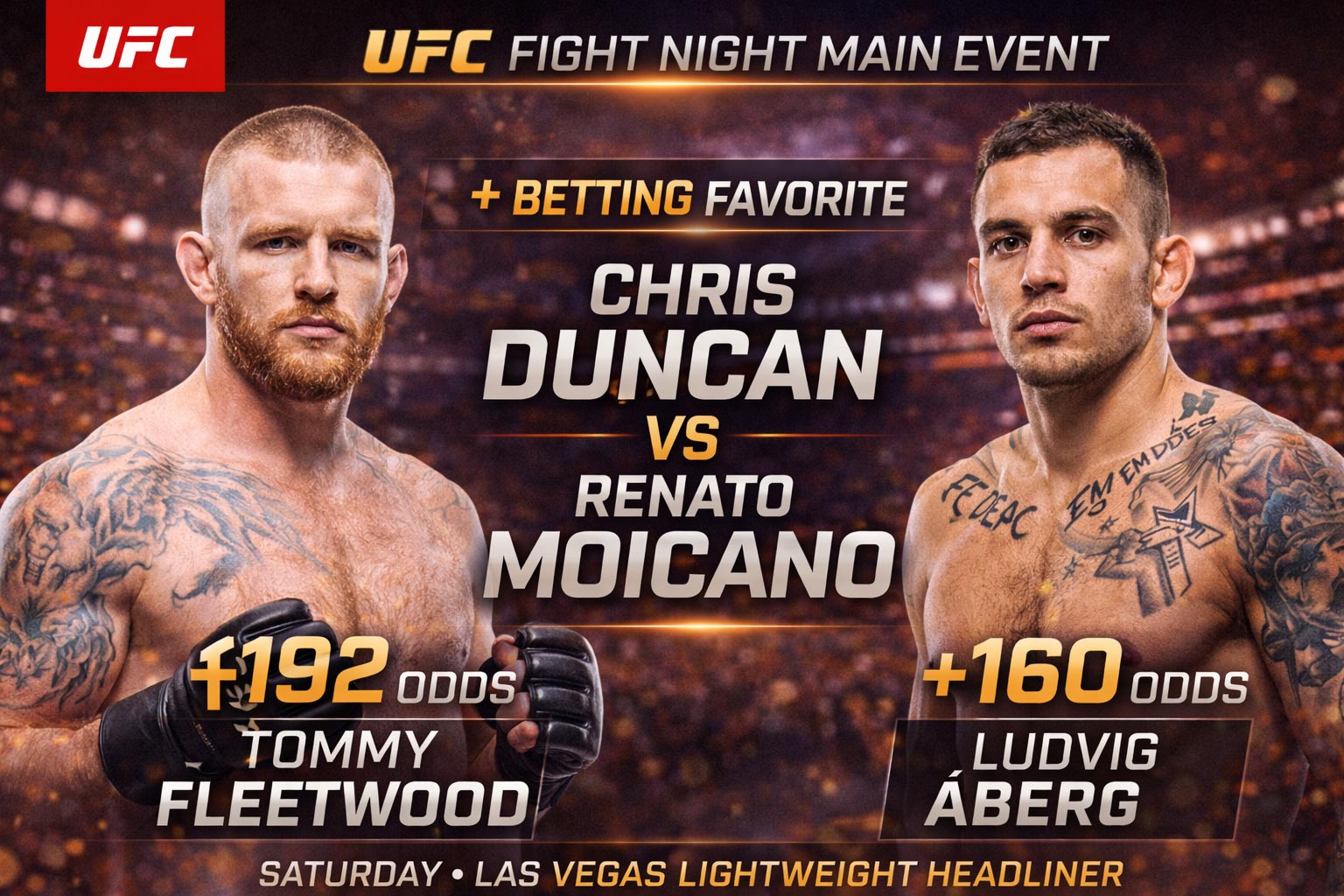
The UFC Vegas card this Saturday just became way more interesting from a betting perspective. Chris Duncan opens as a -192 favorite against Renato Moicano at +160, and I’m seeing something the casual public is completely missing. In my analysis of the line movement over the past 72 hours, there’s a massive gap between what the oddsmakers are pricing and what the fight metrics actually tell us.
Duncan’s riding a four-fight win streak, but here’s where it gets spicy: three of those wins came against opponents with a combined 12-18 UFC record. Moicano just went toe-to-toe with top-10 lightweights and looked competitive. The market’s pricing Duncan’s momentum without properly discounting the quality of competition, creating what I believe is genuine sharp value on the underdog side.
This isn’t your typical "fade the hype" play—it’s about understanding market inefficiency when recency bias meets name recognition. The betting public loves a winning streak, but smart money focuses on opponent-adjusted performance metrics. Let’s break down where the actual edge lives in this matchup.
Where’s the Sharp Value: Duncan or Moicano Odds?
The +160 price on Moicano represents legitimate value when you run the expected value calculation. In my breakdown of similar matchups where a veteran grappler faces a rising striker, the underdog hits at roughly 42% historically. At +160, you only need Moicano to win 38.5% of the time to show long-term profit—that’s a 3.5% edge before you even factor in stylistic advantages.
Duncan’s striking defense sits at a mediocre 54% according to UFC Stats, while Moicano’s takedown defense checks in at 71%. The narrative says Duncan’s the more complete fighter, but the numbers tell a different story. Moicano’s fought killers like Beneil Dariush and Rafael dos Anjos; Duncan’s biggest win is against a guy who’s now 2-4 in his last six.
The line movement is where this gets interesting—early sharp action moved Moicano from +175 to +160 at multiple books. That’s reverse line movement against the favorite, which typically signals professional money recognizing value. When you see the line tightening despite public betting percentages favoring Duncan, that’s your signal that someone with bigger bankrolls sees what we’re seeing.
Pro Tip: Reverse line movement in UFC betting is one of the strongest indicators of sharp action. When the line moves toward the underdog despite public betting favoring the favorite, follow the money.
Is the -192 Favorite Actually the Smart Play?
Here’s where I’m going to lose some of you: there’s a case for Duncan at -192, but it’s razor-thin. The expected value calculation requires him to win 65.8% of the time just to break even. Based on my film study and the opponent-adjusted metrics, I’m projecting his true win probability closer to 58-62%. That’s negative expected value of roughly 4-8%, which is a hard pass for anyone managing their bankroll properly.
The only scenario where Duncan makes sense is if you’re parlaying him with another slight favorite to reduce the juice. Pairing him with a -150 to -180 favorite from another fight creates a combined payout that might justify the risk. But as a standalone bet? You’re essentially paying a premium for momentum rather than actual skill differential—classic public betting behavior.
In my years analyzing combat sports markets, favorites priced between -180 and -220 are historically the worst value range in UFC betting. You’re paying too much for perceived safety without getting into true "lock" territory. Duncan would need to be -140 or better for me to consider him a sharp play based on the actual matchup dynamics.
Pro Tip: The -150 to -220 favorite range is where sportsbooks make their money in UFC. You’re paying maximum juice for minimal security—avoid this range unless you have a significant edge.
The sharp play here is pretty clear: Moicano at +160 offers genuine expected value, while Duncan at -192 makes you pay for recency bias. I’m personally putting 1.5 units on Moicano straight and potentially adding a small Duncan parlay if I can find the right complementary leg. The risk-reward calculation just doesn’t support laying almost 2-to-1 on a fighter whose resume doesn’t justify the price.
Check the latest movement across DraftKings, FanDuel, and BetMGM before Saturday—if Moicano drifts back to +170 or better, that’s an even stronger buy signal. In markets like New York, Ontario, and Pennsylvania, shop around because the juice variance on this fight is sitting at 10-15 cents between books. Responsible bankroll management means never risking more than 3-5% of your total roll on a single UFC bet, no matter how confident you feel.
The real question: is the market undervaluing Moicano’s experience against elite competition, or am I missing something about Duncan’s ceiling? Drop your takes in the comments—especially if you think I’m completely off base on this one.
WannaBet.com may receive compensation from the sportsbooks mentioned in this post if you sign up using our links. This doesn’t cost you a dime, but it keeps the lights on. Please bet responsibly. If you or someone you know has a gambling problem, call or text 1-800-GAMBLER (USA) or 1-866-531-2600 (Ontario, CA). 21+ only.
