

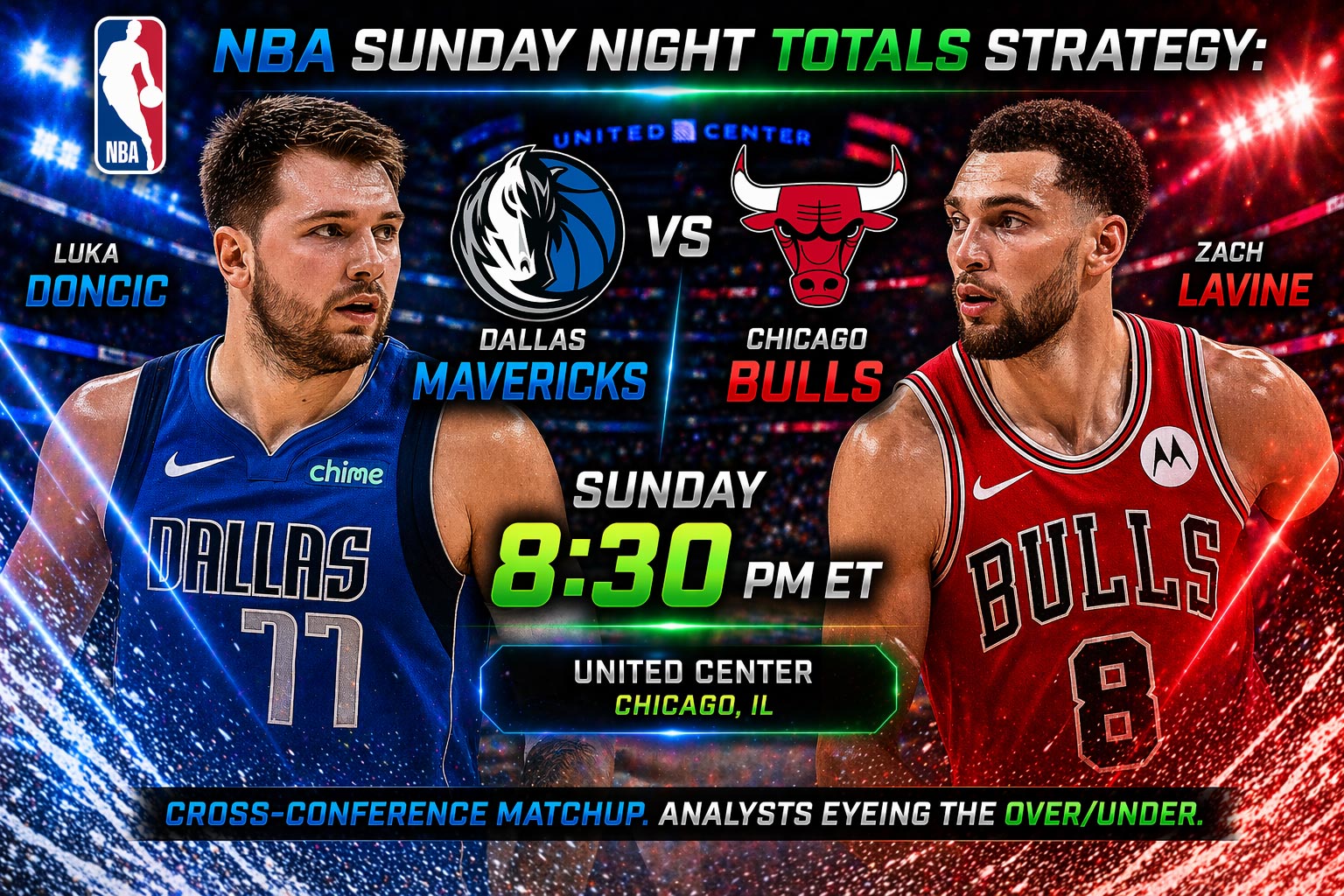
Sunday night NBA means one thing: sharps are hunting edges while the public’s still nursing their hangovers from NFL Sunday. The Mavericks-Bulls matchup at 8:30 PM ET isn’t getting the LeBron-level hype, but that’s exactly where the smart money finds its opportunities. While everyone’s arguing about whether Luka can cover a bloated spread, the real play is staring us in the face on the total—and it’s giving off serious "market inefficiency" vibes that would make my old econ professors proud.
Mavs-Bulls Total: Finding Sunday’s Sharp Edge
The books opened this total around 228.5, and here’s where it gets interesting: both teams are trending in opposite directions on pace metrics, but the public’s still betting like it’s December. Dallas ranks 7th in offensive rating over their last 10 games, averaging 118.2 points per game, while the Bulls are sitting at a respectable 112.4 despite their record suggesting they should be tanking. When you’ve got Luka Doncic running the show against a Chicago defense that’s 23rd in opponent three-point percentage, you’re looking at a recipe for offensive fireworks that the market hasn’t fully priced in.
Chicago’s home court advantage at the United Center isn’t the defensive fortress it used to be—they’re giving up 115.6 PPG at home this season, which is basically an open invitation for Dallas’s pick-and-roll game to feast. The Bulls’ strategy of playing faster to compensate for defensive lapses creates more possessions, which is exactly what we want when we’re eyeing the over. Think of it as market arbitrage: the spread reflects Dallas’s superiority, but the total hasn’t caught up to the game script reality that both teams will be running.
The real edge here is understanding game theory and incentive structures. Chicago has nothing to lose playing spoiler ball in front of their home crowd, which means they’re pushing pace and trading baskets rather than grinding out defensive possessions. Dallas, meanwhile, needs wins for playoff positioning and won’t pump the brakes just because they’re up 8. This isn’t a "let’s kill clock" scenario—it’s a track meet disguised as a basketball game, and the total is giving us better value than trying to lay points with a Mavs team that’s been inconsistent ATS.
Why the Over/Under Has More Value Than the Spread
Spreads are sexy, totals are smart—that’s the mantra when you’re hunting Sunday night edges in markets that haven’t adjusted for recent trends. The Mavs are currently sitting around -6.5 depending on where you’re shopping (shoutout to my Ontario crew who can line shop across multiple books now), but that number comes with heavy juice and recency bias. The public loves backing Luka, which inflates the spread and creates reverse line movement opportunities on totals that the casual bettor isn’t watching as closely.
Here’s the risk mitigation angle that separates the Harvard MBAs from the degenerates: spread betting on a Sunday night B-list game means you’re fighting garbage time, intentional fouls, and coaching decisions that have nothing to do with your bet. The total, conversely, benefits from all those late-game possessions and free throws that kill spread bettors. Every intentional foul in the final two minutes is adding to our total count while spread bettors are sweating whether Dallas can hold a 7-point lead.
The expected value calculation is pretty straightforward when you break down the matchup dynamics. Both teams rank in the top half of the league in pace, both have defensive vulnerabilities that smart offensive coordinators exploit, and neither has a strategic reason to slow the game down. When the market’s focused on "can Dallas cover?" instead of "will this game hit 230?", that’s where the sharp money finds its edge. This is Econ 101 meets sports betting: identify market inefficiencies, exploit information asymmetry, profit.
Let’s talk market psychology for a second because this is where it gets fun. The betting public in big markets like New York and Illinois tends to hammer spreads because they’re easier to understand and more emotionally satisfying—you’re picking a winner and getting points. Totals require you to divorce yourself from rooting interest and think purely about game flow, possessions, and efficiency metrics. That creates a knowledge gap we can exploit, especially on Sunday nights when the sharps are active but the public’s attention is divided.
The line movement tells a story if you know how to read it. When totals move half a point or less despite heavy betting volume, that’s the books trying to balance action while protecting themselves from sharp money. If this total creeps toward 229.5 or 230 by game time, that’s actually confirmation that the smart money is already on the over—the books aren’t moving it because they’re getting balanced action from squares on the under. It’s like watching a poker tell in real-time, except the casino is showing you their hand if you’re paying attention.
Finally, let’s address the elephant in the room: player props versus totals. While everyone’s salivating over Luka’s points prop (probably set around 32.5), the total gives you diversification across all scoring sources. You’re not relying on one guy having a monster night—you’re betting on offensive efficiency and pace, which is inherently less volatile. That’s portfolio theory applied to sports betting, and it’s why totals often provide better risk-adjusted returns than trying to predict individual performances in a game where variance is king.
Sunday night totals are where the smart money separates from the public noise, and this Mavs-Bulls matchup is serving up exactly the kind of market inefficiency that makes betting profitable instead of just entertaining. While the squares are debating whether Dallas can cover a spread that’s juiced to hell, we’re looking at game flow, pace metrics, and defensive vulnerabilities that point toward an over with legitimate edge. The beauty of totals betting is that you’re playing the math instead of the narrative—and in a market dominated by Luka fanboys and Bulls fans with misplaced loyalty, that’s where your Harvard-level analysis actually means something.
What’s your take—are you riding the over with me, or do you see something in the under that I’m missing? Drop your reasoning in the comments because I’m always down to debate strategy with people who actually understand expected value.
WannaBet.com may receive compensation from the sportsbooks mentioned in this post if you sign up using our links. This doesn’t cost you a dime, but it keeps the lights on. Please bet responsibly. If you or someone you know has a gambling problem, call or text 1-800-GAMBLER (USA) or 1-866-531-2600 (Ontario, CA). 21+ only.
