

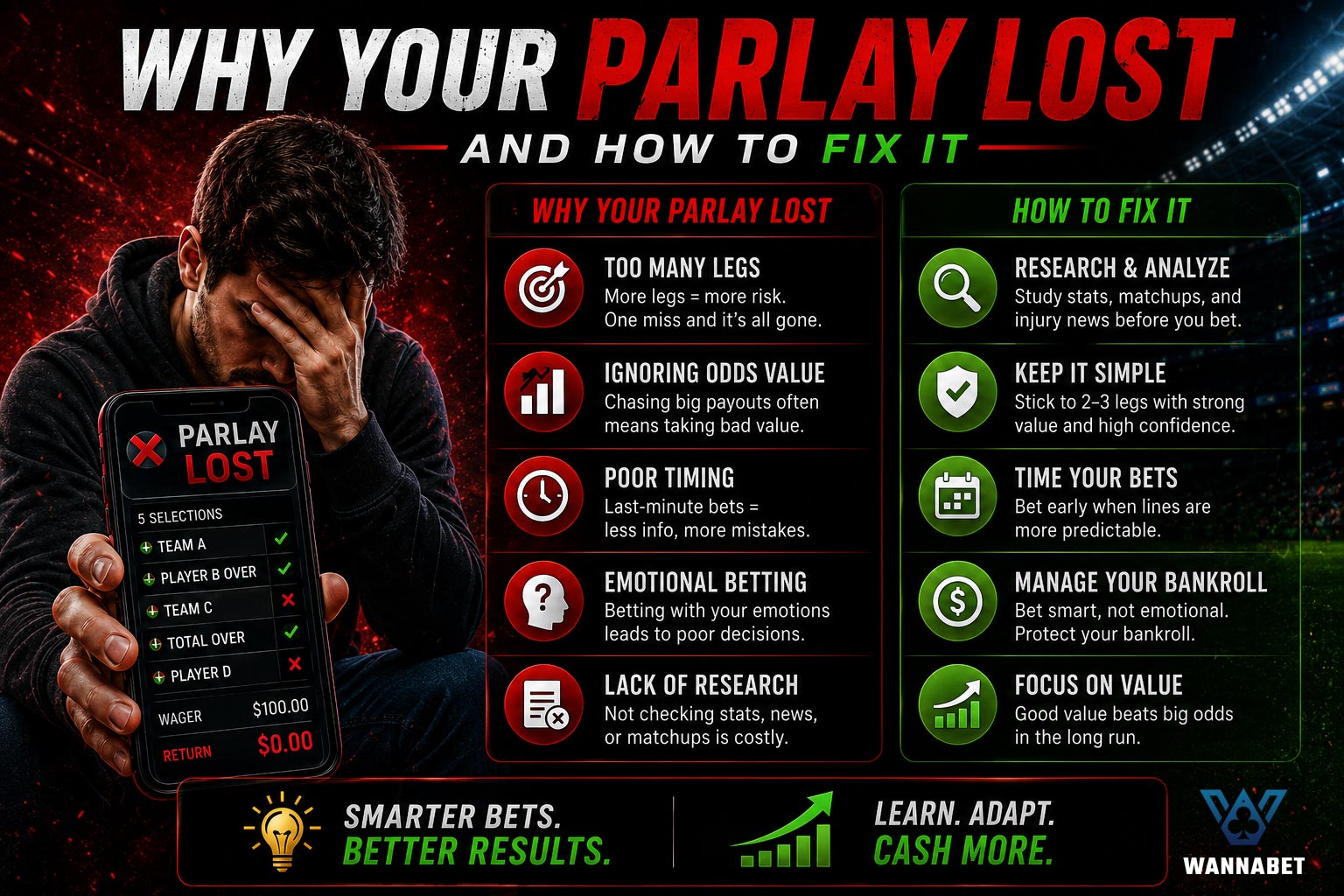
That 6-leg parlay you built last Saturday? The one where you had Warriors -4.5, over 6.5 goals in the Leafs game, and four other "absolute locks" that were supposed to turn your $50 into $1,847? Yeah, it died in the third leg when the Bucks inexplicably decided to forget how to play basketball in the fourth quarter. I’ve watched thousands of these things implode—both my own and the degenerates who’d slip me cash between Econ lectures—and here’s the brutal truth: your parlay didn’t lose because of bad luck. It lost because you fundamentally misunderstood what you were building. The math wasn’t mathing, the edges weren’t edging, and you stacked correlation risk like you were trying to speedrun bankruptcy. But here’s the good news: once you understand the actual framework behind +EV parlay construction, you can stop lighting money on fire and start building slips that have a legitimate shot at cashing.
Why Your 6-Leg Bricked (A Postmortem)
You treated independent probabilities like they were a group project where everyone pulls their weight. Spoiler alert: they don’t. When you stack six different bets together—say, an NFL spread, an NBA total, an NHL moneyline, a tennis match winner, a UFC pick, and an MLB run line—you’re multiplying failure points, not adding them. Each leg might have a 55% hit rate individually (if you’re sharp), but together? That’s 0.55^6, which gives you about an 8.5% chance of actually cashing. The sportsbooks aren’t idiots; they’re giving you those juicy +1500 odds precisely because the math works overwhelmingly in their favor.
The second reason your parlay bricked is correlation bias, and this one’s sneaky. You probably threw together legs that feel independent but actually aren’t. Example: you take Lakers -5.5 and the over 225.5 in the same game. If the Lakers are covering by 6+, there’s a decent chance they’re doing it in a high-scoring environment—but what if it’s a defensive slugfest where they win 98-92? Now both legs are cooked. Or you parlayed Chiefs -7 with Mahomes over 1.5 passing TDs—if Kansas City is covering, Patrick’s probably throwing TDs, but if they’re running out the clock with a ground game, you’re toast on both ends. The market prices these correlations in; you’re just paying for the privilege of not noticing.
The third killer—and this is where most people completely lose the plot—is juice accumulation. Every single leg of your parlay is priced at -110 (or worse), meaning you’re laying 10% vig per bet. When you compound that across six legs, you’re essentially paying a 60% tax on your action before the first whistle even blows. Sportsbooks in New York and New Jersey are printing money off this exact phenomenon. Meanwhile, you could’ve taken those same six picks as straight bets, gone 4-2 (a realistic outcome for a decent handicapper), and walked away with profit instead of a goose egg.
The EV Framework That Actually Wins Parlays
If you’re going to parlay—and look, I’m not your dad, I did this for a living—you need to think about edge stacking, not leg stacking. The only time a parlay makes mathematical sense is when you’ve identified genuine +EV spots on individual legs and you’re using the parlay structure to amplify that edge. This means you’re not just grabbing random "locks" from Twitter; you’re finding market inefficiencies where the book’s line is legitimately off. In Ontario’s regulated market, this might be a player prop that hasn’t adjusted for a recent lineup change, or an NHL puck line where public money has pushed the favorite too far.
The framework is simple: calculate your edge on each leg, then determine if combining them actually multiplies your advantage or just your risk. Let’s say you’ve got three bets where you’ve done the work—studied the injury reports, tracked the line movement, analyzed the matchup data—and you genuinely believe each has a 60% chance of hitting despite being priced at 55%. That’s a real edge. A three-leg parlay with those picks gives you roughly 21.6% chance to hit (0.6^3), and if you’re getting +600 odds, that’s actually +EV math. But the second you throw in a random fourth leg because "it feels right," you’ve diluted the entire thesis.
Here’s the play: limit your parlays to 2-3 legs max, focus on uncorrelated markets (different sports, different game times, different bet types), and only include legs where you’ve identified a genuine information advantage. In Pennsylvania and Illinois, where the market’s deep and liquid, look for spots where sharp money hasn’t moved the line yet—early week NFL totals, overnight NBA player props, or F1 qualifying matchups before the public weighs in. And for the love of God, use parlay insurance promos strategically; books like FanDuel and DraftKings in Ohio and New Jersey constantly offer "one leg refund" deals that literally reduce your downside risk for free. That’s not gambling, that’s arbitrage with extra steps.
The difference between my dorm room bookie operation making five figures a month and going bust wasn’t luck—it was understanding that every bet is either +EV or -EV, and parlays are just multiplication tables for whichever one you’re playing. Most bettors treat parlays like lottery tickets: throw stuff at the wall, pray it sticks, and blame variance when it doesn’t. But if you approach them like a portfolio allocation problem—where each leg represents a calculated edge in an uncorrelated market—you can actually build slips that have mathematical merit instead of just vibes. Will you hit every one? Hell no. But you’ll stop bleeding money on six-leggers that were dead on arrival, and you might actually cash enough to make it worth your time. So here’s my question for you: what’s the dumbest leg you’ve ever thrown into a parlay just because you "needed one more" to hit a certain payout? Drop it in the comments—I guarantee someone’s done worse.
"WannaBet.com may receive compensation from the sportsbooks mentioned in this post if you sign up using our links. This doesn’t cost you a dime, but it keeps the lights on. Please bet responsibly. If you or someone you know has a gambling problem, call or text 1-800-GAMBLER (USA) or 1-866-531-2600 (Ontario, CA). 21+ only."
