

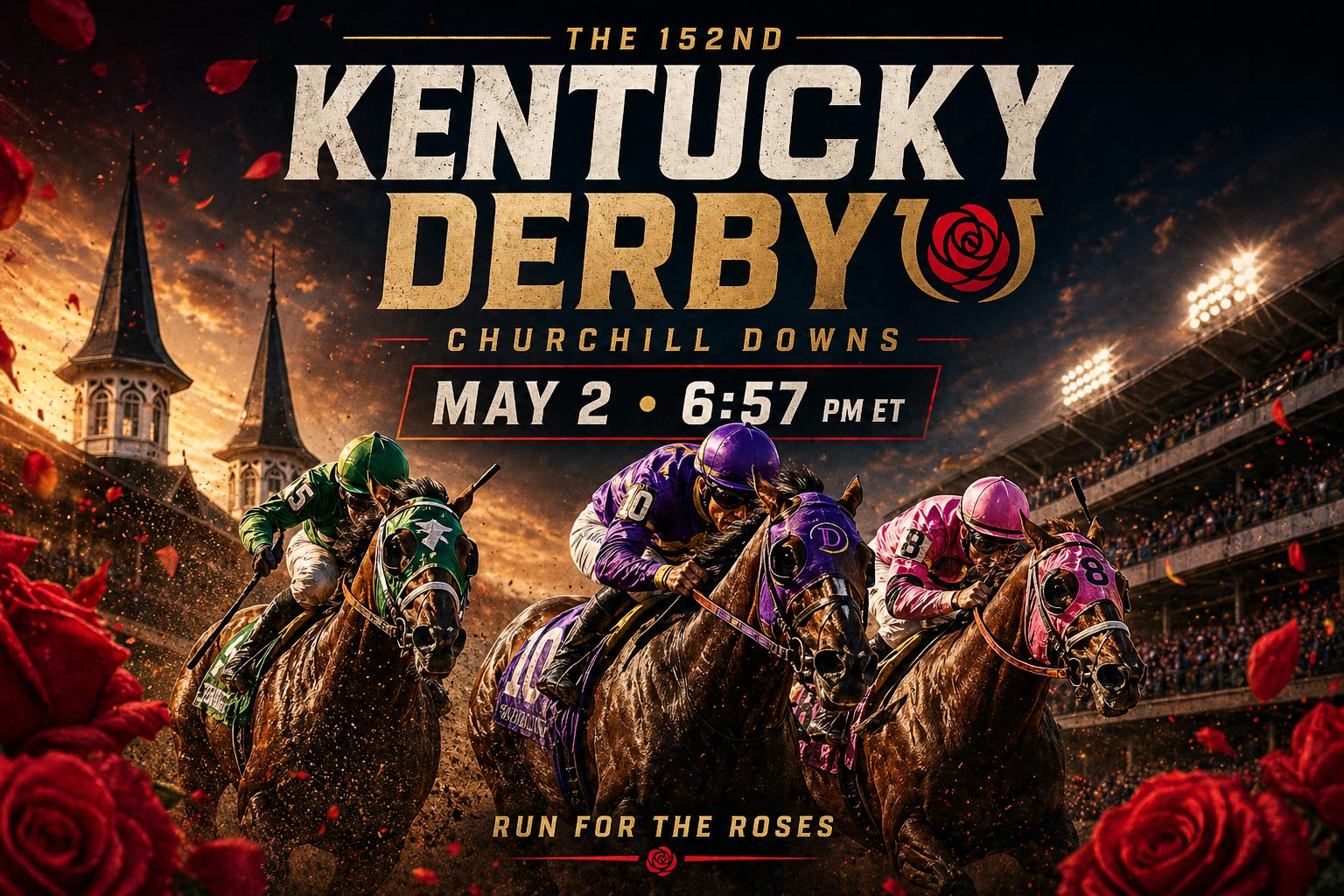
The 152nd Kentucky Derby goes off at 6:57 PM ET on May 2nd at Churchill Downs, and the betting public is about to light money on fire backing Renegade at 4-1. I’ve seen this movie before—hell, I’ve probably taken the other side of this exact bet in three different Derby iterations. The favorite in horse racing’s biggest event is basically a tax on people who think they’re being conservative, and this year is no exception.
Here’s the thing about the Derby that casual bettors never grasp: it’s a 20-horse demolition derby where chaos compounds exponentially, not a two-team playoff game where talent wins out. The expected value on favorites in this race historically craters because the public treats it like an NFL Sunday when it’s actually closer to March Madness Final Four-level variance. I’m fading Renegade harder than I faded my 8 AM accounting lectures junior year, and I’m looking at mid-tier value that actually has mathematical merit.
Why Renegade is a Mispriced Favorite at 4-1
The market has priced Renegade like he’s Secretariat 2.0, but the underlying data tells a completely different story. His Beyer Speed Figures are solid—not elite—and he’s yet to prove himself in a full 1.25-mile race against this caliber of competition. The public sees his Derby prep wins and assumes linear progression, which is the same logical fallacy that makes people think their parlay is "due" after five legs hit.
What really concerns me is the post position and pace dynamics. Renegade drew post 15, which means his jockey has to make an immediate decision: burn energy to get position or get shuffled back into traffic hell. Neither scenario optimizes his running style, which relies on stalking the pace and making one sustained move. The expected value calculation here is brutal—you’re getting 4-1 on a horse that probably has closer to 6-1 or 7-1 true odds when you factor in trip handicapping.
The final nail in the coffin? The Kentucky Derby favorite has won exactly 7 times in the last 30 years—a 23% hit rate. At 4-1 odds, you need a 20% probability just to break even, and that’s before we account for the specific vulnerabilities I just outlined. This is textbook market inefficiency driven by casual money flooding in on name recognition and recency bias. Sharp bettors aren’t touching this number, and neither should you.
The Mid-Tier Value Play That Actually Makes Sense
Chief Wallabee at 8-1 is where I’m parking serious money, and it’s not even close. This horse has been systematically undervalued because he doesn’t have the flashy Derby prep narrative—he didn’t win the Florida Derby or the Santa Anita Derby, so the public yawns. But his consistency metrics are off the charts, and he’s shown legitimate ability to handle the distance with a closing kick that thrives in chaotic pace scenarios.
The pace setup for this Derby is absolutely nuclear, with at least four confirmed speed horses going gate-to-wire. That early burn rate creates the exact conditions where a closer like Chief Wallabee can sit mid-pack, save ground, and explode in the stretch when the speed horses are gassed. It’s basic game theory—you want to be optimally positioned when others are making forced errors. His trainer also has a 22% win rate with closers at Churchill Downs over the past five years, which is an edge the betting market has completely ignored.
The Puma at 10-1 is my secondary play for pure upside exposure. He’s got the pedigree for the distance (his sire won the Belmont), a favorable post position at 8, and he’s training lights-out leading into the race. The knock on him is consistency, which is fair—but in a 20-horse field where variance dominates, I’ll take the horse with 90th percentile ceiling over the one with a 60th percentile floor every single time. This is portfolio theory applied to horse racing: diversify your exposure across uncorrelated outcomes with asymmetric upside.
Look, I’m not saying Renegade can’t win—stranger things have happened at Churchill Downs. But betting favorites in the Kentucky Derby is the same energy as buying index funds at all-time highs and expecting 40% returns. The math doesn’t support the hype, and sharp money knows it. Chief Wallabee gives you legitimate closing speed at a price that accounts for variance, while The Puma is your lottery ticket with actual statistical merit behind it.
The Derby is the one race per year where recreational bettors in New York, New Jersey, and Ontario flood the pools with emotional money, creating genuine market inefficiencies for those who know where to look. Don’t be the person who brags about betting the favorite and finishing fourth. Be the person who cashes an 8-1 ticket and buys the next round.
What’s your Derby play—are you fading Renegade with me or riding the chalk? Drop your picks in the comments, because I want receipts when Chief Wallabee hits the wire first.
"WannaBet.com may receive compensation from the sportsbooks mentioned in this post if you sign up using our links. This doesn’t cost you a dime, but it keeps the lights on. Please bet responsibly. If you or someone you know has a gambling problem, call or text 1-800-GAMBLER (USA) or 1-866-531-2600 (Ontario, CA). 21+ only."
