

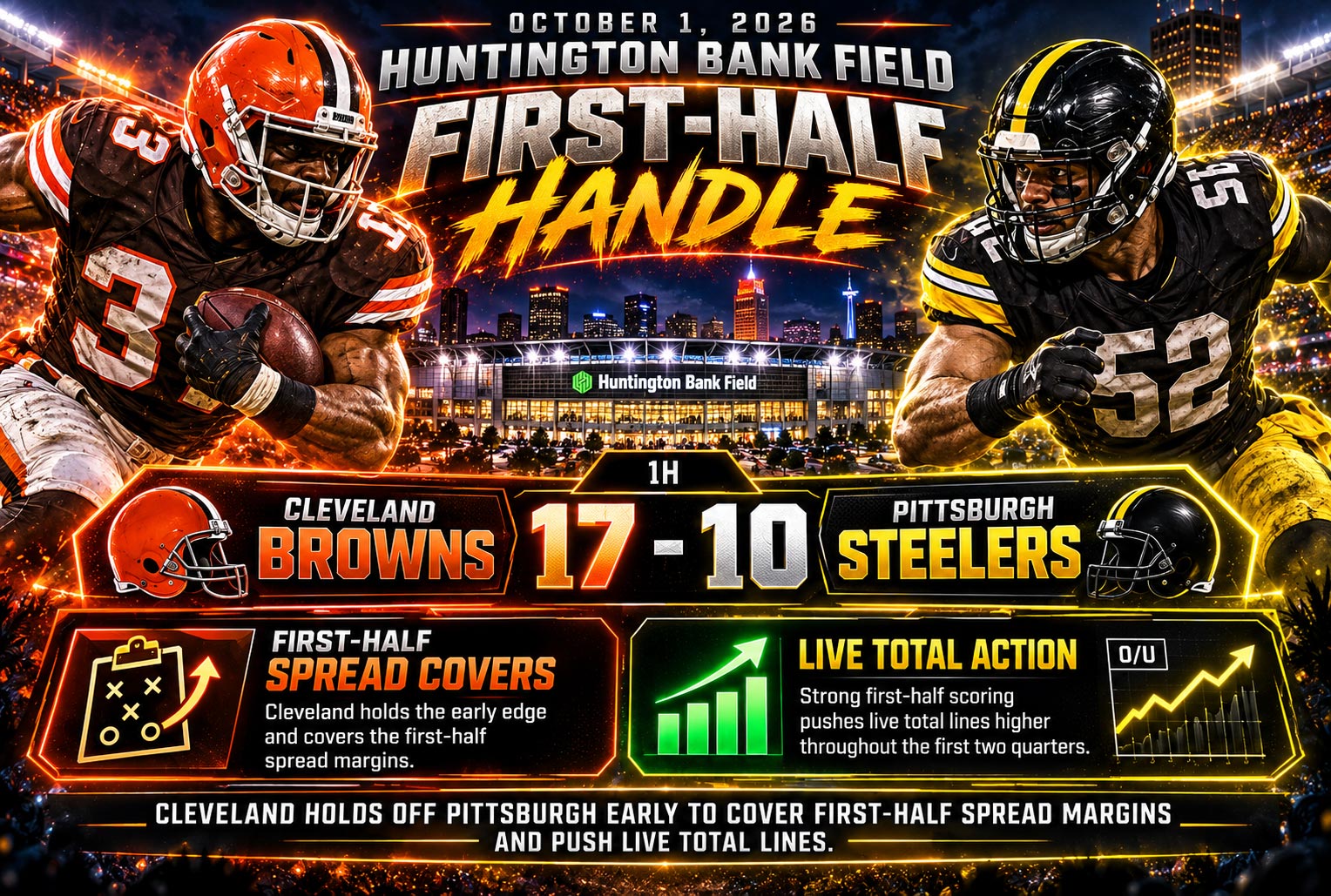
The AFC North rivalry just delivered again, and if you had Cleveland covering the first-half spread at Huntington Bank Field on October 1st, you’re probably still riding that high. The Browns came out swinging against Pittsburgh in front of their home crowd, building enough of a cushion early to cash tickets and mess with live total projections across every major book from DraftKings to BetMGM. This wasn’t some fluke backdoor cover either—Cleveland controlled tempo, won the possession battle, and made the Steelers look pedestrian in a half where sharp money clearly knew something the public didn’t. Let’s break down how the first-half handle played out and what separated the winners from the “I almost took that” crowd.
Browns Cash First-Half Ticket at Huntington Bank
Cleveland’s first-half performance against Pittsburgh was textbook “bet the home team in a divisional rivalry when the line feels too generous” energy. The Browns entered halftime with enough breathing room to cover most first-half spreads that hovered around -2.5 to -3, depending on when you got down. Books in Ohio—where this game mattered most for handle volume—saw heavy action on Cleveland’s first-half line, and the home squad delivered with what looked like a well-scripted opening 30 minutes.
The key here wasn’t just that Cleveland scored—it’s how they controlled the game flow. Time of possession tilted heavily toward the Browns, which kept Pittsburgh’s offense off the field and limited their ability to answer back. When you’re betting first-half spreads, TOP is your best friend because it directly correlates to scoring opportunities and keeps the opposition from executing their game plan. Cleveland’s offensive coordinator clearly had a script ready, and they executed it like they’d been running this simulation all week.
From a market psychology standpoint, this was also a classic case of public fade potential. Steelers bettors—and there are always Steelers bettors—likely overvalued Pittsburgh’s road pedigree in this rivalry, ignoring that Cleveland’s home splits and first-half ATS trends this season were screaming value. The books set a line that looked competitive on paper, but anyone tracking Cleveland’s early-game efficiency knew the number was soft. That’s the edge sharp money exploits: finding spots where public perception lags behind actual performance data.
Cleveland’s Early Edge: What the Sharp Money Saw
Sharp bettors don’t just wake up and randomly hammer first-half spreads—they’re working off information asymmetry and pattern recognition that casual bettors miss. In this matchup, the smart money identified three key factors: Cleveland’s offensive line health, Pittsburgh’s slow-start tendencies on the road, and the emotional amplifier of a home divisional game in October. Those three variables created a scenario where the first-half line offered legitimate expected value, especially if you could grab Browns -2.5 before the sharps moved it to -3.
Let’s talk matchup dynamics for a second. Pittsburgh’s defensive front has been vulnerable to power-run schemes early in games this season, and Cleveland’s rushing attack—when they commit to it—can absolutely bully opponents into submission. The Browns came out running the ball down the Steelers’ throats, establishing play-action opportunities and keeping Pittsburgh’s pass rush honest. This isn’t rocket science; it’s basic game theory: force your opponent to defend their weakness while you attack from your position of strength. The first-half spread was essentially betting that Cleveland’s coaching staff understood this better than Pittsburgh’s defensive coordinator could adjust on the fly.
The live total movement during the first half also told a story. Books initially set the first-half total around 23.5, but once Cleveland started controlling possession and the pace slowed down, live totals dropped into the high teens. If you were tracking this in real-time—which anyone serious about live betting should be—you could see the under becoming playable as the Browns methodically chewed clock. This is where the Harvard MBA brain kicks in: you’re not just betting on outcomes, you’re arbitraging information flow and exploiting the lag between what’s happening on the field and how quickly books adjust their live lines. Cleveland’s first-half dominance created multiple betting windows for anyone paying attention.
The Browns’ first-half cover against Pittsburgh wasn’t just a win for Cleveland backers—it was a masterclass in identifying market inefficiencies and understanding what drives value in divisional matchups. If you were sharp enough to recognize Cleveland’s early-game advantages and got down before the line moved, you cashed a ticket that felt inevitable by the time halftime hit. The lesson here isn’t just about this specific game; it’s about developing the framework to spot these opportunities consistently. Are you tracking first-half ATS trends and home/road splits for divisional games, or are you still betting based on vibes and brand names? Drop your thoughts in the comments—did you catch this cover, or are you kicking yourself for overthinking it?
Related reading: See how the full game played out in our recap of Cleveland’s 27-24 win.
WannaBet.com may receive compensation from the sportsbooks mentioned in this post if you sign up using our links. This doesn’t cost you a dime, but it keeps the lights on. Please bet responsibly. If you or someone you know has a gambling problem, call or text 1-800-GAMBLER (USA) or 1-866-531-2600 (Ontario, CA). 21+ only.

One comment on "Browns Cover First Half Against Steelers at Home"