

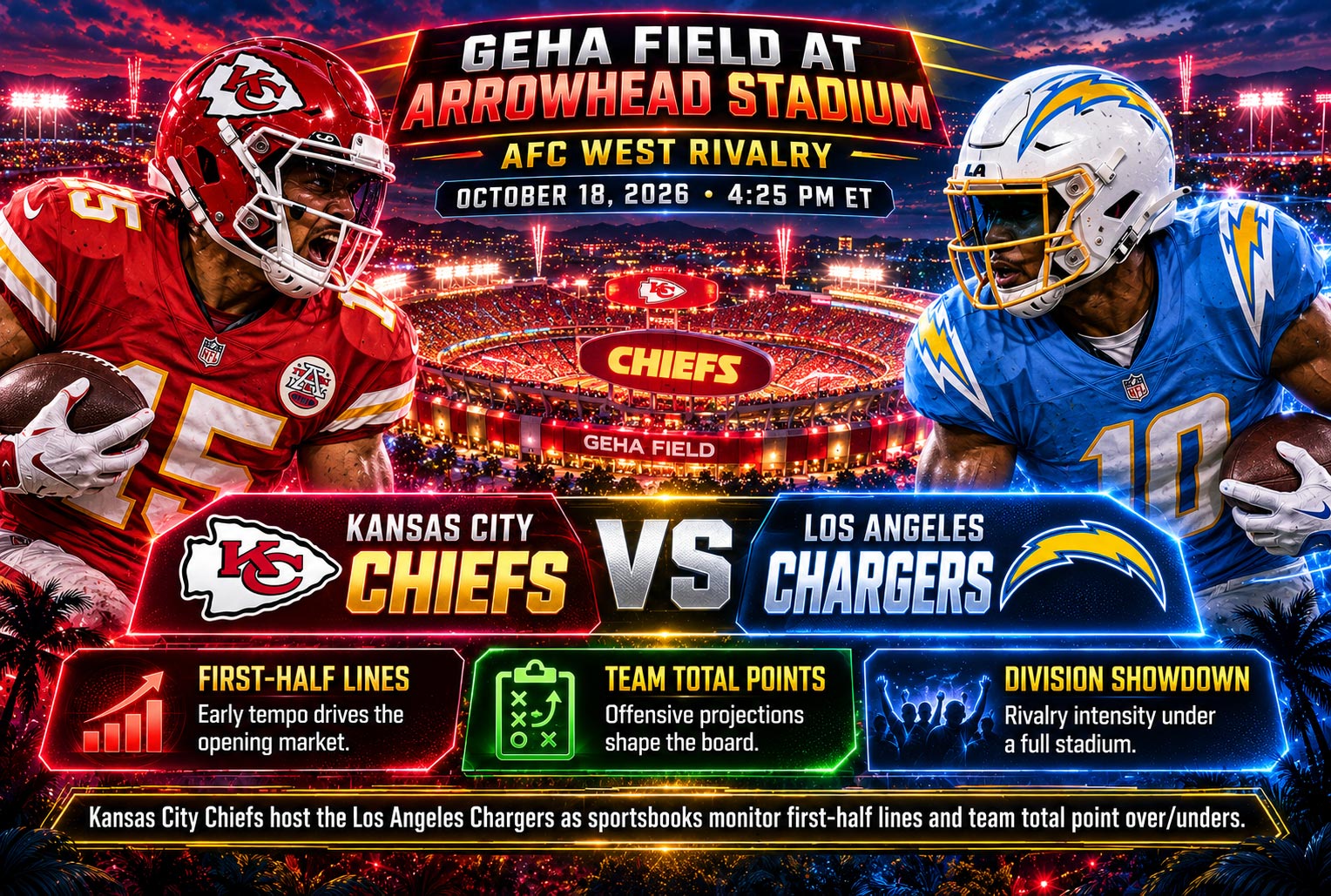
The AFC West is still a bloodbath, and when the Chiefs host the Chargers at Arrowhead on October 18th, the sharpest play might not be picking a full-game winner—it’s targeting the first half. Patrick Mahomes and Justin Herbert have given us some absolute barn burners over the years, but the real edge in this rivalry comes from understanding how these teams script their opening drives and adjust at halftime. I’m breaking down why the first 30 minutes of this divisional slugfest offer better expected value than trying to predict what happens after Jim Harbaugh and Andy Reid make their adjustments.
Chiefs vs Chargers First Half Betting Analysis
The opening line for this game has Kansas City favored by around 4.5 points for the full game, but the first-half spread typically sits at -2.5 to -3 for the home team. That’s where market inefficiency creeps in—the public loves hammering full-game spreads without considering how dramatically these coaches adjust after halftime. Andy Reid is notorious for scripting his first 15 plays with surgical precision, while Harbaugh’s defensive schemes tend to tighten up significantly after he’s seen what the opposing offense is showing.
The first-half over/under usually hovers around 23.5 to 24.5 points for this matchup, which historically has been a goldmine for under bettors in divisional games. When you look at the last six Chiefs-Chargers meetings, four of them have gone under the first-half total, with an average of just 21.3 points scored before the break. These teams know each other too well—it takes a quarter for offenses to find the soft spots in familiar defensive schemes.
Here’s the key trend that Vegas is banking on you ignoring: the Chiefs have been strong ATS in first halves at home, but that edge fades in second halves. The market has overcorrected for Kansas City’s full-game dominance without accounting for how conservative Reid gets with a lead. If you’re laying juice on KC for 60 minutes, you’re paying a premium for second-half clock management that doesn’t cover spreads.
Why the Opening 30 Minutes Hold Value
First-half betting eliminates the variance that comes with garbage time, prevent defense, and coaching staffs playing for field position rather than points. When you’re betting Chargers +3 for the first half, you’re getting Herbert at his freshest, before the Kansas City pass rush has worn down the offensive line. The Chargers’ offense has been money in opening quarters this year—they’re averaging 7.2 points in the first quarter alone, which ranks fourth in the NFL.
The other massive edge here is removing special teams chaos from the equation. Late-game onside kicks, punt return touchdowns, and field goal attempts from desperate situations can swing full-game spreads by multiple points. First-half betting strips out that noise and focuses purely on offensive execution and defensive game-planning. For a matchup between two elite quarterbacks, that’s exactly where you want your exposure.
From a risk mitigation standpoint, first-half wagers also give you the option to hedge or middle during halftime. If you take Chiefs -2.5 first half and they’re up 17-7 at the break, you can grab Chargers +7.5 for the full game and create a middle opportunity. The liquidity in live betting markets for primetime games like this is insane—books in New York and Ontario are practically begging you to take their halftime lines.
The Plays
First Half Spread: Chiefs -2.5 (-110)
Mahomes at home in a scripted game plan is about as close to a lock as you’ll find. Reid’s opening script has been elite all season, and the Chargers’ defense tends to bend early before adjusting.
First Half Under 24.5 (-108)
Divisional familiarity + elite defensive coordinators = conservative football. Both Steve Spagnuolo and the Chargers’ DC know these offenses inside out. Expect a feeling-out process in Q1.
First Half Team Total: Chiefs Over 13.5 (-115)
Kansas City has hit this number in 8 of their last 10 home games. Even if the Chargers keep it close, Mahomes is getting his points before halftime.
The Strategy
The market psychology here is fascinating—casual bettors see “Chiefs vs Chargers” and immediately think shootout because of the quarterback names. That public perception inflates totals across the board, creating value on strategic unders. The sharp money knows that October football in the AFC West is about possession control and field position, not fantasy football box scores.
Your edge comes from understanding that sportsbooks price first-half lines based on full-game projections, then simply cut them in half with slight adjustments. They’re not accounting for the dramatic difference in coaching philosophy between halves. Reid is aggressive early, conservative late. Harbaugh is the opposite—he makes his money in second-half adjustments.
If you’re playing this game in regulated markets like Pennsylvania or Illinois, shop your lines across multiple books. The difference between -2.5 and -3 on a first-half spread is massive—that half-point could be the difference between a push and a loss. DraftKings and FanDuel often have slightly different first-half totals for the same game, so having accounts at both gives you arbitrage opportunities.
Market Inefficiencies to Exploit
The biggest market inefficiency in Chiefs home games is the overreaction to their second-half comebacks. Kansas City’s history of second-half comebacks has conditioned the public to think they’re always a safe full-game bet. That narrative is baked into the full-game spread, but it actually creates value on first-half Chargers positions.
Another edge: weather and time of day. This is a 4:25 PM ET kickoff at Arrowhead in mid-October, which means potential wind and temperature drops as the game progresses. First-half conditions are almost always more favorable for passing offenses, which is why you’ll see scoring decline in Q3 and Q4. The books don’t adjust first-half totals enough to account for this.
The last piece is injury information and its delayed impact on lines. If there’s any questionable status for key players—say, a Chiefs offensive lineman or Chargers edge rusher—the first-half lines move slower than full-game spreads. You can catch value in the 24-48 hours before kickoff if you’re monitoring injury reports from beat writers in Kansas City and Los Angeles.
Advanced Metrics That Matter
Expected points added (EPA) per drive in first quarters tells the whole story: the Chiefs rank second in the NFL at +0.31 EPA/drive in Q1, while the Chargers sit at +0.18. That gap widens at home, where Mahomes has a ridiculous +0.42 EPA/drive in opening quarters at Arrowhead. The market hasn’t fully priced in Kansas City’s early-game dominance.
Defensive success rate in the first half also favors the under. The Chargers allow completions on just 58.4% of passes in first halves this season, compared to 64.1% in second halves. That’s Harbaugh’s defensive scheme working exactly as designed—disguise coverages early, then simplify and execute late. If you’re betting the first-half under, you’re getting the Chargers’ defense at its peak effectiveness.
Time of possession is the final metric casual bettors ignore. The Chiefs average 16:42 of possession in first halves at home, which limits the number of drives both teams get. Fewer possessions = lower variance = more predictable scoring outcomes. That’s exactly the environment where sharp money finds edges on unders and small spreads.
The Chiefs-Chargers rivalry is must-watch television, but the smartest money isn’t watching the whole game—it’s cashing tickets at halftime. First-half betting in divisional matchups eliminates the noise, targets the highest-leverage possessions, and exploits market inefficiencies that casual bettors ignore. Whether you’re in New Jersey hammering FanDuel or in Ontario riding the Bet365 app, the edge is in the opening 30 minutes. So here’s my question for the comments: are you riding the Chiefs first-half spread, or do you think Harbaugh’s game plan keeps this close through two quarters?
“WannaBet.com may receive compensation from the sportsbooks mentioned in this post if you sign up using our links. This doesn’t cost you a dime, but it keeps the lights on. Please bet responsibly. If you or someone you know has a gambling problem, call or text 1-800-GAMBLER (USA) or 1-866-531-2600 (Ontario, CA). 21+ only.”
