

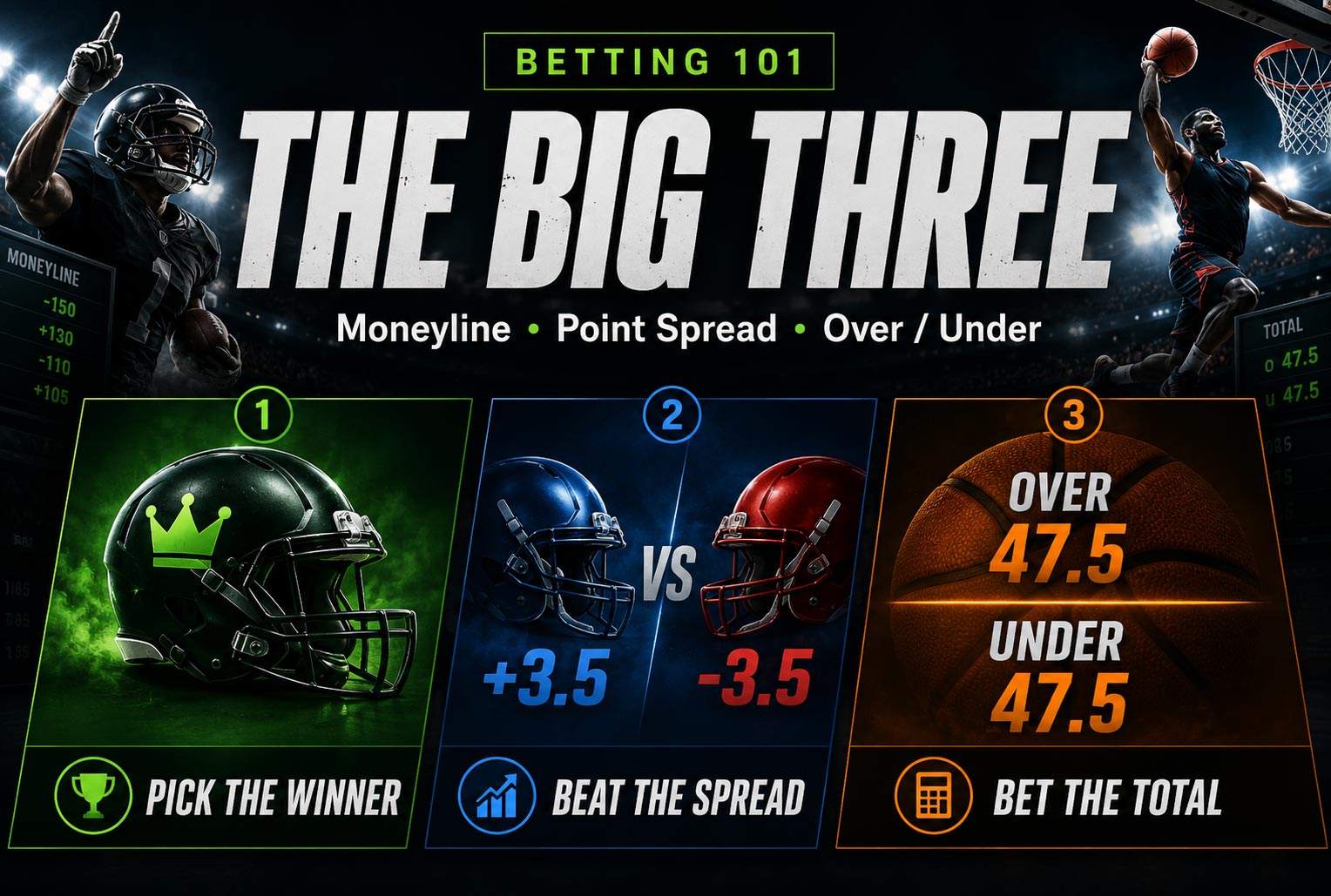
Your buddy just texted you a screenshot of his five-leg parlay that’s going to "definitely hit" this weekend. He’s risking $50 to win $2,400 on a combination of bets he doesn’t actually understand—he just knows the Knicks are playing and Patrick Mahomes exists. Here’s the thing: before you start building these Frankenstein parlays or chasing last-minute prop bets because some Twitter account with a cartoon avatar told you to, you need to understand the foundational bet types that actually make up 90% of sports wagering volume. I’m talking about moneylines, point spreads, and over/unders—the holy trinity of sports betting that separates people who occasionally win money from people who fund their bookie’s summer house in the Hamptons. Master these three, and you’ll at least understand how you’re losing money, which is honestly half the battle.
Why Your Broke Friends Keep Losing Money
They’re placing bets they literally cannot define. I’ve watched grown men confidently hammer a -7.5 spread without knowing whether they need their team to win by 7 or 8 points (it’s 8, by the way—you need to cover the spread, not just touch it). This isn’t Monopoly money we’re talking about; these are real dollars getting torched because people treat sportsbooks like scratch-off lottery tickets instead of markets with actual mechanics. The house edge exists specifically because books know the average bettor won’t spend fifteen minutes learning what "juice" means or why a -110 line isn’t the same as even money.
Your friends are also chasing dopamine instead of expected value. They’d rather bet a six-team parlay at +4000 odds because it "feels" like they’re getting a deal, when in reality they’re giving the sportsbook a 30%+ edge on that action. Compare that to a straight bet on a point spread where the house edge typically sits around 4.5%—it’s not even close. The books want you confused, clicking buttons, riding vibes instead of doing basic risk assessment that any halfway decent finance class would teach you in week one.
Here’s the brutal truth: most people lose because they’re operating without a framework. They don’t know what bet type matches their thesis on a game, so they just pick whatever looks cool in the app. You think the Leafs are going to dominate the Senators but you’re not sure they’ll win by multiple goals? There’s a specific bet for that (moneyline). You think Lakers-Nuggets is going to be a shootout? Different bet (over/under). Matching your market read to the right bet type is literally Risk Management 101, but everyone skips the manual and wonders why their bankroll looks like a bear market.
The Three Bets That Separate Sharps from Suckers
The Moneyline: Betting Straight Winners
The moneyline is the simplest bet in existence—you’re just picking who wins the game, straight up. No points, no totals, just "Team A beats Team B" and you either collect or you don’t. The catch is that odds reflect the probability of each outcome, so betting the favorite means risking more to win less (you might bet $180 to win $100 on a -180 favorite), while taking the underdog offers bigger payouts but lower win probability (+160 means you win $160 on a $100 bet).
This is your go-to when the spread feels like a coin flip but you’ve got conviction on a winner. Say the Rangers are playing the Coyotes and New York is -240 on the moneyline but -1.5 on the puck line—if you think the Rangers win but it might be a tight 3-2 game, you take the moneyline and eat the juice rather than sweat whether they cover the spread. The key is understanding implied probability: a -240 line implies about a 70.6% chance of winning, so ask yourself if you genuinely believe that team wins 7 out of 10 times in that spot.
Moneylines dominate MLB betting because baseball is lower-scoring and spreads (run lines) are almost always fixed at 1.5. You’ll see Yankees -150 vs. Red Sox +130 way more often than spread action, and that’s by design—the market has decided that picking a winner is more efficient than trying to predict margin. In hockey, basketball, and football, moneylines matter most when there’s a massive talent gap or when you’re hedging other positions in your portfolio.
The Point Spread: Leveling the Playing Field
The spread is where sportsbooks turn a mismatch into a competitive betting market by giving the underdog a head start. If the Bills are 10-point favorites over the Patriots, you’re not betting on who wins—you’re betting on margin. Bills -10 means Buffalo needs to win by 11+ for you to cash; Patriots +10 means Boston either wins outright or loses by 9 or fewer. This is the house’s way of creating a 50/50 proposition on games where one team would otherwise be -800 on the moneyline.
Spreads are the bread and butter of NFL and NBA betting because these leagues have enough scoring variance to make margins interesting but enough structure to keep lines tight. The standard juice is -110 on both sides, meaning you risk $110 to win $100—that 10-cent difference is how books make money even when action is balanced. Sharp bettors hunt for line value by comparing their power ratings to the posted spread; if you’ve got the Chiefs winning by 7 and the line opens at -4.5, that’s a 2.5-point edge worth exploiting.
The biggest mistake casual bettors make with spreads is treating them like moneylines. They see Lakers -3.5 and think "Lakers are obviously better than the Suns, lock it in" without considering that the market has already priced in the Lakers being better—the question isn’t who’s better, it’s whether LA is 4+ points better in this specific matchup. Context matters: rest days, injuries, pace of play, home court advantage. Spreads are pricing mechanisms, not power rankings.
The Over/Under: Betting on Game Environment
Over/under bets (also called totals) ignore who wins and focus purely on combined scoring. The book sets a number—say, 218.5 points for a Sixers-Celtics game—and you bet whether the final combined score goes over or under that mark. This bet type is all about game script, pace, and environmental factors rather than team quality, which makes it a completely different analytical exercise than sides.
Totals are where you apply macro trends that the public often misses. Is this an NFL game featuring two bottom-5 offenses playing in 20-mph winds? Smash the under. Are the Suns and Kings—two top-3 pace teams—playing in a game with a 230-point total that still feels low given their season averages? That’s an over look. The edge comes from understanding that books set totals based on market expectations, and the market is often slow to adjust to pace changes, weather, or lineup shifts that impact scoring environment.
In hockey, over/unders are trickier because of goaltending variance and low-scoring games, but that’s exactly why sharp money loves them. A total of 6.5 in an NHL game with backup goalies and teams that play run-and-gun styles is fundamentally different than 6.5 in a defensive slugfest with Vezina candidates in net. The Grand Salami (total goals across all NHL games in a day) is a fun derivative market in Ontario and US books, but it’s essentially a portfolio bet on scoring environment across 8-12 games—treat it like you would any other diversified position.
These three bet types—moneylines, spreads, and totals—are the building blocks of everything else you’ll encounter in sports betting. Parlays? Just multiple bets of these types combined. Props? Usually derivatives of totals (player over/unders) or specialized spreads. Futures? Moneylines extended over a season. Once you understand how to read odds, calculate implied probability, and match your game thesis to the right bet type, you’re not just throwing darts—you’re actually making informed market decisions. You’ll still lose plenty of bets (variance is undefeated), but at least you’ll lose them for the right reasons instead of because you didn’t know what -7.5 meant. So here’s my question for the comments: which of these three bet types do you actually make money on, and which one consistently drains your bankroll? Because I guarantee everyone’s got one that’s their kryptonite.
Keep reading: New to the numbers? Start with how to read odds in any format, then find out how much the book is skimming with our guide to the vig.
WannaBet.com may receive compensation from the sportsbooks mentioned in this post if you sign up using our links. This doesn’t cost you a dime, but it keeps the lights on. Please bet responsibly. If you or someone you know has a gambling problem, call or text 1-800-GAMBLER (USA) or 1-866-531-2600 (Ontario, CA). 21+ only.

13 comments on "The Three Bets You Need to Know Before Going Broke"