

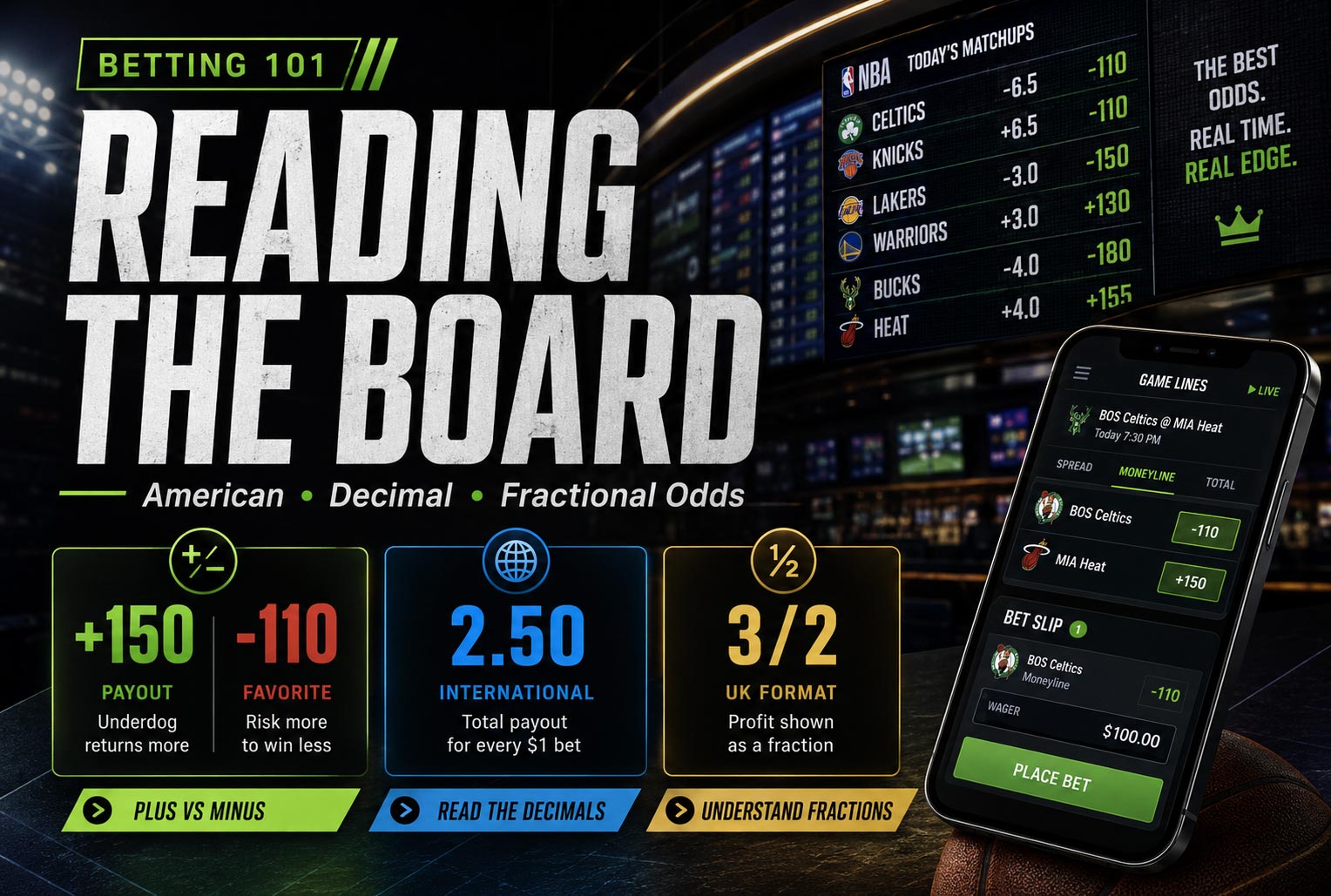
Here’s the thing about odds that nobody tells you: they’re all saying the exact same thing, just in different languages. American books throw minus signs at you like confetti, European sites love their clean decimals, and the Brits are still out here doing fractions like it’s GCSE math. But once you crack the code, you realize it’s all just different ways of answering one question: "How much am I about to make when this hits?" Let me walk you through this like I’m explaining it over beers, because honestly, this stuff is way simpler than your sportsbook wants you to think.
Breaking Down the Three Flavors of Odds
American odds are what you’ll see on every major book in New York, Jersey, and Ontario – those plus and minus numbers that look like someone’s credit score. When you see -110, that minus sign means you’re betting the favorite, and you need to risk $110 to win $100. When you see +200, that plus sign means you’re on the underdog, and a $100 bet nets you $200 profit if it hits.
The trick with American odds is understanding that the number tells you the relationship to $100, not your actual bet size. If you’re throwing down $50 on -110 odds, you’re not winning $100 – you’re winning about $45.45 (your $50 divided by 1.1). Same logic applies to plus odds: $50 on +200 gets you $100 profit, not $200. Think of the American format as the "how much do I need to risk" (minus) versus "how much can I win" (plus) framework.
Here’s where most people mess up: they see -200 and think "that’s twice as good as -100" when it’s actually the opposite. The bigger the minus number, the heavier the favorite, which means less profit relative to your risk. A -200 favorite requires you to bet $200 to win $100, while a +200 underdog pays you $200 on a $100 bet. The asymmetry is intentional – that’s the juice, baby.
Why Every Format Is Just Math in Disguise
Decimal odds are what you’ll find on every international book and they’re honestly the cleanest format once you get used to them. A decimal odd of 2.00 means you get $2 back for every $1 you bet – including your original stake. So if you drop $100 at 2.00 odds, you get $200 total back ($100 profit plus your original $100). The beauty here is that your payout calculation is literally just multiplication: bet amount × decimal odds = total return.
Converting between American and decimal is actually stupid easy once you know the formulas. For American favorites (minus numbers), take 100, divide by the American odds (without the minus), then add 1. So -200 becomes (100/200) + 1 = 1.50 in decimal. For underdogs (plus numbers), divide the American odds by 100 and add 1. A +200 underdog is (200/100) + 1 = 3.00 in decimal. This matters when you’re line shopping across books that use different formats – you need to know you’re actually getting the same price.
Fractional odds are the UK’s gift to confusion, but they’re actually the most straightforward about profit. When you see 5/2 (read as "five to two"), that means you win $5 for every $2 you bet – the fraction is literally profit-to-stake. A $100 bet at 5/2 odds nets you $250 profit ($100 × 5/2) plus your $100 back for $350 total. The math is identical to decimal odds minus one: 5/2 as a decimal is 3.50, and 3.50 – 1.00 = 2.50, which is 5/2. Once you see that relationship, fractional odds stop looking like your high school algebra homework and start making actual sense.
The real edge here isn’t just knowing how to read odds – it’s understanding that the format doesn’t change the underlying probability or value. Whether you’re looking at -110, 1.91, or 10/11, they’re all representing roughly the same thing: a bet that needs to hit 52.4% of the time to break even. The books aren’t trying to confuse you with different formats (okay, maybe a little), they’re just catering to regional preferences. Master all three and you’ll never miss a value opportunity because you couldn’t convert the odds fast enough. So here’s my question: which format actually clicks best for you when you’re trying to calculate value on the fly?
Keep reading: Once the board makes sense, learn the three core bet types, then turn those numbers into an edge with implied probability.
"WannaBet.com may receive compensation from the sportsbooks mentioned in this post if you sign up using our links. This doesn’t cost you a dime, but it keeps the lights on. Please bet responsibly. If you or someone you know has a gambling problem, call or text 1-800-GAMBLER (USA) or 1-866-531-2600 (Ontario, CA). 21+ only."

2 comments on "How to Read Odds Like You Actually Know What You’re Doing"