
Picture this: You’ve got Croatia vs. Brazil in the quarterfinals, and you’re feeling yourself. Croatia at +280? Maybe. Brazil to win? Too chalky. So you do what every degen does when they overthink it—you take the draw at +220 because knockout matches are "always tight." The match goes to penalties, Croatia advances, and you’re already planning what color Lambo you’re buying. Then you check your account and see that beautiful red "LOSS" next to your ticket. What the actual hell just happened? Welcome to the 90-minute trap, my friend. This is the single most expensive lesson in World Cup betting, and it catches thousands of casual bettors every single tournament. Let me break down why your book didn’t screw you—you just didn’t read the fine print.
Why Your World Cup Bet Settled as a Draw
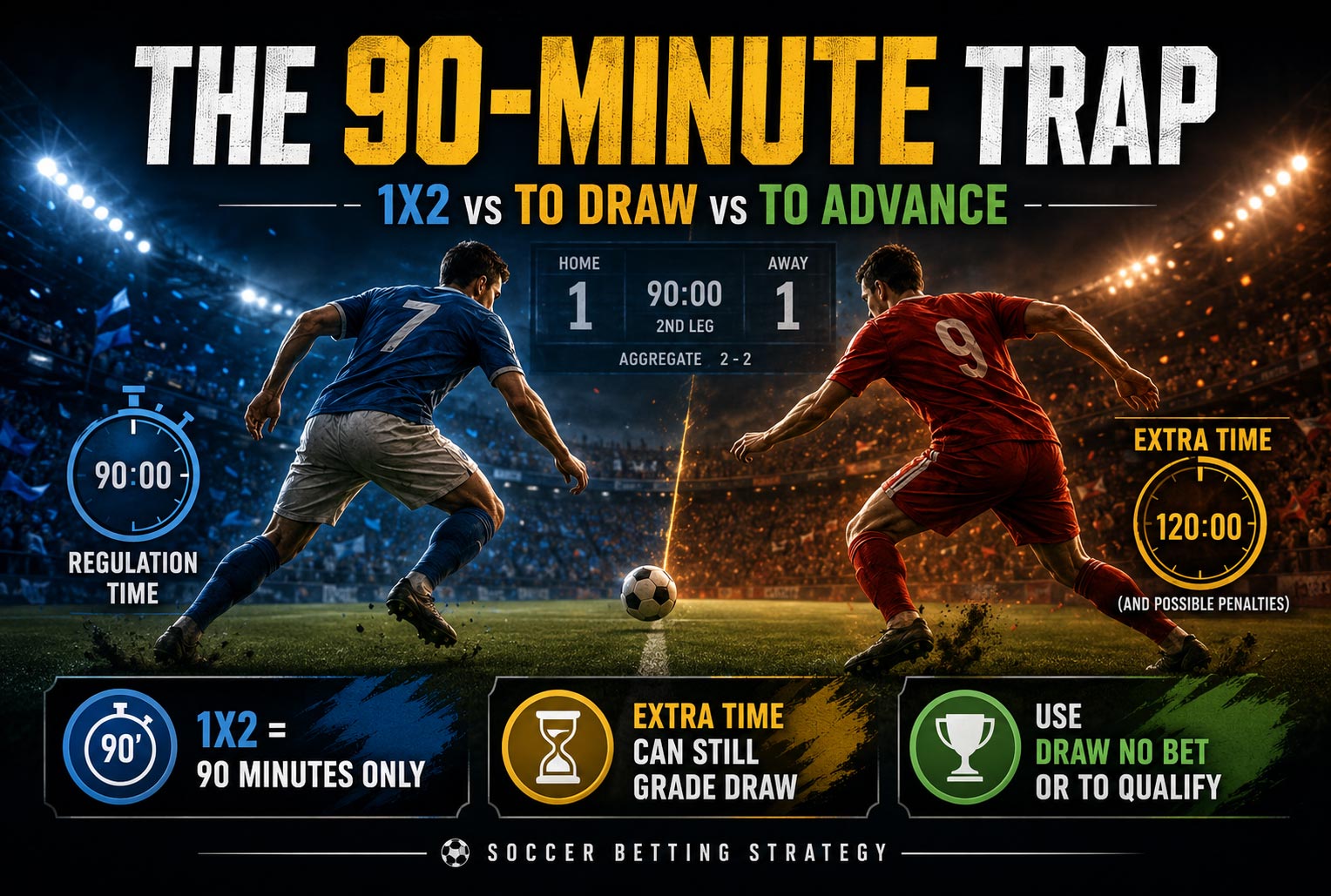
Here’s the deal: When you bet the standard three-way market (also called 1X2 in soccer), you’re betting on the result after 90 minutes plus stoppage time. That’s it. Extra time doesn’t count. Penalties don’t count. If the score is 1-1 after 90 minutes and the match goes to extra time, your bet settles based on that 1-1 scoreline—regardless of what happens in the next 30 minutes or the shootout.
This isn’t some shady book trying to rob you. It’s literally how soccer betting has worked since forever. The three-way market exists because draws are possible in regulation, and books need a way to grade bets before extra time and penalties turn it into a binary outcome. Think of it like betting the first half spread in the NFL—what happens in the second half is irrelevant to how that bet grades.
The confusion comes from how knockout matches work. In group stage games, a draw is the final result. But in the knockout rounds, someone has to advance, so we get extra time and penalties. Your book doesn’t care about the tournament format—they care about the betting market you chose. You bet on 90 minutes, you get graded on 90 minutes. It’s that simple, and honestly, that brutal.
The Fine Print That Cost You Your Parlay
Now let’s talk about where this really hurts: parlays. You’ve got a beautiful four-leg parlay with Brazil ML, France ML, under 2.5 goals in Argentina-Netherlands, and England ML. Three legs hit clean. Then England and Senegal go 1-1 after 90, England wins in extra time, and your entire parlay is toast. You watched England advance and still lost your bet. That’s the exact moment most people start yelling at customer service.
The market you should’ve been betting is "To Qualify" or "To Advance" (sometimes listed as "Winner" or "Match Winner Including Extra Time"). This market settles based on who actually moves on in the tournament, regardless of whether it takes 90 minutes, 120 minutes, or penalties. The odds are usually worse because you’re removing draw risk, but you’re also removing the chance of this exact nightmare scenario. It’s classic risk mitigation—you’re paying slightly worse juice for certainty.
Here’s the MBA framework: Standard ML bets in knockout soccer have hidden optionality that works against you. You’re essentially getting short-squeezed by the match format. The sharp move is either betting "To Qualify" markets if you want a team to advance, or avoiding knockout soccer altogether until you fully understand the market structure. Draw No Bet (DNB) is another option—if it’s a draw after 90, you get your stake back. Slightly worse odds than straight ML, but infinitely better than watching your parlay die while your team celebrates.
How to Actually Bet World Cup Knockouts
First rule: Know which market you’re betting before you click confirm. Most books default to the 90-minute three-way market because it’s the most liquid. But during World Cup knockout rounds, they’ll also offer "To Qualify" markets prominently. If you’re on your book’s app, look for language like "including extra time" or "to advance." That’s your signal you’re in the right market.
Second, understand the pricing. A favorite at -150 on the 90-minute ML might be -200 or worse "To Qualify" because you’re removing draw risk. Is that worth it? Depends on your risk tolerance and whether you’re parlaying. If you’re building a three-leg knockout parlay, paying the extra juice to avoid the draw trap is usually +EV in the long run. One blown parlay from a draw costs you way more than the cumulative juice over multiple bets.
Third, use Draw No Bet strategically. DNB is perfect for tight matches where you like a side but expect a cagey 90 minutes. Think Italy vs. Spain, France vs. Portugal—matches where talent is even and neither team wants to open up. You get your stake back if it’s level after 90, which is basically a free roll compared to sweating extra time. The odds aren’t as juicy as "To Qualify," but the risk profile is chef’s kiss.
Look, I get it—soccer betting is weird if you grew up on spreads and totals. But once you understand the 90-minute vs. full-time distinction, you’ve got an actual edge over the public. Every World Cup, thousands of casual bettors make this exact mistake, and books absolutely feast on it. The difference between a sharp bettor and a degen isn’t some secret algorithm—it’s reading the market rules and understanding what you’re actually betting on. Next time knockout rounds roll around, you’ll know exactly which button to press. Now go forth and stop donating to DraftKings’ quarterly earnings.
What’s the dumbest way you’ve blown a World Cup bet? Drop it in the comments—misery loves company.
Keep reading: Manage soccer risk further with split-line Asian handicaps, lock down the fundamentals in moneylines, spreads and totals, and learn to price a market with implied probability.
"WannaBet.com may receive compensation from the sportsbooks mentioned in this post if you sign up using our links. This doesn’t cost you a dime, but it keeps the lights on. Please bet responsibly. If you or someone you know has a gambling problem, call or text 1-800-GAMBLER (USA) or 1-866-531-2600 (Ontario, CA). 21+ only."
