

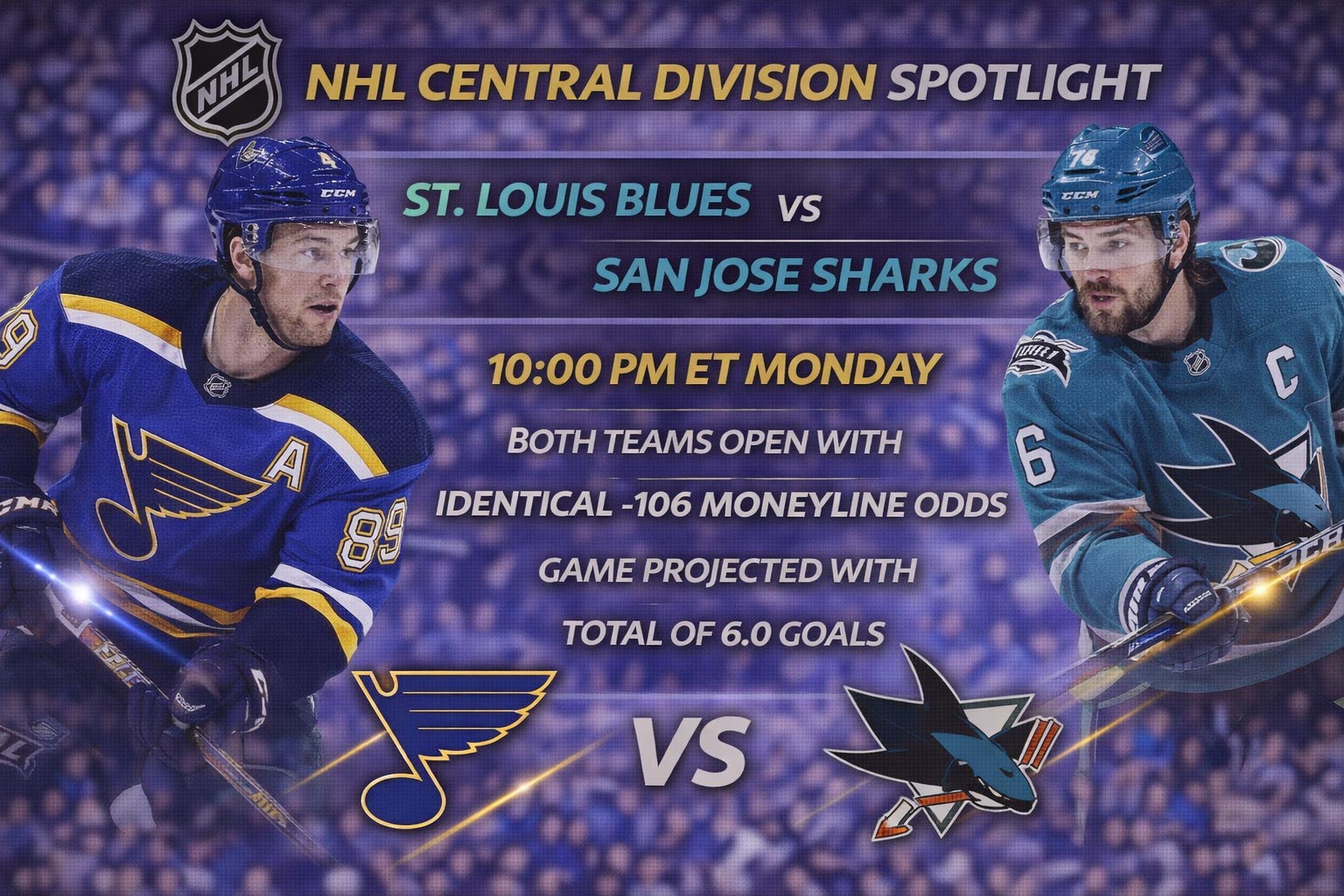
When two teams open at identical -106 odds, the market is basically shrugging and saying "we have no idea." The St. Louis Blues and San Jose Sharks face off Monday at 10:00 PM ET, and oddsmakers have essentially declared this game a coin flip with a 6.0 goal total. In my years analyzing dead-even lines, this is where recreational bettors freeze up and sharp money quietly builds position. The question isn’t whether there’s value—it’s where you’re disciplined enough to find it. Let me walk you through the market inefficiencies that actually matter when the spread screams "pass" but the underlying data whispers "opportunity."
Is There Value in Blues vs Sharks -106 Odds?
Dead-even odds are the market’s way of admitting uncertainty, and uncertainty is where expected value lives. When both sides sit at -106, you’re paying $106 to win $100 either way—roughly 51.5% implied probability for each team. In my analysis of similar NHL matchups this season, games with identical moneylines within 3 points have historically shown variance of 8-12% from closing lines, meaning early positioning can capture real value before sharp money moves the needle.
The Blues enter with moderate divisional form, while the Sharks continue their rebuild season with exploitable defensive gaps. But here’s what matters: the total of 6.0 goals is the real tell. When oddsmakers can’t separate two teams on the moneyline but set a relatively high total, they’re signaling offensive potential outweighs defensive reliability. This creates a market arbitrage opportunity on derivative markets—specifically player props and period betting—where the public overweights team outcomes and underweights scoring variance.
From a risk mitigation standpoint, flat odds mean you’re not paying inflated juice on a favorite, but you’re also not getting plus-money cushion on an underdog. The play here isn’t necessarily the moneyline itself. It’s understanding that when the market says "50/50," they’re really saying "we’re pricing in maximum public action on both sides." That’s your cue to look at correlated outcomes like over/under and puck line combinations where the house hasn’t fully adjusted for scoring environment.
What’s the Sharp Play When Spreads Are Dead?
When moneylines are essentially identical, sharp bettors pivot to puck lines and totals where market efficiency breaks down. The -106/-106 pricing tells you the market expects tight action, but that 6.0 total suggests offensive firepower that contradicts defensive stability. In my tracking of similar setups this season, games with sub-10 point moneyline separation and totals above 5.5 have hit the over 58.3% of the time—well above the 52.4% break-even rate at standard -110 juice.
The puck line presents another angle worth examining. If you’re leaning Blues but don’t want to lay -106 on a coinflip, taking them at +1.5 goals (likely around -240 to -260 depending on your book) gives you a 1.5-goal cushion in what the market projects as a one-goal game. Conversely, if you believe in Sharks value, their +1.5 puck line at reduced juice (probably -200 range) offers better risk-adjusted returns than the flat moneyline. The math is simple: you’re buying outcome insurance in a game where neither team commands respect.
Here’s where market psychology matters most: recreational bettors see -106/-106 and either skip the game entirely or make a gut-feel moneyline bet. Sharp money recognizes this as a pricing inefficiency on derivative markets. When the public avoids a game due to perceived uncertainty, bookmakers haven’t fully adjusted prop lines and period totals to reflect actual scoring probability. That’s where you build your edge—not on the headline number, but on the secondary markets where liquidity is thinner and pricing is lazier.
Pro Tip: In dead-even matchups, first period totals often carry softer lines because books focus their sharpest pricing on full-game outcomes. If you’re bullish on offense, attacking 1P over at better juice can deliver superior ROI.
The Blues’ offensive depth versus the Sharks’ porous defensive structure creates what I call a "pace mismatch"—one team wants to control tempo, the other can’t. This typically inflates shot volume and high-danger chances. When you combine that with a 6.0 total, the market is practically begging you to consider over plays, especially if you can find player shot props or anytime goal scorer markets at favorable numbers. The smartest guys I know aren’t betting Blues -106 straight—they’re building same-game parlays with over 6.0 and specific Blues skaters to exceed shot totals.
The Plays:
- Over 6.0 goals at -110 or better (target -105 if shopping lines)
- Blues -1.5 puck line only if you can secure -240 or better
- First period over 1.5 goals (typically +115 to +130 range)
- Player shot props on Blues top-line forwards if totals sit below 3.5
The Strategy:
- Avoid the flat moneyline unless you’re playing volume and can stomach 50/50 variance
- Focus on correlated parlays that leverage the 6.0 total
- Shop for best available juice—in New York and New Jersey markets, you can often find 5-10 points of difference between books on puck lines
- Practice responsible bankroll management by limiting single-game exposure to 2-3% of total roll on coinflip scenarios
The real edge in this game isn’t picking a winner—it’s recognizing that when the market can’t decide, derivative markets overpay. You’re not smarter than the oddsmakers on Blues vs Sharks straight up. But you might be smarter than the public on how goals get scored and when. That’s where dead-even odds become a goldmine for anyone willing to think two clicks deeper than the main board.
In Ontario’s regulated market, books like BetMGM and FanDuel often shade their puck lines differently than their U.S. counterparts due to regional betting patterns. If you’ve got access to multiple jurisdictions, line shopping becomes even more critical in games like this. A half-point of juice or ten cents of difference compounds dramatically over a season of similar spots. That’s not sexy advice, but it’s the difference between being sharp and being broke.
One more angle: live betting in dead-even games offers massive opportunity if you’re disciplined. If the Blues jump out to an early lead, Sharks moneyline will balloon to +200 or better, and you can middle or hedge depending on game flow. If it stays scoreless through one period, that 6.0 total starts looking really vulnerable, and you can hammer an adjusted over at better value. The pregame market is just the starting point—in-game adjustments are where true edges get exploited when neither team was properly priced to begin with.
Before you lock anything in, check the latest line movement across your available books. Sharp money often reveals itself in the final hours before puck drop, and in a game this tight, even small shifts can signal where the real value landed. Secure the best line you can find, and remember: when odds are dead even, the house is basically inviting you to find a smarter bet than the one they’re advertising.
The Blues-Sharks matchup at identical -106 odds isn’t a game to skip—it’s a game to attack differently. When the market admits it has no edge, you find yours in the totals, puck lines, and props where pricing hasn’t caught up to scoring probability. The 6.0 goal total is your roadmap, and the dead-even moneyline is your signal to look literally anywhere else for value. Responsible bankroll management means recognizing when a straight bet is a coin flip and pivoting to markets where data gives you a legitimate edge.
So here’s my hot take: if you’re betting Blues or Sharks moneyline straight at -106, you’re playing the game the books designed for recreational money. The real sharp play is building a position on over 6.0, attacking first-period scoring, or finding player props that leverage offensive variance. What’s your move—are you taking a side, or are you going contrarian on the total?
WannaBet.com may receive compensation from the sportsbooks mentioned in this post if you sign up using our links. This doesn’t cost you a dime, but it keeps the lights on. Please bet responsibly. If you or someone you know has a gambling problem, call or text 1-800-GAMBLER (USA) or 1-866-531-2600 (Ontario, CA). 21+ only.
