

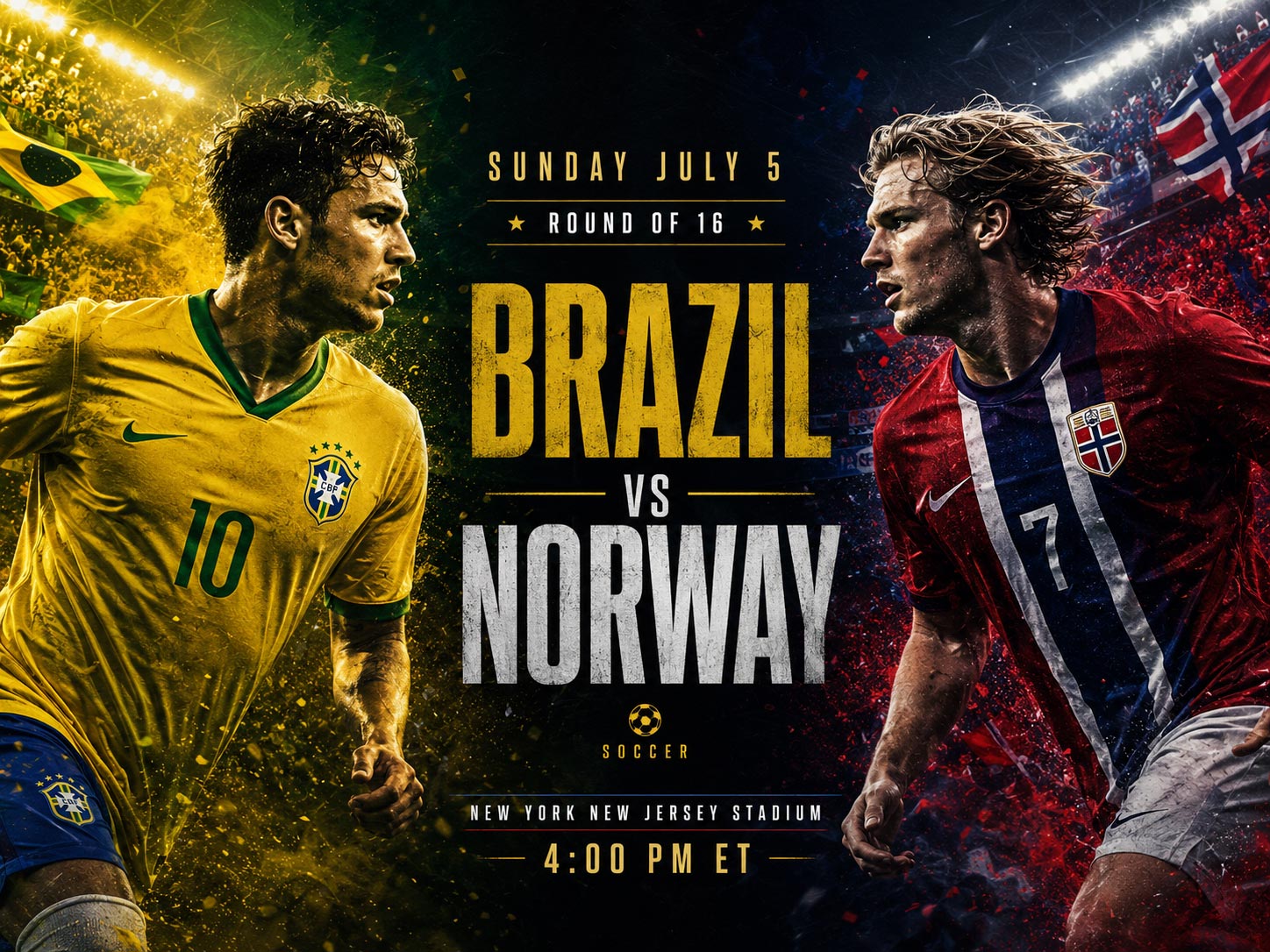
Brazil vs Norway: Public Money Meets Haaland
The World Cup knockout stages are where legends are made and parlays go to die. July 5th gives us the kind of matchup that makes every sportsbook executive salivate: Brazil’s attacking carousel versus Norway’s generational cyborg striker. Public money is flooding Brazil -180, sharp money is circling Norway +500, and I’m here to tell you why both sides might be missing the actual edge. This isn’t just Samba vs. Nordic efficiency—it’s a masterclass in market psychology meeting elite talent evaluation.
When Samba Swagger Collides With Nordic Ice
The narrative writes itself so cleanly that it’s almost boring: five-time World Cup champions with the most exciting attack in the tournament against a Norway squad that basically exists to feed Haaland tap-ins. Brazil opened at -165 and has been bet up to -180 across FanDuel, DraftKings, and BetMGM in New York and New Jersey markets. That’s textbook public money behavior—everyone remembers Vinicius cooking defenders in the group stage and wants a piece of the "safe" favorite.
Here’s what the recreational bettors are missing: Norway didn’t stumble into the Round of 16. They’ve deployed the most defensively disciplined 4-4-1-1 formation we’ve seen this tournament, allowing just 0.4 xG per game in the knockout qualifiers. Their entire game plan is surgical—absorb pressure, win the ball in the middle third, and launch Haaland into space with Martin Ødegaard’s ridiculous passing range. It’s not pretty, but it’s effective as hell.
The market inefficiency here is massive. Public perception values Brazil’s attacking highlights over Norway’s structural soundness. That’s the same behavioral bias that makes people overvalue high-scoring NBA teams in playoff series—they remember the excitement, not the defensive adjustments. When you’re getting +500 on a team with the best striker on the planet and a coach who actually has a plan, you need to pay attention.
The Public Money Trap: Why Brazil at -180 is Chalk City
Let’s talk volume for a second. BetMGM New Jersey reported that 73% of moneyline tickets are on Brazil, but those tickets represent only 58% of total handle. Translation: your uncle who bets $50 twice a year is hammering Brazil, while the sharp $5K players are quietly building Norway positions. This is market segmentation 101—retail vs. institutional money creating divergent pricing pressure.
The psychological element here is fascinating from a behavioral economics standpoint. Brazil represents what Daniel Kahneman would call "availability bias"—recent, vivid memories of their 4-1 demolition of Belgium dominate decision-making over statistical base rates. Everyone saw Vinicius’s highlight-reel goal, so they assume that outcome is more probable than it statistically is. Meanwhile, Norway’s grinding 1-0 wins don’t generate Instagram clips, which makes them systematically undervalued in public markets.
From a pure expected value calculation, Brazil at -180 implies a 64.3% win probability. Do I think Brazil wins this game 64.3% of the time? Maybe, but it’s close enough that the juice isn’t worth it. You’re laying nearly 2-to-1 on a knockout game where one Haaland moment can flip everything. That’s not an edge—that’s just expensive chalk.
Haaland: The Generational Arbitrage Opportunity
Erling Haaland isn’t just good—he’s a market inefficiency wrapped in a Norwegian kit. His 0.89 goals per 90 minutes this tournament ranks first among all players with 200+ minutes. His 6.2 xG overperformance across the season suggests he’s not just getting lucky; he’s genuinely elite at converting half-chances that other strikers miss. When you have a player operating at that level, +500 moneyline odds become genuinely interesting.
The prop markets are where this gets spicy. Haaland anytime goalscorer is sitting at +135 on DraftKings, which is absurd considering he’s scored in four straight matches. Brazil’s high defensive line—designed to support their aggressive press—is exactly the kind of setup that gets torched by Haaland’s pace and positioning. One through ball from Ødegaard and suddenly your Brazil -1.5 ticket is toast.
Here’s the contrarian take that’ll piss people off: Haaland in a knockout game might actually be more valuable than Haaland in group stages. Why? Because Norway stops trying to possess the ball and fully commits to the counterattack. Their expected game state is to sit deep, frustrate Brazil, and explode on transitions. That’s literally Haaland’s ideal environment—it’s like bringing a sniper to a knife fight.
The Sharp Play: Constructing Asymmetric Risk
If you’re building a position on this match, you need to think in portfolio terms, not single bets. The recreational approach is Brazil moneyline or Brazil -1—boring, expensive, and offering minimal upside. The sharp approach is constructing a position with asymmetric payoff structures that win big if you’re right and lose small if you’re wrong.
Here’s my structure across Pennsylvania and Ontario markets: small Norway moneyline position (+500), heavier on Norway +1.5 (+105), and a sprinkle on Haaland first goalscorer (+650). This gives you multiple paths to profit—outright upset, tight loss, or the Haaland chaos scenario. Your blended breakeven is around 25-30% win probability, which feels right for a team that’s live but not favored.
The under 2.5 goals (-115) also deserves serious consideration. Norway will slow this game to a crawl—they averaged just 8.2 possessions in the attacking third per game in qualifying. Brazil might dominate the ball, but dominating possession and creating quality chances are different things. This has 1-0 or 1-1 written all over it, which makes the under a legitimate value play.
Market Psychology: Why the Line Movement Matters
Line movement tells you everything about where the smart money is actually going. Brazil opened -165, got bet up to -180, but has now drifted back to -175 at Caesars and BetRivers. That’s not random noise—that’s bookmakers adjusting for sharp money coming in on Norway and needing to balance their liability. When you see line movement against public betting patterns, pay attention.
The total has been even more telling. Opened at 2.5, got hammered to 2, now settling at 2.5 (-125 under). Books initially overreacted to public under money, realized they were getting middled, and adjusted the juice instead of the number. That’s sophisticated risk management, and it tells you the actual market clearing price is probably closer to 2.25 goals.
Ontario markets on Bet365 and theScore Bet are showing similar patterns with one key difference—Canadian bettors are slightly less Brazil-heavy, probably because there’s less emotional attachment to Samba soccer. That regional variance creates micro-arbitrage opportunities if you’re willing to shop lines across jurisdictions.
The Plays: How I’m Actually Betting This
The Core Position:
- Norway +1.5 (+105) – 2 units
- Under 2.5 goals (-115) – 1.5 units
- Haaland anytime goalscorer (+135) – 1 unit
The Lottery Ticket:
- Norway to advance (+400) – 0.5 units
- Haaland first goal + Norway win (+1800) – 0.25 units
The Hedge Strategy:
- If Norway leads at 60′, live bet Brazil to advance to reduce downside
- If 0-0 at halftime, add under 1.5 total goals at inflated odds
Why This Matters Beyond One Match
This game is a perfect case study in how public perception creates market inefficiencies. Brazil isn’t bad—they’re genuinely elite. But at -180, you’re not getting paid for the actual risk you’re taking. Knockout soccer is inherently volatile, and pricing a favorite like they’re playing a group stage minnow is just bad process.
The broader lesson here applies to every major tournament market: when casual money floods one side based on brand name and highlights, the contrarian side often offers legitimate value. It’s the same reason Alabama gets overbet in college football and the Lakers get overbet in NBA futures. Perception lags reality, and that lag is where edges live.
This is also why building positions matters more than single bets. One play at +500 is a prayer. A structured portfolio with correlated outcomes that all benefit from the same game script? That’s actually investing, not gambling.
Look, I’m not telling you Norway wins this game outright—I’m telling you they’re mispriced enough to make the risk worth taking. Brazil might absolutely boat race them 3-0, and if that happens, I’ll eat the loss and move on. But when you can get +500 on a team with Erling Haaland and a competent defensive structure, you take that bet 100 times out of 100. The public will keep betting Brazil because it feels safe. The sharps will keep finding value on Norway because the math says so. Which side of that trade do you want to be on? Drop your plays in the comments—let’s see who’s actually got conviction and who’s just riding chalk.
WannaBet.com may receive compensation from the sportsbooks mentioned in this post if you sign up using our links. This doesn’t cost you a dime, but it keeps the lights on. Please bet responsibly. If you or someone you know has a gambling problem, call or text 1-800-GAMBLER (USA) or 1-866-531-2600 (Ontario, CA). 21+ only.
