

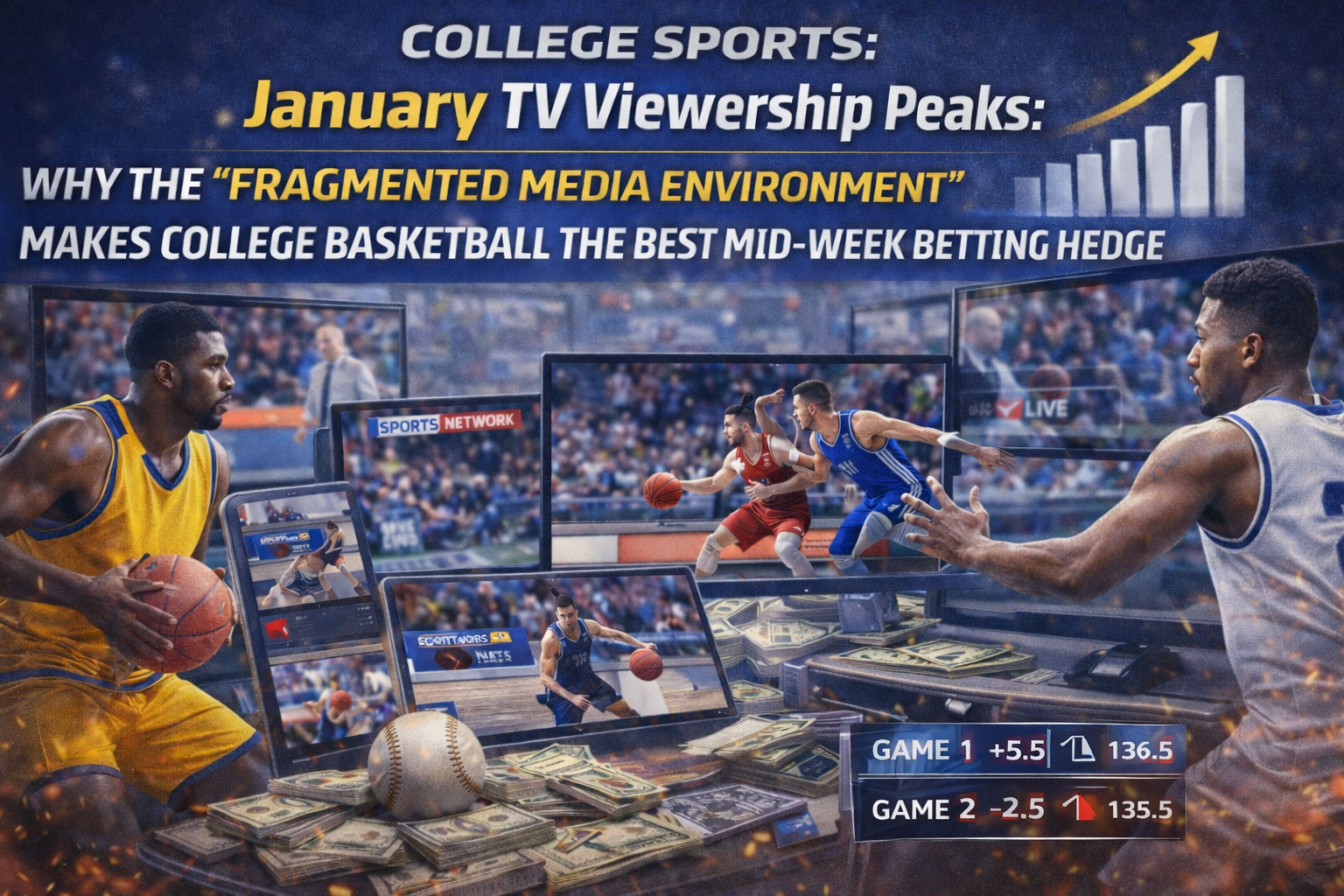
College Sports: January TV Viewership Peaks: Why the “fragmented media environment” makes college basketball the best mid-week betting hedge.
Hey fellas – I’m about to give you the cheat code that kept my P2P operation printing money every Tuesday and Wednesday during my MBA. While everyone’s glued to their phones scrolling TikTok and watching Netflix, there’s this beautiful paradox happening: college basketball is somehow dominating mid-week viewership, and the books haven’t fully adjusted their lines to reflect it. The “fragmented media environment” everyone keeps whining about? That’s actually creating the most exploitable market inefficiency since everyone thought Tom Brady was washed in 2019.
January is when this whole thing goes nuclear. Conference play heats up, student sections are packed, and suddenly Kansas vs. Baylor on a Tuesday night is pulling better ratings than most primetime shows. The public’s attention is scattered across seventeen different streaming platforms, but degenerates like us? We’re locked in on ESPN2 watching mid-major madness while the rest of the world binges reality TV.
Here’s the thesis: the same fragmentation that’s killing traditional media is creating pricing inefficiencies in college basketball markets that make it the sharpest mid-week betting hedge available. Let me break down why your Tuesday night bankroll should be parked on CBB while everyone else is betting NFL props from games that happened three days ago.
January College Hoops: Your Mid-Week Cash Printer
January college basketball is different, and the numbers don’t lie. TV viewership for major conference games peaks during this month because it’s the sweet spot: football is over (except for the NFL playoffs), March Madness hype is building, and conference races actually matter. According to Nielsen data, college hoops viewership in January consistently outperforms the same games in November and December by 30-40%. The market knows this, but here’s what they’re missing: the betting volume hasn’t caught up proportionally.
The books are still pricing these games like it’s early season when nobody’s paying attention. They’re allocating their sharpest oddsmakers to NFL playoff props and NBA player markets because that’s where the public money flows. Meanwhile, Tuesday night when Duke plays Virginia, you’ve got regional betting patterns creating massive edges because the lines are set by algorithms and junior traders, not the A-team. This is textbook market arbitrage—you’re finding value where the institutional focus is weakest.
Here’s the real kicker: mid-week college hoops games have significantly less sharp money than weekend matchups. The professional betting syndicates are busy crushing NFL and NBA, which means the lines move based on public sentiment rather than sophisticated modeling. When 60% of the public is hammering the over because they saw a highlight on SportsCenter, but the sharp money hasn’t shown up to balance it out, you’ve got yourself a beautiful fade opportunity. It’s like showing up to a poker table where half the players don’t know the rules.
Why Fragmented Media Makes CBB the Sharpest Play
The “fragmented media environment” is just fancy consultant-speak for “nobody watches the same thing anymore,” but it’s created an asymmetric information advantage for college basketball bettors. Think about it: NFL games are dissected by a thousand podcasts, every NBA player prop has a Twitter thread with advanced metrics, but college hoops? Most casual bettors don’t even know who’s starting for Gonzaga on a random Wednesday. This information gap is your edge.
Streaming fragmentation means that unless you’re actively seeking out college basketball content, you’re not seeing it. Games are scattered across ESPN+, Peacock, Fox Sports, and conference-specific networks that most people don’t even have in their cable package. The result? Public betting is driven by brand recognition (they’ll hammer Duke regardless of matchup) rather than actual game analysis. When information asymmetry exists in a market, the informed player prints money. This is literally day-one MBA stuff applied to gambling.
The viewership data backs this up in a weird way: while overall TV audiences are fragmenting, college basketball’s engaged viewership is actually more concentrated. The people watching a Tuesday night Big Ten game are die-hards, not casuals. But the betting markets are still pricing for casual attention because that’s what drives volume. You’re essentially getting sharp-level information access while betting into soft, public-driven lines. It’s the best of both worlds, and January is when this dynamic peaks because conference play narratives are strong enough to pull viewers but not mainstream enough to attract sharp money.
The Tuesday-Wednesday Betting Window
Here’s where the rubber meets the road: Tuesday and Wednesday nights are the golden window for college basketball betting. The books are dealing with lower volume, which means they’re less willing to take big positions and more likely to shade lines toward public perception. You’re not fighting against the same sharp action that shows up for Saturday’s marquee matchups. This is risk mitigation 101—you’re entering the market when your competition is weakest.
The mid-week scheduling also creates situational spots that the public completely ignores. Teams playing their second road game in four days, students back from winter break affecting home court advantage, coaches managing minutes differently in the grind of conference play—these variables matter, but casual bettors don’t factor them in. Meanwhile, you can find this information with 20 minutes of research because college basketball Twitter is ridiculously transparent. Coaches literally tell you who’s banged up in their press conferences.
From a portfolio theory perspective (yeah, I’m going there), mid-week college hoops serves as the perfect hedge against your weekend NFL and NBA action. You’re diversifying across different sports, different days of the week, and different market dynamics. If your Sunday NFL bets go south, you’re not chasing losses on Monday Night Football—you’re playing a completely different game on Tuesday where you actually have an edge. That’s smart bankroll management, not just degen energy.
The Market Psychology Angle
January creates this perfect storm of psychological factors that make college basketball lines exploitable. The public is suffering from NFL playoff tunnel vision, which means their college hoops bets are basically afterthoughts. They’re not doing the work, they’re just clicking buttons between checking their NFL futures. When your competition is half-assing it, you don’t need to be a genius to profit—you just need to be present and prepared.
There’s also recency bias on steroids in college basketball betting. A team wins big on Saturday, and the public is still riding that high when they play on Tuesday, even if the matchup is completely different. The books know this and will shade the line, but not enough to kill the value because they’re worried about getting middled. You can exploit this by simply asking: “Is this team actually good, or did they just catch a favorable matchup?” That one question will save you more money than any tout service.
The fragmented media environment amplifies this because highlight culture dominates perception. Casual bettors are forming opinions based on 30-second clips rather than watching full games. They see a guard drop 30 points and think he’s prime Steph Curry, not realizing he was playing against a zone defense that wouldn’t make a high school coach proud. You watch the games (or at least check the box scores and shot charts), and suddenly you’re operating with institutional-level information in a retail-priced market.
Why January Specifically Matters
Conference play in January is when the wheat separates from the chaff, but the betting markets are still pricing in preseason expectations. Teams that looked good in November against cupcakes are now getting exposed, while under-the-radar squads are proving they can hang in league play. The books are slow to adjust their power ratings because they’re built on full-season data that’s heavily weighted toward recent performance. This creates a 2-3 week window where you can absolutely crush.
The other factor is motivation and roster clarity. By January, you know which teams are actually trying to make a tournament run versus which ones are mailing it in. You know which freshmen have figured it out and which lottery picks are still lost. This information is publicly available, but the betting lines don’t fully reflect it because the algorithms can’t quantify “gives a shit” as a metric. Human analysis beats the model here, and that’s your edge.
January also has the highest concentration of mid-week games because conferences are trying to maximize TV windows. More games mean more opportunities, and more opportunities mean you can be selective. You’re not forcing bets on Saturday when sharp money is flooding the market—you’re cherry-picking Tuesday night spots where you’ve done the work and the public is literally watching something else. Volume plus selectivity equals expected value. That’s the formula.
The Execution Strategy
So how do you actually play this? First, focus on power conferences (Big Ten, Big 12, SEC, ACC) where you have information access but the games aren’t marquee enough to attract sharp money. Avoid the absolute top matchups—Duke vs. UNC on a Tuesday is going to have efficient pricing. You want the Rutgers at Penn State type games where you can actually find an edge because nobody’s paying attention.
Second, look for situational spots: teams on short rest, road-heavy schedules, matchup advantages that the public doesn’t see. College basketball is more matchup-dependent than almost any sport because of style differences. A team that presses full-court will destroy a squad that can’t handle pressure, but the betting line might not reflect it if both teams have similar records. This is where watching games (or reading quality breakdowns) pays dividends.
Third, manage your bankroll like you’re running a hedge fund, not a degen operation. Mid-week college hoops should be 20-30% of your weekly betting volume—enough to matter, but not so much that a bad Tuesday ruins your week. Treat each bet as an independent expected value calculation, not a parlay-or-die situation. The edge in these markets is real but small, which means you need volume and discipline to extract value over time.
The Ontario and US Market Dynamics
Here’s where it gets interesting for my Ontario crew: the Canadian market is even softer on college basketball than the US. Most Canadian bettors are hockey-first, and college hoops is an afterthought. The sportsbooks operating in Ontario are pricing these lines for a North American audience, but the local betting patterns skew heavily toward NHL and Raptors. This creates opportunities where you’re essentially getting US-sharp information with Canadian-casual pricing. It’s beautiful.
In the major US markets (New York, New Jersey, Pennsylvania, Illinois, Ohio), you’ve got more competition, but you also have more books to shop. Line shopping in college basketball is crucial because the lower limits mean books are more willing to post different numbers. A half-point in college hoops is worth more than in NFL because possessions matter differently. You should have accounts at 3-4 books minimum and be checking lines on every bet. This isn’t optional—it’s the difference between being profitable and being a square.
The promos in these markets also tend to be weaker for college basketball than NFL or NBA, which means the books aren’t trying as hard to attract action. That’s actually good for you because it means they’re not shading lines as aggressively. You’re getting closer to “true” market prices rather than promotional-adjusted numbers. Less marketing budget allocated to a sport usually means less sophisticated pricing—take advantage of it.
Look, I built a business on finding edges that other people were too lazy or too distracted to spot. January college basketball on Tuesday and Wednesday nights is exactly that kind of opportunity. The fragmented media environment that everyone complains about? It’s creating information asymmetry that you can exploit if you’re willing to do even basic homework. While the public is watching Love Island or whatever, you’re cashing tickets on mid-major unders.
The key is treating this like the market inefficiency it is, not just another degen opportunity. You’re not betting college hoops because it’s fun (though it is)—you’re betting it because the risk-adjusted returns are better than anything else available mid-week. That’s how you build a bankroll that survives the variance of a full sports calendar.
So here’s my question for the comments: What’s your best Tuesday night college hoops edge? Are you riding conference trends, fading public teams, or just hammering unders when students are on break? Let’s compare notes, because the more sharp money that flows into these markets, the faster this edge disappears. Might as well print while we can.
WannaBet.com may receive compensation from the sportsbooks mentioned in this post if you sign up using our links. This doesn’t cost you a dime, but it keeps the lights on. Please bet responsibly. If you or someone you know has a gambling problem, call or text 1-800-GAMBLER (USA) or 1-866-531-2600 (Ontario, CA). 21+ only.
