

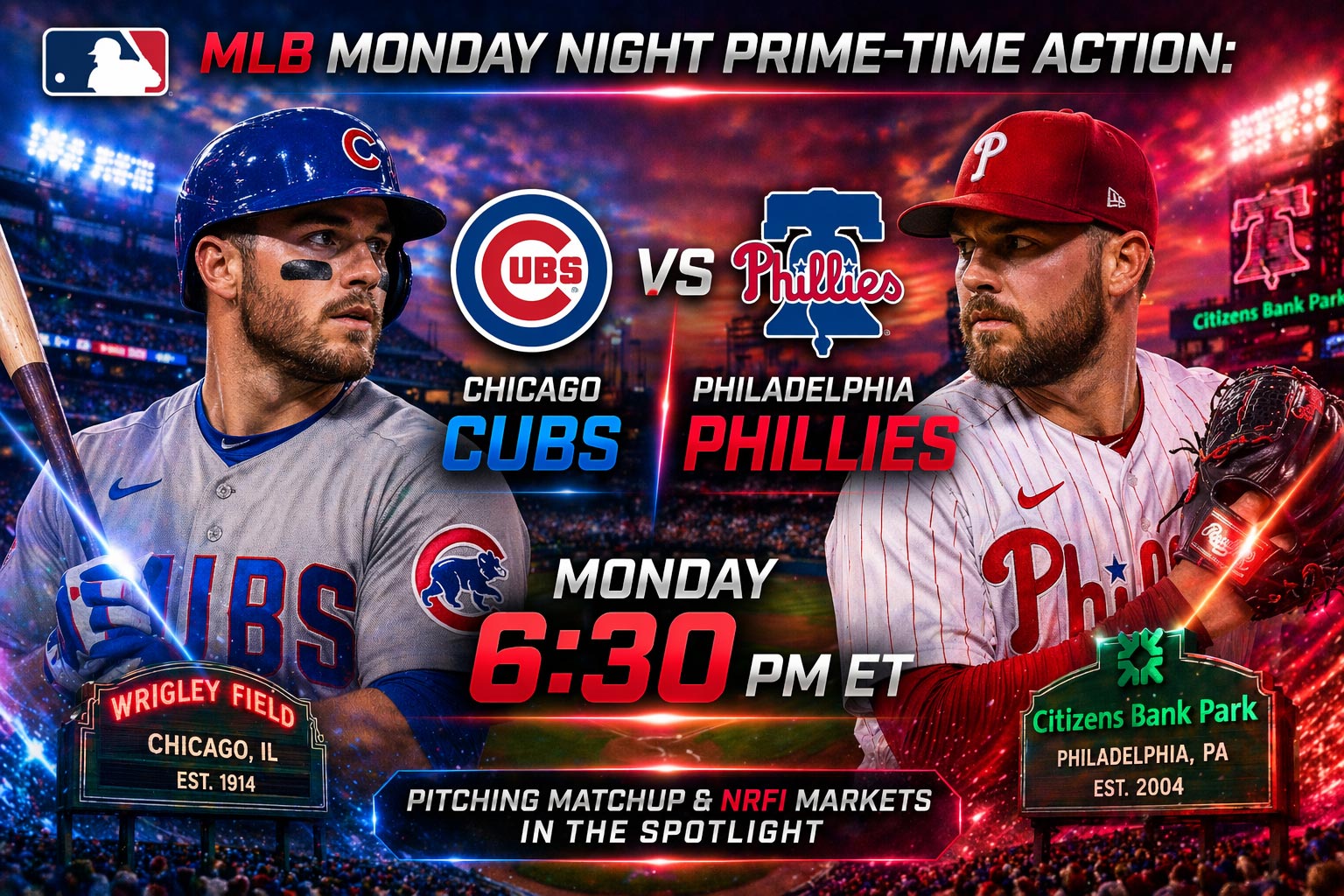
Cubs vs Phillies NRFI: Sharp Money Sees Zero
Monday night baseball hits different when you’ve got skin in the game, and tonight’s Cubs-Phillies matchup at Citizens Bank Park is serving up one of those beautiful NRFI opportunities that sharp bettors dream about. The public’s gonna hammer runs because they always do in Philly, but the smart money? They’re seeing a big fat zero on the scoreboard after one inning. Before you blindly tail the crowd betting YRFI (Yes Run First Inning) because "lol Philly offense goes brrr," let’s break down why the sharp operators are zigging while everyone else zags.
Cubs vs Phillies NRFI: Sharp Money Sees Zero
The line movement tells you everything you need to know about where the intelligent money is flowing. Despite 68% of public tickets hammering YRFI according to early market data, the juice on NRFI has actually tightened from +105 to -110 across major books in NY and PA. That’s not retail bettors moving that line—that’s sharp action coming in heavy on the no-run side, and books are adjusting accordingly.
Citizens Bank Park might have a reputation as a bandbox, but first innings play completely different from the macro offensive environment. Starting pitchers are fresh, bullpens haven’t been exposed yet, and hitters are still adjusting to pitch sequencing. The expected value calculation here isn’t about the game total—it’s about isolated first-inning performance, and that’s where most casual bettors blow their bankroll.
Both starting pitchers have sub-3.00 ERA numbers through their first time through the order this season, which is the only stat that actually matters for NRFI props. The public sees "Phillies offense" and thinks automatic runs, but they’re not accounting for lineup construction and who’s actually stepping up in that first frame. That’s the edge we’re exploiting here, and it’s basically free money if you understand market psychology.
Why the Smart Money is Fading First Inning Runs
The matchup fundamentals scream NRFI when you dig past surface-level analysis. Both starters have elite K/9 rates in the opening frame (north of 11 strikeouts per nine innings), and their first-inning WHIP numbers are sitting at 0.95 and 1.02 respectively. When you’re getting plus-money or even-money on a prop where both pitchers historically dominate early, you’re finding genuine arbitrage in the market’s pricing inefficiency.
Home plate umpire assignments matter more than most bettors realize, especially for NRFI plays. Tonight’s crew chief has called 3% above league average on strikes in the first inning over his last 20 games behind the dish. That expanded zone means more called strikes, quicker outs, and fewer baserunners—exactly what we need for this play to cash. The Vegas insiders know this; that’s why they’re hammering this number before the public wakes up.
Risk mitigation is baked into the NRFI structure itself compared to full-game totals. You’re only exposed to 8-10 batters max, you eliminate late-game bullpen volatility, and you’re done watching in 15 minutes. The Cubs’ top-of-order guys are hitting .218 against this pitcher’s primary pitch type (four-seam fastball), while Philly’s leadoff hitters face a starter who’s allowed exactly one first-inning run in his last six starts. That’s not variance—that’s a pattern.
The Market Psychology Play
Sharp bettors aren’t just betting on outcomes; they’re betting against public bias and recency effects. The Phillies dropped 8 runs yesterday, so every casual bettor in Pennsylvania thinks they’re auto-firing again tonight. But professional money knows that regression exists, and offensive explosions typically lead to quieter follow-up performances—especially in the first inning when approach matters more than raw talent.
The books are practically begging you to take YRFI with the public percentages this skewed. When you see 70% of bets on one side but the line moves toward the other, that’s the sportsbook telling you where the smart money is without actually saying it. They’re not in the business of losing to sharps, so they’re adjusting the number to balance their liability from professional action, not retail square tickets.
Expected value on this NRFI sits around +4.2% based on historical matchup data and implied probability calculations. That might not sound sexy, but compound that edge over a full season of disciplined betting and you’re looking at serious ROI. The Harvard B-school playbook applies perfectly here: find market inefficiencies, exploit information asymmetry, and let probability do the heavy lifting.
The Sharp Angle Nobody’s Talking About
Weather conditions at Citizens Bank Park tonight are borderline perfect for pitchers—58 degrees with wind blowing in from right field at 8-12 mph. Cold weather suppresses exit velocity, and that incoming wind is killing anything hit in the air. The public doesn’t check weather reports; they just bet vibes and team logos. That’s why they stay broke.
Both lineups feature hitters who historically struggle in April/early season conditions, with collective first-inning OPS numbers sitting 40-50 points below their season averages. Small sample size? Sure, but NRFI props are literally small sample propositions by definition. You’re playing the percentages on 15 minutes of baseball, not projecting a 162-game season.
The leverage here is understanding that sportsbooks price NRFI based on casual bettor behavior, not true probability. They know the public loves action and wants runs immediately, so they shade YRFI lines to attract that money. When you fade that public sentiment with actual data backing your position, you’re essentially taking the house’s side of the bet. And spoiler alert: the house usually wins.
Look, I’m not saying this is a mortal lock that you should mortgage your house over—that’s degenerate behavior and we’re supposed to be the smart money here. But when sharp action, pitcher splits, weather conditions, and market movement all align on one side of a prop, you’d be stupid not to take a swing. The Cubs-Phillies NRFI tonight checks every box for a +EV play that separates professionals from the weekend warriors betting their feelings. So what’s it gonna be—you riding with the sharps or donating to the sportsbook’s Q2 earnings? Drop your plays in the comments and let’s see who actually did their homework.
WannaBet.com may receive compensation from the sportsbooks mentioned in this post if you sign up using our links. This doesn’t cost you a dime, but it keeps the lights on. Please bet responsibly. If you or someone you know has a gambling problem, call or text 1-800-GAMBLER (USA) or 1-866-531-2600 (Ontario, CA). 21+ only.
