

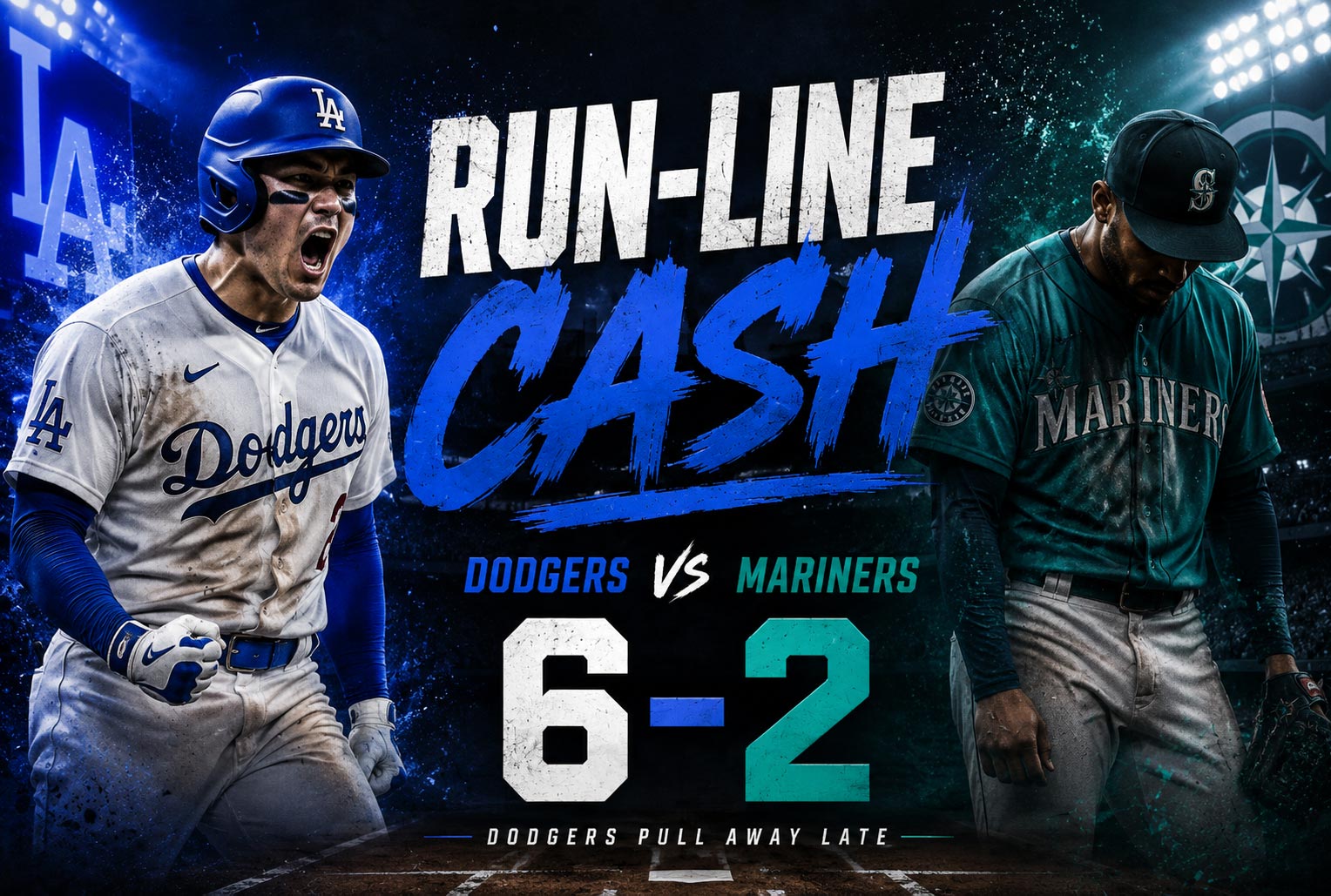
The Dodgers just reminded everyone why they’re the sharpest play in baseball when the run line makes sense. Wednesday night at Chavez Ravine, LA didn’t just beat Seattle—they obliterated the Mariners 6-2 while covering the -1.5 spread that had sharp money salivating all afternoon. If you laid -220 on the straight moneyline, congrats on your win, but you left serious expected value on the table when the run line was sitting there at much friendlier odds.
Dodgers Run Line Cashes on Late-Inning Bombs
The game script played out exactly how run-line believers drew it up: close enough to keep it interesting, but with LA’s superior lineup depth eventually breaking through when it mattered. Through six innings, this was a nail-biter at 3-2, the kind of game that makes moneyline bettors sweat and run-line holders question their life choices. Then Dalton Rushing stepped up in the seventh and launched a three-run nuke that basically printed money for anyone who had LA -1.5.
Teoscar Hernández added a solo shot later because apparently the Dodgers weren’t satisfied with just covering—they wanted to style on Seattle and everyone who faded them. That insurance run turned a 5-2 lead into a 6-2 laugher, giving run-line holders that comfortable cushion where you can actually enjoy the ninth inning instead of stress-eating Tums. The four-run margin of victory meant LA covered by 2.5 runs, which in betting terms is like winning your parlay and having the last leg push for a bonus.
Here’s the beautiful part: the total stayed well under the pre-game number, meaning the game environment favored pitching and defense until LA’s bats woke up late. That’s the dream scenario for run-line bettors—a low-scoring affair where your team pulls away at the end rather than winning 9-8 in a shootout that ages you five years. The late power surge was surgical, efficient, and most importantly, profitable for anyone who understood the market dynamics at play.
Why Sharp Money Loved LA at -1.5 vs Seattle
Let’s talk about the setup, because this is where understanding market psychology separates the pros from the recreational weekend warriors. The Dodgers opened as heavy moneyline favorites—we’re talking -220 juice, which means you’d need to risk $220 to win $100. That’s brutal ROI for a regular-season baseball game, even against a Mariners team that’s been struggling offensively. Sharp bettors looked at that number and immediately pivoted to the run line, where LA -1.5 was typically priced around -120 to -130 depending on your book.
The risk-reward calculation here is Finance 101: you’re taking on marginally more risk (needing a two-run victory instead of any win) but cutting your juice exposure by nearly 40%. Over a 162-game season, that difference in juice compounds like interest in a high-yield savings account—except way more fun and with significantly more trash talk in your group chat. Seattle’s offense has been anemic lately, ranking bottom-five in runs scored over their last 15 games, which meant the Dodgers’ path to a multi-run win was clearer than usual.
The final piece of the puzzle was LA’s bullpen advantage and late-game power potential. The Dodgers’ lineup from top to bottom can go yard at any moment—it’s basically death by a thousand cuts except the cuts are 450-foot bombs to center field. When you’re betting the run line, you’re banking on exactly what happened: your team not just winning, but pulling away late when the inferior squad’s bullpen gets exposed. Seattle’s relief corps has been sketchy all season, and sharp money knew that even in a close game, one swing could blow it open. That’s exactly what Rushing delivered, turning a sweat into a cash with one swing.
The Dodgers-Mariners game was a masterclass in why understanding line value matters more than just picking winners. Sure, you could’ve taken LA straight up and collected your money, but the run line offered significantly better expected value for only a modest increase in risk. When you’re dealing with an elite home team facing a struggling offense, that -1.5 spread becomes less of a gamble and more of a calculated market inefficiency. The late power surge wasn’t luck—it was the logical outcome of superior roster construction meeting inferior pitching depth. So here’s my question: are you still laying -220 on heavy favorites, or are you ready to start thinking like the sharps and hunting for better numbers? Drop your take in the comments—I want to hear if you rode this one or if you’re kicking yourself for playing it safe.
We called it: Our Dodgers vs Mariners betting preview flagged the run line and total-bases angles before first pitch.
WannaBet.com may receive compensation from the sportsbooks mentioned in this post if you sign up using our links. This doesn’t cost you a dime, but it keeps the lights on. Please bet responsibly. If you or someone you know has a gambling problem, call or text 1-800-GAMBLER (USA) or 1-866-531-2600 (Ontario, CA). 21+ only.
