

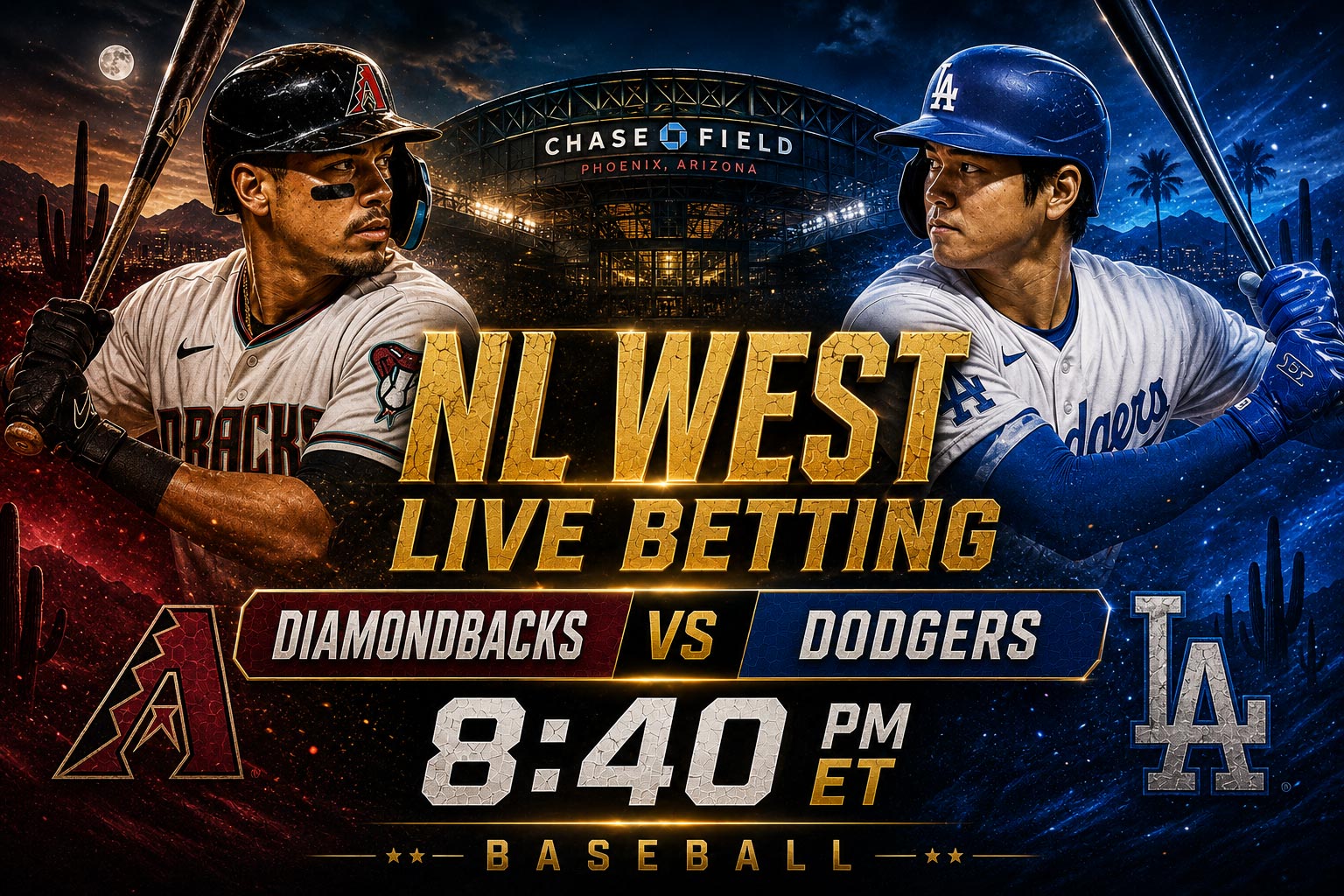
The Dodgers-Diamondbacks rivalry hits different when you’re staring at live odds at 10 PM on a random Thursday in June. This isn’t some playoff drama—it’s a divisional slugfest at Chase Field where the total’s already moved twice before first pitch, and the sharps are circling Shohei Ohtani props like vultures over a carcass. Tonight’s game (June 4, 2026, 8:40 PM ET) is setting up to be a live betting goldmine if you know where the inefficiencies live. The public’s gonna pound the Dodgers moneyline because they always do, but the real edge? It’s hiding in the live markets once this thing gets rolling.
Dodgers-Dbacks Live Bet: Where the Edge Is
The Pre-Game Setup Is a Trap
Here’s what’s happening before the game even starts: Books are getting absolutely hammered with Dodgers money, which makes sense given LA’s roster construction and the fact that casual bettors treat them like the Yankees of the West Coast. But Chase Field plays like a launching pad in June—we’re talking 95-degree temps at first pitch with that Arizona dry heat turning fly balls into souvenirs. The opening total probably started around 9.5, and if it’s moved to 10 or 10.5 by game time, that’s your first signal that the market’s reacting to public sentiment rather than environmental reality.
The real play isn’t touching this game pregame at all. You’re paying maximum juice on inflated lines that have been steamed by square money all afternoon. Instead, you’re waiting for the live market to adjust in real-time, specifically targeting those middle innings where books overreact to small sample theater. Think about it: one three-run homer in the second inning and suddenly the total shoots up to 12.5, but the underlying pitching matchup hasn’t fundamentally changed. That’s your arbitrage window.
The edge in live betting Dodgers-Dbacks tonight comes from understanding that variance creates opportunity. Books need to protect themselves from sharp late money, so they overcorrect on live lines after big moments. Your job? Fade the panic when a team goes down early or hammer the under when a total inflates after one offensive explosion. This is basic risk mitigation applied to in-game volatility—you’re essentially buying low when the market sells high on emotion.
Middle-Inning Execution Strategy
The sweet spot for tonight’s live action is innings 4-6, where you’ll see the most dramatic line movement with the least actual information gain. If the Dodgers jump out to an early lead (which they love to do), watch the Diamondbacks’ live moneyline—it’ll balloon to something absurd like +280 or +320. That’s when you’re considering a small position, especially if Arizona’s got the heart of their order coming up. Chase Field late-game comebacks aren’t statistical anomalies; they’re built into the ballpark’s DNA.
Similarly, if this game stays tight through four innings (like 2-2 or 3-3), the live total becomes your playground. Books will keep it relatively high because of the venue, but if both bullpens are actually sharp tonight, you’re getting inflated over numbers that the pregame market would never offer. The key is watching pitch counts and bullpen usage—if either starter’s cruising on 60 pitches through five, that total’s probably overvalued by a full run.
Don’t sleep on the run line either. Live run lines in high-scoring environments create beautiful middle opportunities. Say the Dodgers go up 5-2 in the fifth—their live run line might move to -2.5 at plus money. If you already have Dodgers -1.5 from pregame (which I don’t recommend, but some of you degenerates definitely did), you can now hedge with Diamondbacks +2.5 live and guarantee a middle. That’s not gambling; that’s just math with extra steps.
The Psychology Play Nobody Talks About
Here’s something I learned running book in college: public bettors have recency bias so hardwired into their brains that they’ll chase narratives mid-game like it’s their full-time job. If Ohtani strikes out twice early, his prop markets will soften. If he doubles in his first at-bat, suddenly everyone wants a piece of his home run action at worse odds. The market overreacts to individual plate appearances in a way that creates exploitable inefficiencies.
Tonight’s specific edge? Watching how books adjust Ohtani props live after each at-bat. If he goes 0-for-2 early with weak contact, his total bases line will drop, but his actual quality of contact metrics might suggest he’s about to break through. That’s your cue to grab inflated plus-money on his next hit prop. Conversely, if he goes yard in the first inning, his remaining props will be juiced to hell—fade that noise unless you enjoy paying 20% vig for the privilege of bragging rights.
The other psychological element is understanding when books are protecting themselves versus when they’re baiting action. Late-game spreads that look "too good to be true" usually are—books know exactly what they’re doing when they offer a +4.5 run line at -110 in the eighth inning. But middle-inning totals? Those are often algorithmically adjusted without human oversight, which means they’re more exploitable. Find the cracks in the automation, and you’ll find your edge.
Ohtani Props & Alt Totals: Tonight’s Play
Why Ohtani Props Are Printing Money This Season
Shohei Ohtani in 2026 is basically a liquidity event disguised as a baseball player. Every at-bat generates more betting handle than some entire Tuesday night slates, which means books are constantly adjusting his lines based on volume rather than pure statistical modeling. This creates market inefficiency—when you’ve got Joe Public from Jersey hammering "Ohtani over 1.5 total bases" because he saw a highlight on Twitter, the books move the line to protect themselves, not because the underlying probability changed.
The specific play tonight revolves around alternative total bases markets. The standard Ohtani total bases line is probably sitting around 1.5 or 2.5 depending on the book, but the alt markets (0.5, 3.5, 4.5) are where the actual value lives. If you’re getting Ohtani over 0.5 total bases at anything better than -300, you’re essentially betting he gets a hit in a game where the Dodgers are projected to score 5+ runs. That’s not a "lock" (nothing is), but it’s about as close to expected value positive as you’ll find in player props.
Here’s the MBA framework applied: You’re diversifying across correlated assets (Ohtani props) while maintaining asymmetric upside. Throw a unit on over 1.5 total bases at a reasonable line, then sprinkle some action on the long-shot over 3.5 at +400 or whatever inflated number you can find. If he has a monster game, you’re printing. If he goes 1-for-4 with a single, you’re probably breaking even. That’s portfolio optimization, baby—just with more gambling and fewer Patagonia vests.
Alternative Team Totals: The Matrix Play
Here’s where tonight gets spicy: alternative team totals are criminally underutilized by the betting public, which means there’s still edge to be found. Instead of betting the standard Dodgers team total of 5.5, you’re looking at the alt markets—Dodgers over 4.5 at better odds, or Dodgers over 7.5 at big plus money. The key is understanding the distribution of outcomes and finding where the book’s pricing doesn’t match the actual probability curve.
Chase Field in June with two offenses that can absolutely rake? The probability of the Dodgers scoring exactly 5 or 6 runs is high, but the probability of them scoring 7+ is also higher than the public thinks. Books price alt totals assuming normal distribution, but baseball scoring isn’t normally distributed—it’s more clustered and fat-tailed. That means the over 7.5 at +250 might actually have implied probability closer to 30% instead of the 28.5% the odds suggest. Tiny edges compound over time.
The contrarian play is also looking at alt unders if you think this game stays tighter than expected. Dodgers under 3.5 runs at +300 or better is basically betting on an Arizona pitching performance that keeps LA’s bats quiet. It’s low probability, sure, but if you’re getting 3-to-1 or 4-to-1 on something that happens 20-25% of the time, you’re making the mathematically correct bet over a large enough sample. This is the stuff that separates sharp bettors from the "I got a feeling" crowd.
The Parlay Trap vs. The Smart Stack
Look, I know you’re going to build a same-game parlay because that’s what everyone does now—it’s basically the financial equivalent of ordering bottle service at a club. Books love SGPs because the correlation between outcomes isn’t properly priced, which means you’re paying invisible vig on every leg. But if you’re dead-set on parlaying tonight (and I can’t stop you), at least do it intelligently.
The "smart stack" for tonight: Dodgers-Diamondbacks over 9.5 + Ohtani over 1.5 total bases + Ohtani to record an RBI. These outcomes are positively correlated (high-scoring game benefits all three legs), but they’re not so tightly correlated that you’re just betting the same thing three times. You’re capturing different angles of the same thesis: this game’s going to be a slugfest, and Ohtani’s going to be in the middle of it. Find a book offering decent SGP odds (DraftKings usually prices these better than FanDuel), and keep your stake reasonable.
The trap parlay is the one where you’re adding uncorrelated or negatively correlated legs just to pump up the payout. Dodgers moneyline + under 10.5 runs + Ohtani over 2.5 total bases? You’re basically hoping for a low-scoring Dodgers win where Ohtani somehow accounts for half their offense. Possible? Sure. Probable? Not at the odds you’re getting. Every leg you add to a parlay increases the vig exponentially—it’s like compound interest except you’re the one getting charged. Keep it tight, keep it correlated, or just bet straight sides and props like an adult.
Tonight’s Dodgers-Diamondbacks game is setting up to be one of those random June battles that actually matters for your bankroll if you play it right. The edge isn’t in blindly betting LA because they’ve got the better roster—it’s in exploiting live market inefficiencies, capitalizing on Ohtani prop volatility, and understanding when alt totals are mispriced. Chase Field under the lights with two offenses that can mash is basically a laboratory for finding value in chaos. So what’s the move—are you riding Ohtani props into the sunset, or are you going full degen on a live middle? Drop your plays in the comments, and let’s see who actually knows ball versus who’s just here for the dopamine hits.
"WannaBet.com may receive compensation from the sportsbooks mentioned in this post if you sign up using our links. This doesn’t cost you a dime, but it keeps the lights on. Please bet responsibly. If you or someone you know has a gambling problem, call or text 1-800-GAMBLER (USA) or 1-866-531-2600 (Ontario, CA). 21+ only."
