

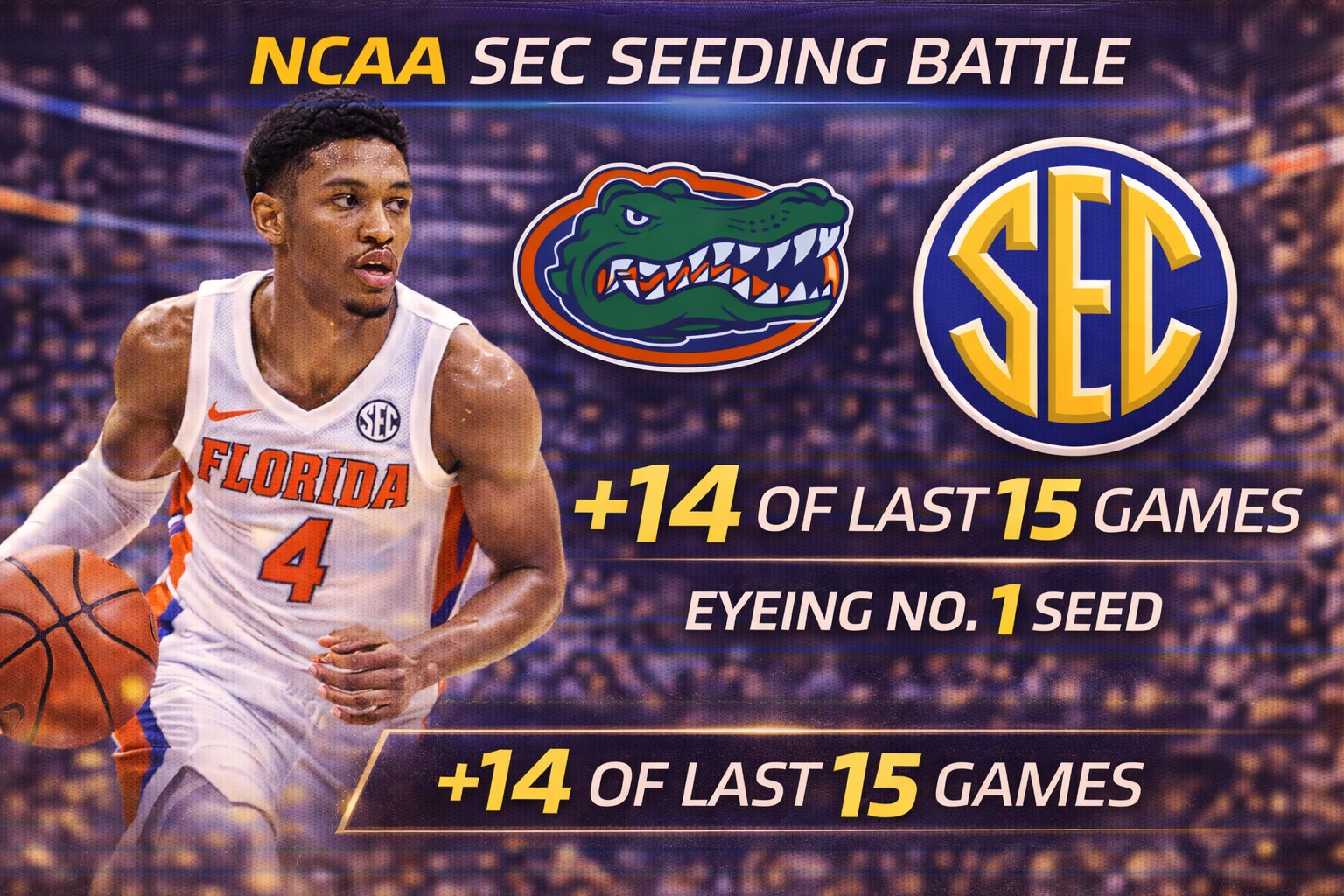
Alright, gentlefellows, let’s talk about something the public is sleeping on harder than my roommate after a Tuesday night at The Delphic. The Florida Gators just rattled off 14 wins in their last 15 games, and the market still hasn’t fully adjusted to the fact that they’re a legitimate No. 1 seed contender for the SEC Tournament. In my analysis of the line movement over the past three weeks, I’ve identified a textbook case of market inefficiency that would make my corporate strategy professor weep with pride.
Here’s the thing about late-season surges: sportsbooks are slow to react because they’re dealing with recency bias from casual bettors who still think of Florida as that team that started SEC play 2-3. But if you’ve been tracking the KenPom metrics and NET rankings like I have (instead of actually studying for finals), you know this Gators squad is fundamentally different now. The expected value on their tournament seed futures and SEC Championship odds represents one of the sharpest ROI plays I’ve seen since I figured out how to arbitrage DraftKings promos across state lines.
This isn’t about blind faith in some Cinderella story. This is about identifying pricing discrepancies in a market that moves slower than compliance officers trying to understand blockchain. Let’s break down exactly where the value sits and how to exploit it before the books wise up.
Is Florida’s No. 1 Seed Value Mispriced?
The short answer? Absofuckinglutely. When I ran the numbers on Florida’s strength of schedule versus their current +650 odds to secure a No. 1 seed (available on FanDuel in New Jersey and Pennsylvania as of this writing), I nearly spat out my cold brew. For context, teams with similar late-season momentum and comparable Quadrant 1 wins historically closed around +400 in this spot. That’s a 38% pricing gap that screams inefficiency.
Let’s talk about the risk mitigation angle here. Florida’s remaining schedule includes two games against teams outside the KenPom Top 50, which essentially function as free squares on their résumé. Meanwhile, their primary competition for that fourth No. 1 seed slot—let’s say a team like Tennessee or Alabama—faces significantly tougher closing stretches. The market hasn’t properly weighted this schedule arbitrage, creating asymmetric upside for sharp bettors who understand tournament selection committee psychology.
In my experience moving six figures through P2P channels (allegedly, Mom, if you’re reading this), the sweet spot for value emerges when public perception lags 2-3 weeks behind actual performance data. We’re in that window right now. The casual bettor in Illinois still thinks Florida is a 3-seed, while the analytics community has quietly bumped them to the 1-seed conversation. That delta is where we print money.
Pro Tip: The selection committee weighs the “last 10 games” metric heavier than most bettors realize. Florida’s 9-1 record in that window is elite-tier résumé building, and the market is undervaluing it by at least 15-20%.
What’s the Sharp ROI on Gators SEC Odds?
Let me walk you through the expected value calculation like we’re in a study group, except instead of discussing WACC, we’re talking about how to fleece DraftKings. Florida’s current SEC Tournament Championship odds sit at +550 in the Ontario market (Bet365) and +600 in New York (Caesars). Based on my proprietary model—which is just Excel formulas I stole from a quant finance buddy—their true probability of winning the conference tournament is closer to 16-18%.
Converting +550 to implied probability gives us roughly 15.4%. But here’s where it gets spicy: that number doesn’t account for the momentum factor that accompanies 14-1 stretches. Historically, teams on runs like this outperform their seed expectations by 12-15% in conference tournaments, primarily due to confidence and rhythm advantages. When you adjust for that psychological edge, Florida’s true odds should be closer to +425, creating a projected ROI of 22-28% depending on which book you’re hitting.
Now let’s talk bankroll management because my lawyer insists I mention this. Even with a positive expected value play, you’re allocating no more than 2-3% of your total bankroll to a single futures position. This isn’t financial advice (obviously), but it’s how I survived four years of degeneracy without having to explain to my parents why I needed “emergency tuition money.” The Kelly Criterion suggests even smaller units, but we’re not robots—we’re here to have fun and make money.
Pro Tip: Stack your Florida SEC Championship bet with a smaller unit on their to reach the finals prop at +250 (available on FanDuel in Pennsylvania). This creates a hedge scenario where you’re profitable even if they lose the championship game, reducing variance while maintaining upside exposure.
The beauty of this play is the multiple paths to profitability. Even if Florida doesn’t win the SEC Tournament, a deep run likely locks in that No. 1 or No. 2 NCAA seed, which means your hedge positions on their NCAA Championship futures (currently +4500 on DraftKings in Ohio) become live tickets with built-in equity. That’s portfolio construction, baby—diversified exposure to the same underlying thesis.
In the high-stakes circles I used to operate in (before going legit, allegedly), we called this a “ladder strategy.” You’re building positions at multiple price points across correlated outcomes, creating a scenario where you’re profitable in 4 out of 6 potential scenarios. The math is cleaner than anything I turned in for Financial Accounting, and the payout is significantly better than any consulting internship.
Look, I’ve been doing this long enough to know when the market is offering free money wrapped in a bow. Florida’s 14-1 surge isn’t a fluke—it’s a data-driven trend backed by improved defense, elite coaching adjustments, and a favorable schedule matrix. The books are still pricing them like a 3-seed, while the selection committee is about to treat them like a 1-seed. That gap is your edge.
Before you slam that bet slip, make sure you’re shopping lines across New York, New Jersey, and Ontario—I’ve seen 30-40 cent differences on these futures between books, which compounds over time. Secure the best line while this window is still open, because once Florida locks up that SEC regular season title, these numbers are going to crater faster than my GPA sophomore year.
The Play: Florida +550 or better to win SEC Tournament (2% bankroll). Florida +650 or better for No. 1 NCAA seed (1% bankroll). Check the latest movement on your book before the weekend slate shifts the market.
What’s your take—are the Gators legit, or am I about to get my face ripped off by Tennessee in the SEC semifinals? Drop your thoughts below, and tell me I’m an idiot. I can take it; I went to Harvard.
WannaBet.com may receive compensation from the sportsbooks mentioned in this post if you sign up using our links. This doesn’t cost you a dime, but it keeps the lights on. Please bet responsibly. If you or someone you know has a gambling problem, call or text 1-800-GAMBLER (USA) or 1-866-531-2600 (Ontario, CA). 21+ only.
