

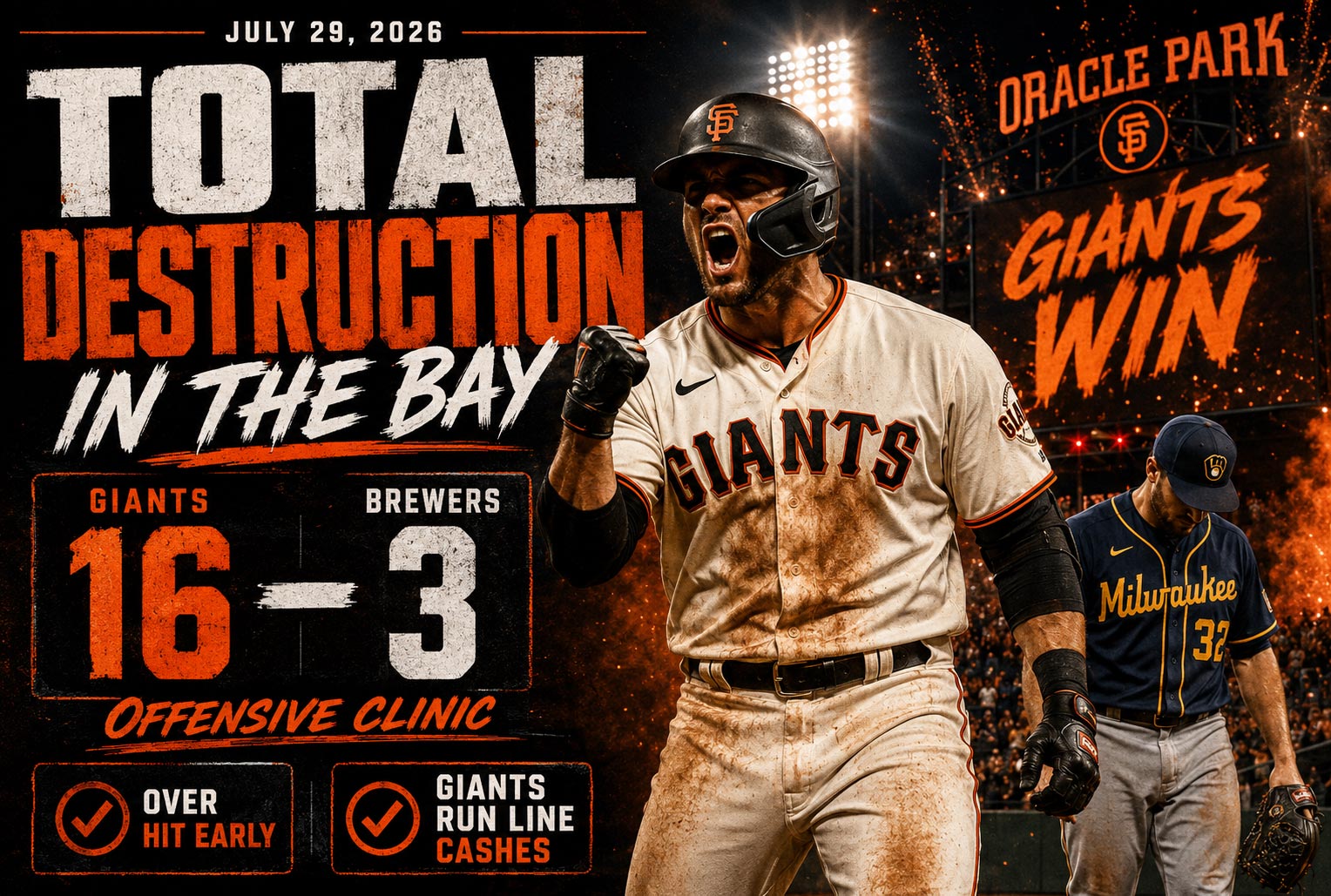
The oddsmakers got absolutely bodied on July 29th, and if you weren’t on the right side of Giants-Brewers, you missed one of those rare games where sharp money knew something the public didn’t. Oracle Park was supposed to host a pitcher’s duel with a modest 8.0-run total, the kind of sleepy Tuesday night game where casual bettors hammer the under because "it’s San Francisco, bro." Instead, the Giants turned Milwaukee’s pitching staff into a batting practice session, dropping 16 runs in what became a masterclass in exploiting market inefficiencies. This wasn’t luck—this was textbook sharp betting execution, and the 16-3 final score had professional bettors cashing tickets by the middle innings while recreational money burned faster than a tech startup’s Series A funding.
How Sharp Money Steamrolled a Giants Blowout
The line movement told the entire story before first pitch if you knew where to look. Early money came in hot on the Over, pushing it from 8.0 to 8.5 at some books, while sharp bettors simultaneously hammered Giants alternative run lines at -2.5 and -3.5. This wasn’t random—sharp action identified a fundamental mismatch between Milwaukee’s depleted bullpen (which had thrown 6+ innings the previous two games) and San Francisco’s suddenly hot lineup that was averaging 5.8 runs over their last seven home games.
The public, meanwhile, was doing what the public always does: overthinking shit and betting based on name recognition rather than current form. Milwaukee’s reputation as a solid pitching team created a perception gap that sharps exploited mercilessly. When you’ve got a market inefficiency this glaring—a tired bullpen, favorable park factors for left-handed power, and inflated public perception—you don’t just bet it, you attack it with size.
By the fourth inning, this game was effectively over for anyone paying attention to live betting edges. The Giants had already plated 8 runs, the Over was a done deal, and the run line was looking like free money. This is what separating signal from noise looks like in real-time—while casual bettors were still checking their phones wondering what happened, sharps were already calculating their ROI and looking for the next edge.
The Market Inefficiency That Paid 16-3 Dividends
The core inefficiency here was the market’s failure to properly price recent workload and regression to the mean. Milwaukee’s bullpen had been overworked, their starters were on short rest, and Oracle Park’s dimensions actually favor left-handed pull hitters when the wind is right (which it was that evening). Oddsmakers set that 8.0 total based on seasonal averages rather than current situational factors—a classic case of backward-looking data creating forward-looking opportunities.
Sharp bettors also recognized something crucial: the Brewers’ offense wasn’t going to keep this competitive once they fell behind. Milwaukee ranked 23rd in comeback win percentage and had the second-worst OPS against right-handed pitching in games where they trailed by 4+ runs. This created a perfect storm for alternative run line value—once the Giants built a lead, the game script was essentially locked in, and that -2.5 line that opened at +140 suddenly looked like the steal of the century.
The real genius move was combining the Over with Giants team total Over and sprinkling in some -2.5 run line action for a correlated parlay. These bets move together—if San Francisco is crushing, they’re likely covering big spreads and pushing the total over simultaneously. It’s not rocket science, but it requires understanding game theory and how scoring environments create compounding value across multiple bet types rather than treating each wager as an isolated event.
The aftermath tells you everything about market efficiency (or lack thereof). Books got absolutely wrecked on this game, with some offshore shops reporting their worst single-game MLB loss of the month. When sharp money moves in coordination and the game script follows exactly as the numbers suggested it would, that’s not gambling—that’s exploiting information asymmetry for profit. The casuals who bet the under because "Oracle Park plays small" learned an expensive lesson about the difference between narrative and data.
This Giants-Brewers bloodbath perfectly illustrates why sharp bettors win long-term while the public keeps funding sportsbook revenue reports. It wasn’t about getting lucky on a random blowout—it was about identifying a clear market inefficiency, understanding situational handicapping factors that the opening lines didn’t properly account for, and having the conviction to bet it with size when the edge presented itself. The 16-3 final wasn’t some statistical anomaly; it was a predictable outcome for anyone doing actual work instead of betting based on vibes and outdated team reputations. Next time you see a total that feels off or a run line that seems too generous, ask yourself: am I seeing something the market missed, or am I about to become exit liquidity for sharps who already moved the line? Drop your worst "thought it was a lock" beat-down story in the comments—misery loves company, and we’ve all been on the wrong side of a game that went sideways by the third inning.
WannaBet.com may receive compensation from the sportsbooks mentioned in this post if you sign up using our links. This doesn’t cost you a dime, but it keeps the lights on. Please bet responsibly. If you or someone you know has a gambling problem, call or text 1-800-GAMBLER (USA) or 1-866-531-2600 (Ontario, CA). 21+ only.
