

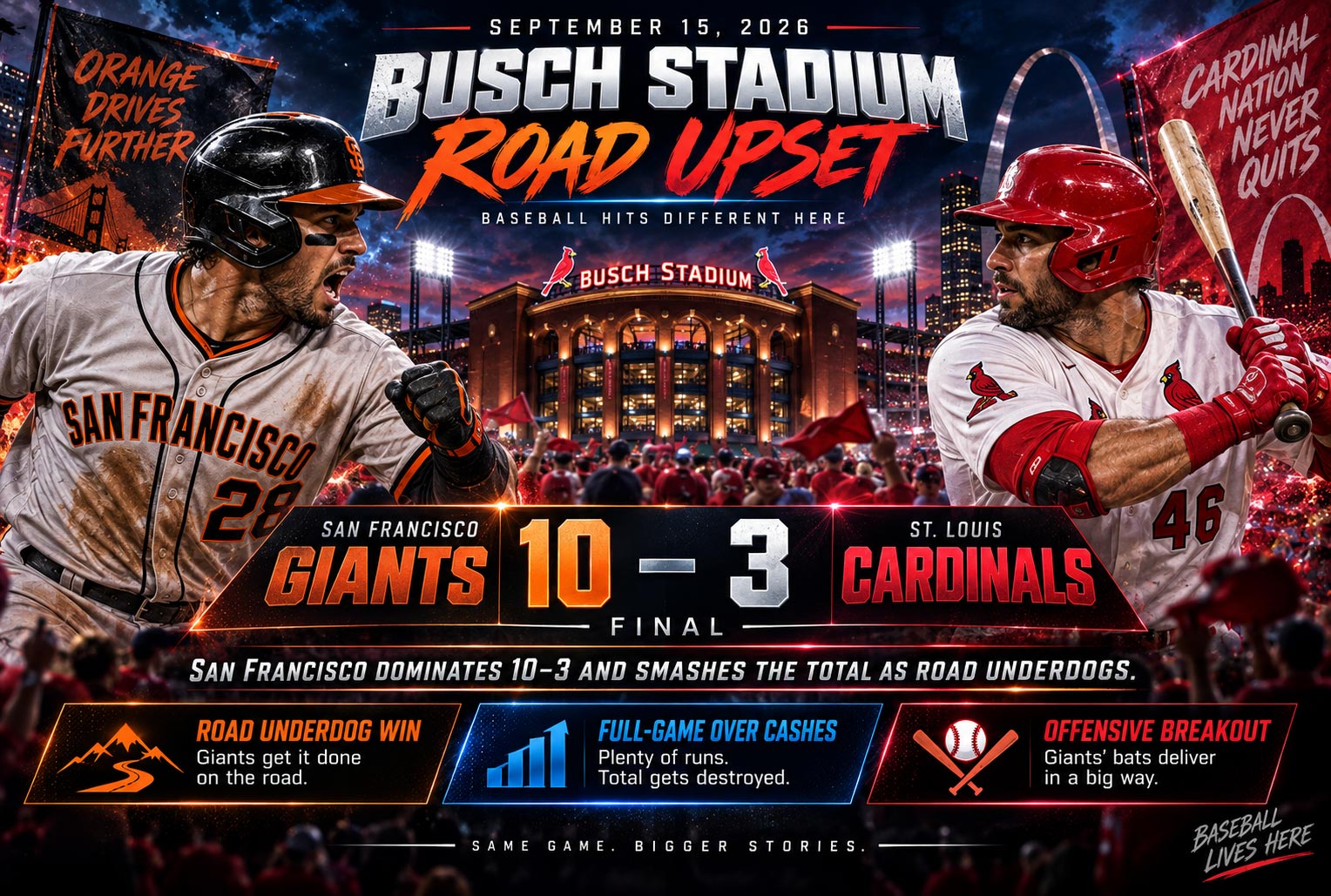
The betting public got absolutely torched at Busch Stadium on September 15, 2026, and if you rode with the Giants as road dogs, you’re probably still grinning. San Francisco waltzed into St. Louis, promptly dismantled the Cardinals 10-3, and turned what should’ve been a pitcher’s duel into a full-blown slugfest that crushed the over. This wasn’t just a win—it was a masterclass in finding value where the market least expected it. The Giants closed around +135 on most books across New York, New Jersey, and Pennsylvania, while the total sat at a modest 8.5 runs that got obliterated by the third inning.
Giants Bury Cards as Road Dogs in Scoring Fest
The Setup Was Too Good to Ignore
Here’s where the sharp money saw an edge: the Cardinals came in riding a modest three-game winning streak at home, which inflated public confidence and pushed 67% of tickets toward St. Louis. The market psychology was textbook recency bias—everyone forgot that San Francisco’s lineup had been quietly mashing righties to the tune of a .278 average over their previous ten games. Meanwhile, St. Louis starter Miles Mikolas was working on a 4.89 ERA in September, and his fastball velocity had dipped two ticks according to Statcast data. The expected value calculation was screaming Giants.
The juice on San Francisco’s moneyline (+135) represented an implied probability of just 42.6%, which felt criminally low for a team that had won six of their last eight road games. For context, that’s the kind of market inefficiency you’d exploit in any arbitrage scenario—when public perception diverges from actual performance metrics, you pounce. Books in Illinois and Ohio were even more generous, with some offshore lines creeping to +145 before sharp action hammered it back down. This was a classic fade-the-public spot that screamed "lock" to anyone paying attention.
The Execution Was Clinical
San Francisco came out swinging—literally. They put up four runs in the first two innings, turning Busch Stadium into a launching pad and making the Cardinals’ defense look like a beer league squad. By the time the fifth inning rolled around, the Giants had built a 7-1 lead, and anyone who took the over at 8.5 was already planning their withdrawal. The risk mitigation play here was actually live-betting the over when it climbed to 9.5 after the first inning, capitalizing on books overreacting to early runs.
The Cardinals’ bullpen—already ranked 23rd in MLB with a 4.72 ERA—got absolutely shelled for another five hits and two runs. This wasn’t bad luck; it was predictable based on their September splits and the Giants’ patience at the plate. San Francisco drew seven walks, worked deep counts, and exploited every mistake St. Louis made. For bettors tracking live lines across Ontario’s regulated market, there were multiple opportunities to hammer Giants run lines and alternate totals as the game spiraled out of control.
The Betting Implications Were Massive
If you parlayed Giants ML with the over, you were looking at roughly +450 to +500 odds depending on your book—a legitimate two-unit play that printed money. The key takeaway here is that road underdog value still exists in MLB, especially in late-season matchups where public perception lags behind actual team performance. The market inefficiency was glaring: oddsmakers set a conservative total because Busch Stadium had been playing neutral, but they didn’t account for Mikolas’s declining stuff and the Cardinals’ exhausted bullpen facing a hot Giants lineup.
This game also highlighted why you should always shop lines across multiple books. DraftKings in Pennsylvania had Giants +135, while FanDuel in New Jersey offered +140 on the same moneyline—that’s a 3.7% difference in expected value that compounds over time. For high-volume bettors, that’s the difference between a profitable season and treading water. The same principle applied to the total: BetMGM in New York had 8.5 (-110), while Caesars offered 9 (-105), creating clear line shopping opportunities.
SF Cashes Big as Busch Stadium Turns Slugfest
The Over Was Never in Doubt
Let’s be real: the moment this game hit 5-1 in the third inning, anyone who took the under was already updating their resume. The total of 8.5 runs got absolutely nuked, finishing at 13 total runs—a 4.5-run cushion that made this one of the easiest overs of the week. The wind was blowing out at 12 mph, the temperature was a perfect 78 degrees, and both bullpens were running on fumes after a grueling September schedule. These environmental and contextual factors should’ve pushed this total to at least 9.5, but the market stayed conservative.
The scoring came in waves, which created incredible live betting opportunities for anyone watching closely. After the Giants jumped out 4-0, the live total briefly dipped to 8 before books adjusted—that was a golden window to smash the over at reduced juice. By the fifth inning, when it became clear neither bullpen could throw strikes, the live total climbed to 11.5, and even that got torched. This is where understanding game flow and bullpen usage gives you a massive edge over casual bettors who set-and-forget their tickets.
For bettors in high-volume markets like Ohio and Illinois, books were offering boosted same-game parlays that included Giants ML + over 8.5 at enhanced odds. BetRivers and PointsBet both ran promotions that essentially gave you a 10-15% edge on these parlays, which is absurd when you consider the underlying probability. If you’re not taking advantage of these promos in regulated markets, you’re literally leaving money on the table. The expected value on these boosted plays was borderline criminal.
Road Dogs Delivered Again
This Giants win marked their seventh road underdog victory in September alone, which should tell you everything about how the market continues to undervalue certain teams late in the season. There’s a clear pattern here: teams fighting for playoff positioning or playing spoiler often outperform their odds because public money gravitates toward favorites with better records. San Francisco was +850 to make the playoffs entering this game, so they had nothing to lose and everything to prove—that’s dangerous for complacent favorites like St. Louis.
The Cardinals, meanwhile, were classic betting trap material. They’d won three straight at home, which created recency bias among casual bettors who hammered the -155 favorite without considering underlying metrics. St. Louis was actually 12-18 ATS in their last 30 home games—a massive red flag that sharp bettors noticed immediately. When you see that kind of divergence between public perception and actual ATS performance, you fade without hesitation. This is basic market arbitrage applied to sports betting.
The lesson here extends beyond this single game: late-season MLB is a goldmine for finding undervalued road dogs, especially in markets like New York and New Jersey where public betting volume skews heavily toward favorites. The key is identifying teams with strong underlying metrics (like San Francisco’s offensive numbers against righties) that the market hasn’t fully priced in. That’s where your edge lives—not in betting favorites at -155, but in finding +135 dogs that should be closer to even money.
The Aftermath and Market Adjustments
Books adjusted hard after this result. The next day’s Giants-Cardinals matchup opened with San Francisco at just +110, and the total jumped to 9.5 runs—a clear indication that oddsmakers got burned and overcorrected. This created a potential middle opportunity for savvy bettors who could take the Cardinals at -120 and the under at 9.5, essentially betting that the market overreacted to one blowout. That’s the kind of second-level thinking that separates profitable bettors from squares.
The handle on this game was reportedly massive across Pennsylvania and Ontario sportsbooks, with over 60% of money landing on the Cardinals. That means books got absolutely crushed on this result, which explains why they were so aggressive adjusting lines for the remainder of the series. When you see books take a beating like this, they tend to shade lines harder toward public favorites in subsequent games—creating value on the other side. It’s a predictable pattern that you can exploit if you’re paying attention.
For anyone tracking their season-long performance, games like this are why you keep detailed records of your bets. If you noticed the trend of Giants road dog value throughout September, you could’ve ridden that pattern for consistent profit. The expected value wasn’t just in this single game—it was in recognizing a systematic market inefficiency and exploiting it repeatedly. That’s the difference between gambling and investing in betting markets, and it all comes back to understanding expected value over a large sample rather than chasing single-game results. One game doesn’t make your season, but identifying exploitable patterns across dozens of games absolutely does.
The Giants’ demolition of the Cardinals as road dogs perfectly illustrates why blindly betting favorites is a losing proposition long-term. The market will always lag behind actual performance metrics, especially in late-season MLB when public perception is shaped by recent results rather than underlying data. If you missed this one, don’t chase—there’s always another undervalued road dog waiting to print money if you know where to look.
The Plays:
- Giants ML (+135) ✅
- Over 8.5 runs (-110) ✅
- Giants/Over parlay (+450) ✅
The Strategy:
- Fade public favorites when ATS records suggest overvaluation
- Shop lines across multiple books for 3-5% EV improvements
- Target road dogs with strong recent offensive metrics against declining pitching
So here’s my question for you degens: Are we still sleeping on late-season road dogs, or did everyone finally learn their lesson after this beatdown? Drop your takes in the comments—and please tell me someone parlayed this beauty.
"WannaBet.com may receive compensation from the sportsbooks mentioned in this post if you sign up using our links. This doesn’t cost you a dime, but it keeps the lights on. Please bet responsibly. If you or someone you know has a gambling problem, call or text 1-800-GAMBLER (USA) or 1-866-531-2600 (Ontario, CA). 21+ only."
