

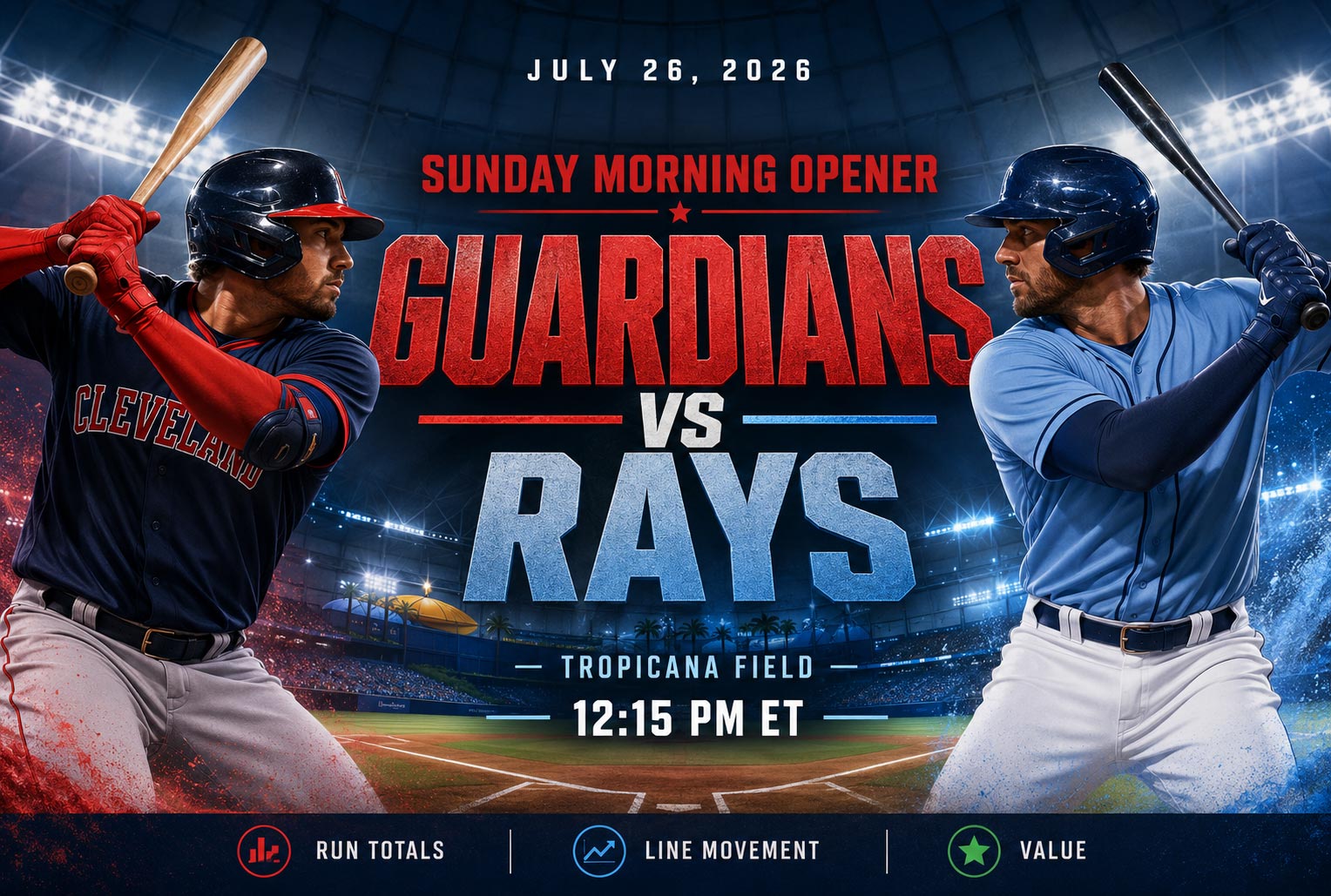
The Tropicana Field Sunday matinee between Cleveland and Tampa Bay isn’t exactly primetime viewing, but it’s got every sharp bettor I know glued to their phones this morning. When you see coordinated line movement at 7 AM on a MLB total, that’s not grandma in Des Moines firing off her weekly parlay—that’s professional money finding an edge. The opening total of 8 runs has been absolutely hammered down to 7.5 at most books, and here’s the kicker: public betting percentages show 62% of tickets on the over. So why is the line moving the opposite direction? Because sharp money doesn’t give a damn about what the casual crowd thinks, and they’re loading up on the under like it’s Amazon stock in 2001.
Sharp Money Hammering Guardians-Rays Total
The line movement on this game is textbook sharp action, and if you’ve been in this space long enough, you can spot it from a mile away. We opened at 8 runs across the major books—DraftKings, FanDuel, BetMGM—and within three hours of the line posting, we’re sitting at 7.5 with juice creeping toward -115 on the under. That’s not organic movement from weekend warriors betting their mortgage payment; that’s coordinated smart money getting down early before the window closes.
What makes this particularly interesting is the betting splits tell a completely different story than the line movement. According to Action Network’s public betting data, 62% of tickets are on the over, but 71% of actual money is on the under. That’s a classic reverse line move, which in efficient market theory means institutional bettors (sharps, syndicates, whatever you want to call them) are taking a contrarian position against public sentiment. When the masses are zigging, the Harvard MBA grads who actually make a living at this are zagging.
The velocity of the move matters too—we’re talking about a half-run shift in under four hours on a Sunday morning when most recreational bettors are still nursing their Saturday night hangovers. Books don’t move lines aggressively unless they’re getting hit by accounts they respect, and right now, the risk management teams at every major shop are clearly seeing action they can’t ignore. This isn’t noise; this is signal.
Why the Smart Money Is Fading the Public Here
Let’s talk pitching matchups because that’s where the edge lives in MLB totals. Cleveland is throwing Tanner Bibee, who’s been absolutely dealing lately with a 2.87 ERA over his last six starts and a strikeout rate that’s ticking up to 9.4 K/9. More importantly, his ground ball rate against right-handed hitters is sitting at 48%, which plays perfectly in a dome environment where fly balls don’t get the same carry. Tampa Bay counters with Zach Eflin, who’s been criminally undervalued this season—3.12 ERA, 1.08 WHIP, and he’s gone at least six innings in eight of his last ten outings. When you’ve got two starters with this kind of form, the under becomes a value play even at 7.5.
The market psychology angle here is fascinating because casual bettors love overs—it’s basic behavioral economics. Rooting for runs is more fun than rooting for outs, so recreational money naturally gravitates toward higher-scoring games regardless of the matchup. The public sees two teams that can hit (Cleveland’s been decent at the plate lately, Tampa Bay has power in the lineup) and they default to the over without doing the actual work on pitcher performance, bullpen usage, or park factors. Meanwhile, the sharps are running their regression models, factoring in rest days, umpire tendencies, and weather conditions (it’s a dome, so that last one’s moot, but you get the point).
There’s also the situational spot to consider—this is a Sunday day game after both teams played Saturday night. Day-after-night games historically trend under because hitters don’t get their full routine, timing feels off, and starting pitchers typically have an advantage. The sharps know this, they’ve got databases going back decades proving it, and they’re exploiting it while the public is still thinking "Rays bats at home = runs." That’s the difference between betting with your gut and betting with an actual edge.
Here’s my take: I’m following the sharp money to the under 7.5, and I’d still take it at -115 juice if that’s where your book is sitting. The pitching matchup supports it, the line movement confirms where the smart money went, and the contrarian angle gives us value against an over-inflated public side. Will it hit? Nothing’s guaranteed in gambling, but I’ll take these odds every time over a coin flip.
What are you guys seeing on your books? Is this under still available or did the line already move past 7.5 in your jurisdiction?
WannaBet.com may receive compensation from the sportsbooks mentioned in this post if you sign up using our links. This doesn’t cost you a dime, but it keeps the lights on. Please bet responsibly. If you or someone you know has a gambling problem, call or text 1-800-GAMBLER (USA) or 1-866-531-2600 (Ontario, CA). 21+ only.
Sharp money doesn’t make noise—it makes moves. This Guardians-Rays total is a masterclass in how professional bettors identify market inefficiencies and exploit them before the window closes. While the public is chasing the dopamine rush of rooting for runs, the smart money is quietly banking on elite pitching and situational advantages that most casual bettors completely overlook. Whether you tail this play or not, understanding how to read line movement and betting splits is the difference between being a long-term winner and just another ATM for the sportsbooks.
