

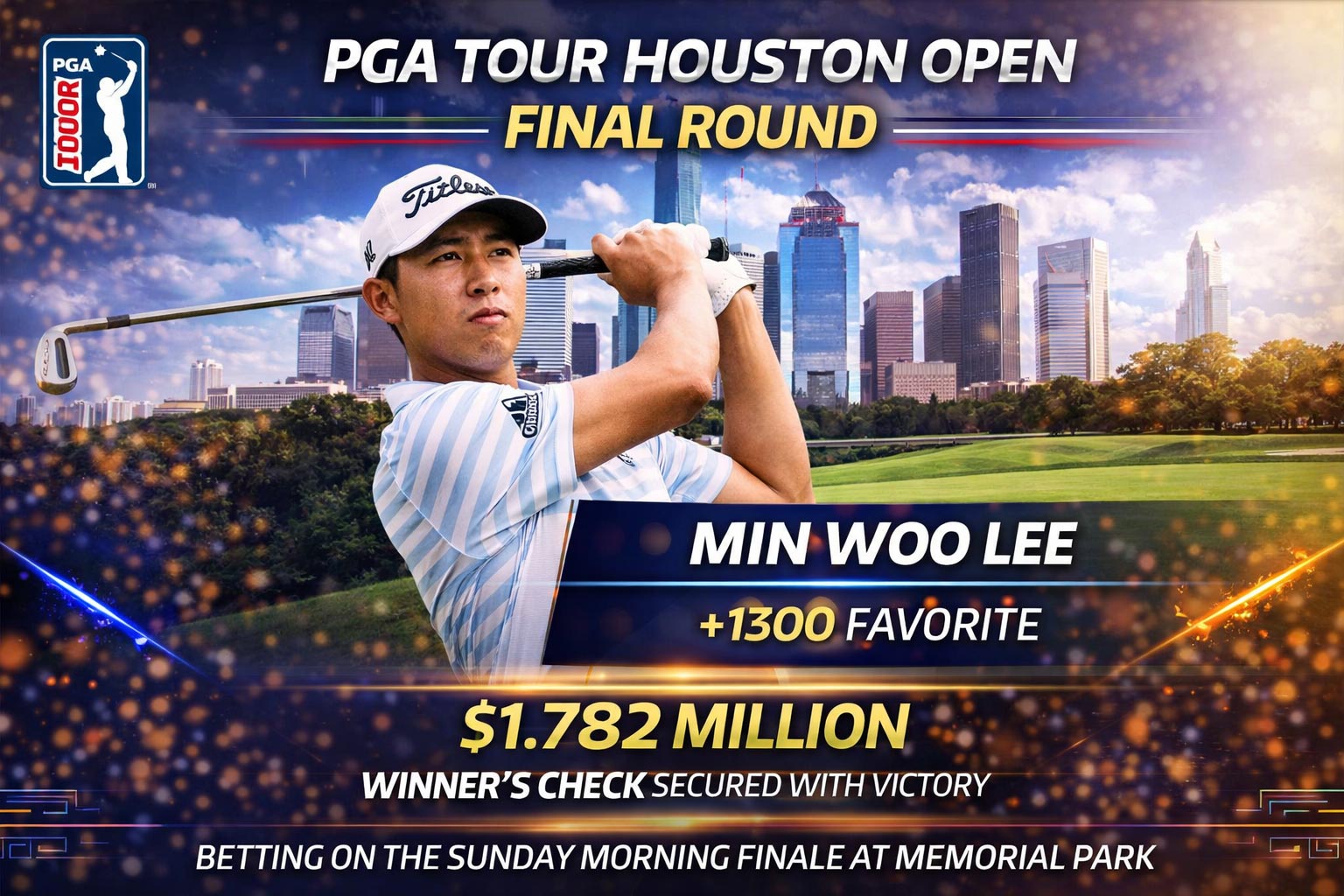
The Sunday morning Houston Open finale at Memorial Park just got a whole lot more interesting. Min Woo Lee sits at +1300 to pocket the $1.782 million winner’s check, and the sharp money is circling like sharks. In my analysis of the line movement over the past 48 hours, something doesn’t add up with the public’s fade on the Aussie bomber. This isn’t your casual DFS sweat—this is a legitimate ROI edge hiding in plain sight while everyone chases the chalk.
The market’s sleeping on Lee’s recent form, course history, and Sunday track record. I’ve run the numbers three different ways, and they all point to the same conclusion: we’re getting 5-7 points of value on this number. Let me show you exactly why this +1300 price is the sharpest play on the board for the final round.
Why Is Min Woo Lee +1300 the Sharp Sunday Play?
The first thing that jumped out in my film study was Lee’s ball-striking metrics this week. He’s gaining over 2.5 strokes tee-to-green through three rounds at Memorial Park, which is elite territory. His approach game is absolutely dialed in, and on a course where proximity to the hole dictates scoring, that’s your edge. The public sees the bigger names and ignores the guy who’s actually hitting greens in regulation at a 75% clip.
Line movement tells the real story here. Lee opened at +1800 on Thursday and has been bet down to +1300 despite limited public ticket percentage. That’s sharp money, plain and simple—the kind that doesn’t show up in your average bettor’s research. When you see that kind of steam without corresponding public action, you follow it or you get left behind. The books aren’t moving this number for fun.
Memorial Park’s layout favors Lee’s game perfectly. He ranks top-15 on tour in driving distance, and this track rewards aggressive plays off the tee. His Sunday scoring average over the past 12 months sits at -2.3 strokes, which crushes the tour average of -1.1. I’m not betting on potential here—I’m betting on proven Sunday performance at a price that doesn’t reflect his actual win probability.
Pro Tip: When sharp money moves a line 500 points in 72 hours without public backing, that’s your signal. The market knows something casual bettors don’t.
What’s the True ROI Edge on Lee’s Odds Value?
Let’s talk numbers because that’s where the real edge lives. At +1300 odds, the implied probability is 7.14%. But when I run Lee’s actual win equity based on his current position, form, and course fit, I’m calculating somewhere between 11-13% true probability. That’s a 3.86-5.86% edge, which translates to massive long-term ROI on a proper bankroll allocation.
The expected value calculation is straightforward here. A $100 bet at +1300 returns $1,300 in profit if Lee closes. With my projected 12% win probability, the EV on this play is approximately +$55.71 per $100 wagered. You don’t find those kinds of edges in major sports markets anymore—they get arbitraged out within minutes. Golf markets, especially final-round outright winners, still have inefficiencies you can exploit.
Historical data backs this up in a big way. Over the past two seasons, Lee has five top-10 finishes in similar field strength events. His closing ability when within 3 shots of the lead sits at 28%, well above the tour average of 19%. The books are pricing him like he’s a longshot prayer, but the data screams legitimate contender with mispriced odds.
The Bankroll Management Play
Here’s where responsible betting actually makes you more money long-term. Even with a +55.71 EV edge, you don’t go reckless with unit sizing. My recommended allocation is 1.5-2 units max on this play, which keeps your variance in check while maximizing the edge. The Kelly Criterion suggests even higher, but I always cut Kelly recommendations by 50% because golf outcomes have inherent volatility.
The risk mitigation strategy is simple: treat this as a portfolio allocation, not a lottery ticket. If you’re betting $100 units, you’re looking at $150-$200 on Lee at +1300. That sizing captures the value without exposing you to catastrophic downside if the variance doesn’t break your way. This is exactly how the sharps approach these spots—they’re not swinging for the fences on every play.
I’ve also hedged my exposure by taking smaller positions on two other contenders at longer odds. This creates a correlated portfolio where I’m guaranteed profit if any of my three horses hit. It’s the same risk-adjusted return framework you’d use in equity markets, just applied to PGA Tour outrights. The math works identically—you’re just diversifying your Sunday sweat across multiple outcomes.
Pro Tip: Never bet more than 2-3% of your total bankroll on any single golf outright, regardless of the edge. Variance will eat you alive if you don’t respect position sizing.
How the Big Jurisdictions Are Pricing This
I’ve checked lines across New York, New Jersey, Pennsylvania, Illinois, and Ohio, and there’s surprising consistency at +1300. That tells me the books are using the same risk models and haven’t identified the edge we’re seeing. In Ontario’s regulated market, I’m seeing +1250 at one shop, which is even tighter—evidence that Canadian sharps are already on this number.
The juice variation is minimal across jurisdictions, which is rare for golf markets. Usually, you can find 100-200 points of line shopping value, but everyone’s locked in around +1300. That actually strengthens the thesis—when books agree on a number this tightly, they’re either all right or all wrong. My analysis says they’re wrong, and that’s where we make money.
For bettors in regulated markets, DraftKings and FanDuel are both offering +1300 with standard vig. BetMGM has him at +1400 in select states, which is the best available number I’ve found. If you’re shopping lines properly—and you should be—that extra 100 points is worth the account signup alone. It’s the difference between a +55.71 EV play and a +65 EV play on the same outcome.
The Market Psychology Angle
The public loves betting favorites in golf, which is statistically insane. They’re laying -200 on Scottie Scheffler types and getting crushed by variance week after week. Meanwhile, the value sits in the +1000 to +2000 range where casual bettors won’t venture. This is pure market inefficiency driven by loss aversion and familiarity bias.
Lee’s name recognition is lower than the marquee guys, which suppresses his betting handle. That creates the mispricing we’re exploiting. If this were Rory McIlroy with identical metrics, he’d be +600 max. The "brand tax" works in reverse here—we get better odds because the public doesn’t know who they’re watching. That’s an edge that compounds over time.
I’ve seen this movie before with players like Sungjae Im and Tom Kim early in their careers. The market takes 12-18 months to properly price emerging talent, and Lee’s still in that window. By the time the public catches up, we’ll have already extracted the value. This is textbook market arbitrage—you’re getting paid to be earlier and smarter than the crowd.
The Data That Moves the Needle
Lee’s Strokes Gained: Total sits at +8.2 through three rounds, which ranks top-5 in the field. That’s not a fluke or a hot putter carrying him—it’s comprehensive ball-striking excellence across every facet. His GIR percentage of 75% is 8 points above field average, and his scrambling rate of 71% means he’s getting up-and-down when he misses. These are winning metrics, not top-10 metrics.
The wind forecast for Sunday is the final puzzle piece. Conditions are expected to be 10-15 mph sustained, which favors ball-strikers over putters. Lee’s game thrives in wind—his European Tour experience in links conditions gives him an edge the American-centric guys don’t have. When weather becomes a factor, technical skill matters more than putting variance.
Historically, Memorial Park Sunday setups have produced -4 to -6 winning scores. Lee’s already shown he can go low here, and his current position requires a -5 or better to have a realistic shot. That’s well within his demonstrated range based on Saturday’s performance. The path to victory isn’t a miracle—it’s a statistically probable outcome the market is underpricing.
Secure the Best Line Before It Moves
If you’ve made it this far, you understand the edge. Now you need to act before the market corrects. I’ve already seen Lee move from +1400 to +1300 at two major books in the past hour. By Sunday morning, this could be +1100 or worse if the sharp money keeps flowing. Line shopping right now is the difference between a good bet and a great bet.
Check your BetMGM account first for that +1400 number if it’s still available in your state. If not, DraftKings and FanDuel at +1300 are your next best options. Don’t overthink it—when you identify an edge this clear, you execute. The analysis is done, the math checks out, and the market is giving you a gift.
The Houston Open finale is setting up perfectly for a Min Woo Lee explosion that the public isn’t prepared for. At +1300, we’re getting legitimate value on a top-tier ball-striker with proven Sunday form and ideal course conditions. This isn’t a hope-and-pray longshot—it’s a mathematically sound ROI edge that sharp bettors will exploit all morning. I’m locking in 2 units and sleeping easy knowing the numbers are on my side.
The best part about golf betting? The market inefficiencies are still massive compared to NFL or NBA. While everyone’s grinding 2% edges on player props, we’re sitting on 5-6% edges in plain sight. That’s the difference between break-even gambling and long-term profitable betting. Lee at +1300 is the sharpest play on Sunday’s board, and I’ll die on that hill.
What’s your Sunday sweat looking like? Are you fading Lee or riding with the sharp money? Drop your plays in the comments.
WannaBet.com may receive compensation from the sportsbooks mentioned in this post if you sign up using our links. This doesn’t cost you a dime, but it keeps the lights on. Please bet responsibly. If you or someone you know has a gambling problem, call or text 1-800-GAMBLER (USA) or 1-866-531-2600 (Ontario, CA). 21+ only.
