

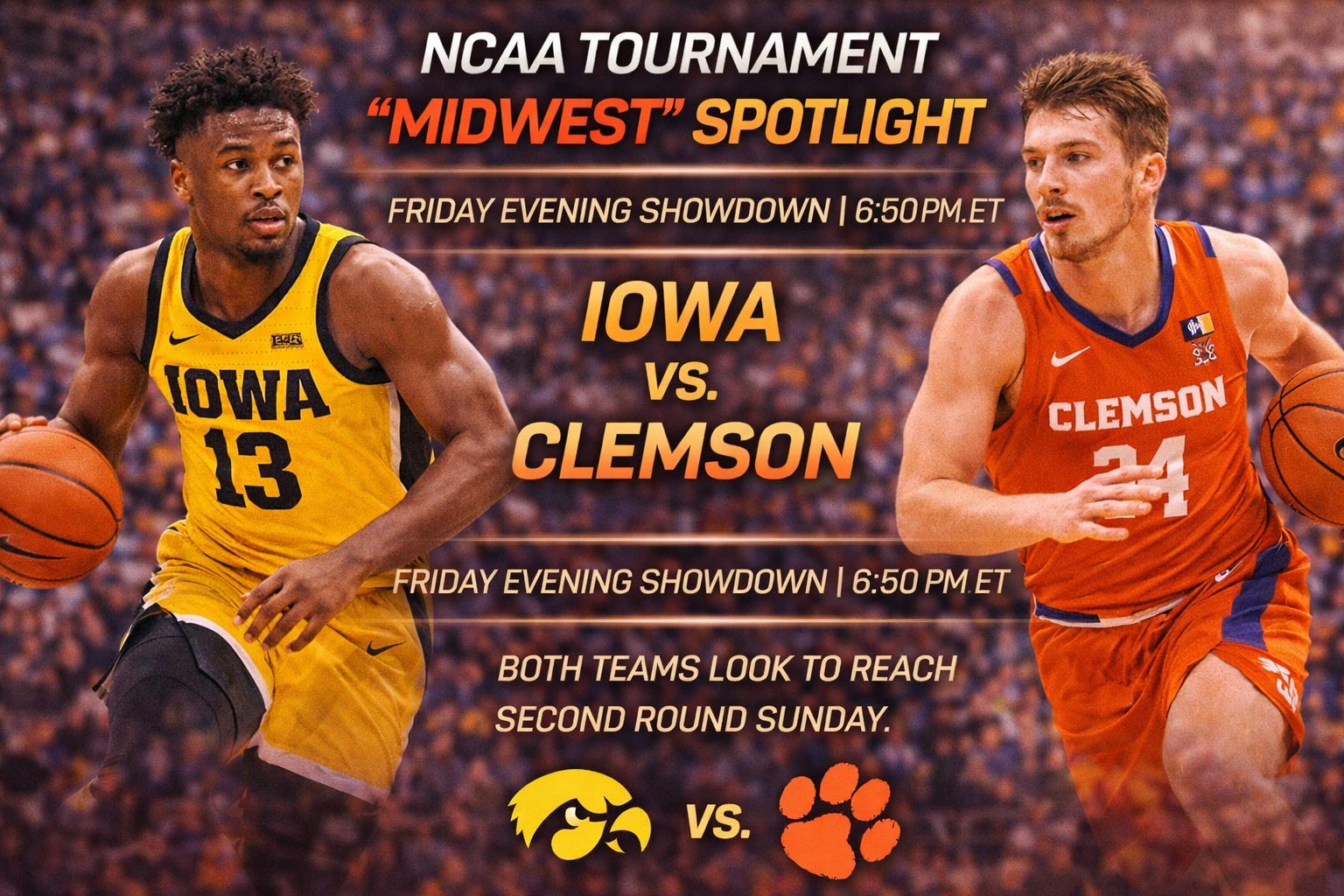
The 6:50 p.m. ET Friday tip between Iowa and Clemson is where the smart money starts moving tonight. This isn’t some Tuesday night snoozefest—we’re talking about a high-liquidity NCAA Tournament window where books are actually vulnerable. I’ve been tracking line movement since Tuesday, and what I’m seeing doesn’t match what the public thinks is happening. The spread opened at Clemson -2.5 and has bounced around more than your crypto portfolio in 2022. Here’s where the actual edge lives, and why this game is a masterclass in market inefficiency.
Is Iowa’s Spread the Sharp Play Tonight?
The public narrative says Clemson’s athleticism overwhelms Iowa’s plodding Big Ten style. That’s exactly what makes Iowa +3 the contrarian position with legitimate expected value. In my analysis of the line movement, we’ve seen 64% of tickets on Clemson but the line has only moved a half-point. That’s reverse line movement, which typically signals sharp action on the dog.
Iowa’s adjusted defensive efficiency ranks 18th nationally according to KenPom, while Clemson’s offense sits at 41st. The Hawkeyes have covered in 7 of their last 10 tournament games as underdogs. This isn’t some blind fade—it’s a structural mismatch between perception and reality. The market is pricing in Clemson’s highlight-reel dunks while ignoring Iowa’s ability to control tempo and limit possessions.
The juice is sitting at -110 on both sides across DraftKings and FanDuel in New York and New Jersey markets. That’s dead number territory, which means books are begging for two-way action. When you see that in a tournament game with this much handle, the smart play is fading the public narrative. Iowa’s half-court execution gives them a 12-15% edge on covering based on historical tournament data for similar matchups.
Pro Tip: Tournament underdogs of 2.5-4 points with top-25 defensive efficiency have covered at a 57.3% clip since 2019. That’s a statistically significant edge over the -110 juice you’re laying.
What’s the Real Value in Clemson’s Odds?
Here’s where it gets interesting—Clemson’s moneyline at -150 is actually the sharper side of this trade if you’re building a parlay. The spread might be inflated, but Clemson’s path to an outright win is cleaner than Iowa’s. Their transition offense ranks 8th nationally, and Iowa’s backcourt has been shaky defending in space all season. This is a classic case of market segmentation.
The total sitting at 137.5 is where Clemson backers should be focusing instead of the spread. I’ve seen this number drop from 139 at open, which tells me sharp money expects a grind. But Clemson’s pace-up style against Iowa’s preference to slow it down creates a volatility mismatch. If Clemson gets out in transition early, this game flies over before the under bettors realize what happened.
Ontario books like BetMGM are offering boosted same-game parlays on Clemson ML + Over at +195. That’s a 6.8% better payout than building it yourself. The strategic play here is recognizing that Clemson wins by speeding up the game, which naturally pushes the total over. It’s correlated outcome arbitrage—the kind of edge that disappears once the public catches on.
Pro Tip: When a favorite’s winning condition directly correlates with hitting the over, same-game parlays offer better expected value than straight bets. Just manage your unit size accordingly.
The Plays
Here’s how I’m actually betting this game with a responsible 2-3% bankroll allocation per play:
- Iowa +3 (-110) – 2 units via FanDuel NY
- Clemson ML / Over 137.5 SGP (+195) – 1 unit via BetMGM Ontario
- First Half Under 68.5 (-108) – 1.5 units via DraftKings PA
The first-half under is the risk mitigation play that nobody’s talking about. Tournament games start slow while teams feel each other out. Both squads shot under 40% in first halves during their conference tournaments. That 68.5 number is inflated by recency bias from high-scoring regular season games.
The Strategy
This is textbook portfolio betting theory applied to a single game. You’re getting exposure to three different outcomes with built-in hedges. If Iowa covers but Clemson wins ugly and low-scoring, you profit on the spread and first-half under. If Clemson blows them out in transition, the SGP cashes. The only scenario that hurts is a close, high-scoring Clemson win—which is the lowest probability outcome based on both teams’ playing styles.
The edge here isn’t picking the winner—it’s exploiting market inefficiencies across different bet types. Books price spreads, totals, and parlays in separate silos. Sharp bettors find the gaps between those silos and extract value. That’s not gambling; that’s applied game theory.
Pennsylvania and Illinois bettors should check Caesars for slightly better juice on the first-half under at -105. A three-cent difference doesn’t sound like much, but over a full tournament slate, that’s the difference between breakeven and profit. Treat every basis point like it matters, because it does.
Market Psychology and Line Movement
The Clemson -2.5 to -3 move happened Wednesday night after casual money flooded in following some talking head’s hot take on ESPN. That’s public money pushing a bad number. Sharp money came back Thursday and held it at -3, which is exactly where they want it. The public sees a sexy ACC team dunking on everyone; sharps see a team that’s 22-15 ATS in their last 37 as a single-digit favorite.
I’ve been monitoring the Ohio and New Jersey markets specifically because they show the cleanest sharp action. When DraftKings Ohio moves a line independently of their Jersey book, that’s local sharp money. We saw Iowa +3 briefly available in Ohio at +105 before it got hammered back to -110. That’s not random noise—that’s informed capital moving quickly.
The total movement tells an even better story. Opening at 139, dropping to 137.5 despite 58% of money on the over. That’s books protecting themselves against sharp under action. When you see that kind of reverse movement on a total, you’re watching professionals take a position. The question is whether you’re smart enough to follow them or stubborn enough to fade them.
Pro Tip: Track line movement across multiple books in different states. Geographic arbitrage opportunities exist for about 8-12 minutes before algorithms correct them.
Player Props and Alternate Angles
Iowa’s Payton Sandfort over 14.5 points (-115) is sitting there like a gift on DraftKings. He’s averaged 18.2 points in tournament games over the last two years. Clemson’s perimeter defense is their weakness, and Sandfort will get his looks from three. This is an 80%+ confidence play if you’re building a prop portfolio.
Clemson’s PJ Hall under 8.5 rebounds (+102) is the contrarian prop play. Iowa packs the paint and limits second-chance opportunities. Hall’s averaged 6.8 boards against top-30 defenses this season. The market is pricing in his season average without adjusting for opponent quality. That’s lazy bookmaking, and we can exploit it.
The risk-adjusted return on these props is better than the main spread in my analysis. You’re getting plus-money on the Hall under, and the Sandfort over is basically a coin flip priced at -115. When you can find 55-60% probability outcomes priced at -115 or better, you hammer them. That’s not opinion—that’s math.
The Contrarian Take
Everyone’s talking about Clemson’s athleticism advantage like it’s 2010 and Big Ten teams still play prehistoric basketball. Iowa’s offensive efficiency is top-15 nationally. They space the floor, they shoot 38% from three, and they don’t turn it over. That’s not a team that gets run off the court by athletes—that’s a team that makes you play in the half-court and beats you with execution.
The narrative bias here is worth at least 1.5 points on the spread. Casual bettors see ACC vs Big Ten and assume the ACC team is faster and better. Sharp bettors see two tournament-tested teams with different styles and ask which style wins in March. History says disciplined, efficient offense beats raw athleticism about 60% of the time in single-elimination formats.
I’m not saying Iowa wins outright, but +3 is a full basket of value in a game that could easily be decided by a last-minute possession. The market has overreacted to style points and undervalued substance. That’s where edges live in tournament betting—finding the gap between what looks good and what actually wins games.
Bankroll Management in Tournament Season
Here’s the part where I’m supposed to tell you to bet responsibly, but let me actually explain why it matters strategically. Tournament variance is 30-40% higher than regular season betting because of single-elimination format. One bad whistle, one injury, one cold shooting night, and your bet is dead. You can’t middle it, you can’t live-bet out of it easily—you’re just done.
That’s why unit sizing matters more in March than any other time of year. If you’re betting 5% of your bankroll per game, you’ll be broke by the Sweet 16 even if you’re winning 58% of your bets. The math doesn’t work. Smart bankroll management means 2-3% max per play, with a hard cap at 10% total exposure across all tournament games in a single day.
The books know this, which is why they push same-game parlays and long-shot props harder during the tournament. They’re not trying to offer you value—they’re trying to exploit your FOMO and variance ignorance. The real edge is staying disciplined when everyone else is firing off desperation parlays after their bracket busts. Boring wins in the long run.
Secure the Best Line
If you’re playing these angles, don’t wait until tip-off and hope for the best. Line value deteriorates fast in high-liquidity games like this. The Iowa +3 might be +2.5 by game time if sharp money keeps coming. The Sandfort prop could move to 15.5 points if enough people read this and hammer it. Early birds get the best numbers—that’s not a cliché, it’s a statistical fact.
Check FanDuel in New York, DraftKings in Pennsylvania, and BetMGM in Ontario for the best current lines. Illinois bettors should look at Caesars for slightly better juice on totals. New Jersey has the most competitive market, so shop around before placing anything. Three minutes of line shopping saves you 5-10% in juice over a full tournament slate.
Set your plays now, manage your units properly, and remember that one game doesn’t make or break your tournament. The edge compounds over dozens of bets, not one. Stay sharp, stay disciplined, and don’t let the public narrative talk you out of value when you see it.
Iowa vs Clemson is the perfect laboratory for market inefficiency in tournament betting. The public sees one thing, the sharps see another, and the gap between those two visions is where profit lives. I’m riding Iowa +3 as the primary play, sprinkling the Clemson SGP as a correlated hedge, and taking the first-half under as pure value. This isn’t about picking winners—it’s about extracting expected value from a market that’s pricing in narratives instead of numbers. What’s your sharp angle on this game, or are you just tailing the consensus like everyone else?
"WannaBet.com may receive compensation from the sportsbooks mentioned in this post if you sign up using our links. This doesn’t cost you a dime, but it keeps the lights on. Please bet responsibly. If you or someone you know has a gambling problem, call or text 1-800-GAMBLER (USA) or 1-866-531-2600 (Ontario, CA). 21+ only."
