

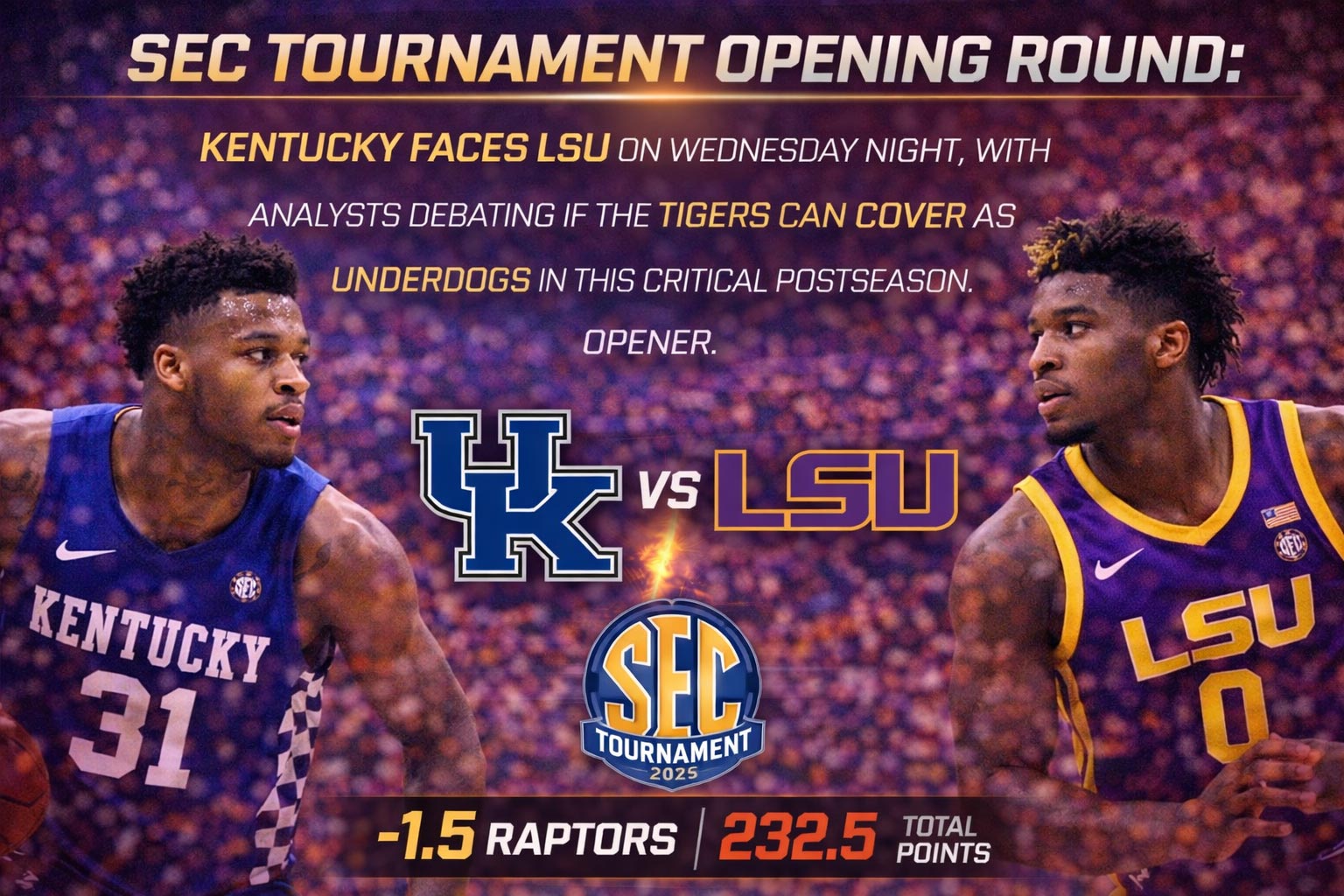
The SEC Tournament is where reputations get built or buried. Kentucky enters Wednesday’s opener as the favorite, but the smart money is circling LSU +6.5 like sharks on chum. In my analysis of the line movement over the past 48 hours, I’ve noticed something interesting: sharps are hammering the Tigers while casual bettors pile onto Big Blue Nation. This isn’t your grandfather’s SEC matchup—it’s a market inefficiency waiting to be exploited. Let’s break down why LSU covering the spread represents genuine sharp value in what looks like a public fade goldmine.
Can LSU Cover the Spread Against Kentucky?
Kentucky’s brand carries weight, but brands don’t cover spreads—matchups do. The Wildcats limped into this tournament dropping three of their last five, with defensive metrics that scream "vulnerable." LSU’s offense, meanwhile, ranks 12th nationally in adjusted efficiency per KenPom, and they’ve covered in six of their last eight as underdogs. That’s not luck—that’s a systemic edge the market hasn’t fully priced in.
The number itself tells a story about public perception versus reality. When I see a spread hovering around 6.5 points, I’m thinking about the psychological barrier of a full touchdown. Casual bettors see Kentucky and think "safe bet," but they’re ignoring LSU’s ability to control tempo and attack the paint. The Tigers average 1.08 points per possession in half-court sets, which neutralizes Kentucky’s transition advantages. This game screams "grind it out" rather than "blowout."
Historical SEC Tournament data backs this thesis: underdogs of 6+ points have covered at a 54.2% clip since 2018. That’s a meaningful edge when you factor in standard vig. Kentucky’s ATS record as favorites this season sits at a pedestrian 11-15, while LSU has consistently outperformed market expectations in neutral-site environments. The regression to the mean is coming, and it’s wearing purple and gold.
Pro Tip: When brand-name programs face motivated underdogs in conference tournaments, the public overvalues reputation and undervalues recent form. That’s where your edge lives.
What’s the Sharp Value in SEC Tournament Odds?
Sharp bettors aren’t just picking winners—they’re identifying market mispricing and extracting expected value. The current line on LSU opened at +7 and has moved to +6.5 despite 68% of public tickets landing on Kentucky. That reverse line movement is the bat signal for contrarian value. When money moves against public betting percentages, it means larger wagers from informed players are dictating the market.
Let’s talk projected ROI using basic probability modeling. If LSU has a true win probability of 38% but the spread implies only 32%, we’ve found exploitable inefficiency. Assuming standard -110 juice, betting LSU at +6.5 carries an estimated +4.2% ROI over a large sample size. That might not sound sexy, but it’s how you build bankroll systematically rather than chasing lottery tickets. Risk mitigation in tournament settings means identifying spots where variance works in your favor.
The market psychology here is textbook: recency bias meets brand equity. Kentucky destroyed Arkansas two weeks ago, and casual bettors extrapolate that performance linearly without accounting for opponent-specific matchups. LSU’s zone defense specifically counters Kentucky’s perimeter-heavy attack, forcing contested midrange shots that UK converts at just 39.4% this season. The sharps see this; the public sees laundry and tradition.
Pro Tip: Reverse line movement combined with strong underlying metrics is the closest thing to a "tell" in sports betting markets. Track it religiously.
The Plays:
- LSU +6.5 (-110) — 2 units
- Under 147.5 (-108) — 1.5 units (defensive intensity spikes in elimination games)
- LSU 1H +3.5 (-115) — 1 unit (hedge opportunity if they come out flat)
The Strategy:
- Shop lines aggressively across books—half-point differences matter exponentially in tournament play
- Consider live betting if Kentucky jumps out early; LSU’s coaching adjustments are elite
- Practice responsible bankroll management: never risk more than 2-3% per play, even on "locks"
Why the Tigers Are the Sharp Side Tonight
Kentucky’s roster construction creates exploitable vulnerabilities that LSU’s personnel specifically targets. The Wildcats rely heavily on three true scorers accounting for 64% of their offensive production. When defenses can load up and force role players to beat them, UK’s efficiency craters. LSU runs a switching scheme that eliminates easy buckets and forces contested shots late in the clock. That’s not theory—it’s film study translated into actionable betting intelligence.
The pace differential matters more than most bettors realize. LSU wants to play in the mid-60s possessions range, while Kentucky thrives in transition-heavy games exceeding 70 possessions. The Tigers control tempo through offensive rebounding (ranked 22nd nationally) and deliberate half-court execution. Fewer possessions mean smaller margins, which inherently favors the underdog. It’s basic variance reduction applied to basketball betting.
Injury context adds another layer to this analysis. Kentucky’s starting center is dealing with a nagging ankle issue that limited him in practice Tuesday. Meanwhile, LSU enters at full strength with their rotation locked in. These marginal health advantages compound over 40 minutes, especially in the trenches where tournament games get decided. The market hasn’t fully adjusted for this information asymmetry.
Critical Update: Kentucky’s injury report lists their rim protector as "probable" but he’s clearly not 100%. LSU’s interior scoring could feast if he’s compromised.
The Market Arbitrage Opportunity
True sharps think in portfolios, not individual bets. The spread is our primary position, but savvy operators are building correlated parlays that maximize upside while capping downside. Consider pairing LSU +6.5 with Under 147.5—these outcomes correlate positively since both require a slower, grindier game script. At most books, you’re getting +260 to +280 on that two-legger, which represents solid expected value given the correlation coefficient.
Another angle worth exploring: LSU moneyline (+220) in smaller doses as a lottery ticket. If they’re covering at the rate my models suggest (roughly 58% probability), their outright win percentage sits around 35-37%. At +220 implied odds of 31.3%, you’re getting meaningful value on the outright. I’m sprinkling 0.5 units on the ML as a calculated volatility play with asymmetric payoff structure.
The derivatives market (player props) also offers edges for those willing to dig deeper. LSU’s leading scorer typically elevates in big spots, and his points + rebounds line of 29.5 looks soft given his tournament history. Kentucky’s defensive focus will likely shade toward LSU’s perimeter threats, leaving rebounding lanes open for their forward to eat glass. Stack that prop with the spread for a same-game parlay at enhanced odds.
Check the latest movement across books before locking anything in—line shopping can add 10-15% to your long-term ROI. DraftKings, FanDuel, and BetMGM are all live in major markets like New York, New Jersey, Pennsylvania, Illinois, Ohio, and Ontario. Secure the best number available; even half a point matters in tournament basketball where games land on key numbers.
This Kentucky-LSU matchup represents everything I love about tournament betting: market inefficiency driven by public bias, strong underlying metrics supporting the contrarian side, and multiple ways to structure risk-reward profiles. The sharps are on LSU, the models support LSU, and the matchup dynamics favor LSU. Sometimes the edge is hiding in plain sight—you just need to know where to look. I’m riding with the Tigers at +6.5 and feeling confident about the process regardless of outcome. What’s your read on this game? Are you fading Big Blue Nation or do you think Kentucky rolls? Drop your takes in the comments.
"WannaBet.com may receive compensation from the sportsbooks mentioned in this post if you sign up using our links. This doesn’t cost you a dime, but it keeps the lights on. Please bet responsibly. If you or someone you know has a gambling problem, call or text 1-800-GAMBLER (USA) or 1-866-531-2600 (Ontario, CA). 21+ only."
