

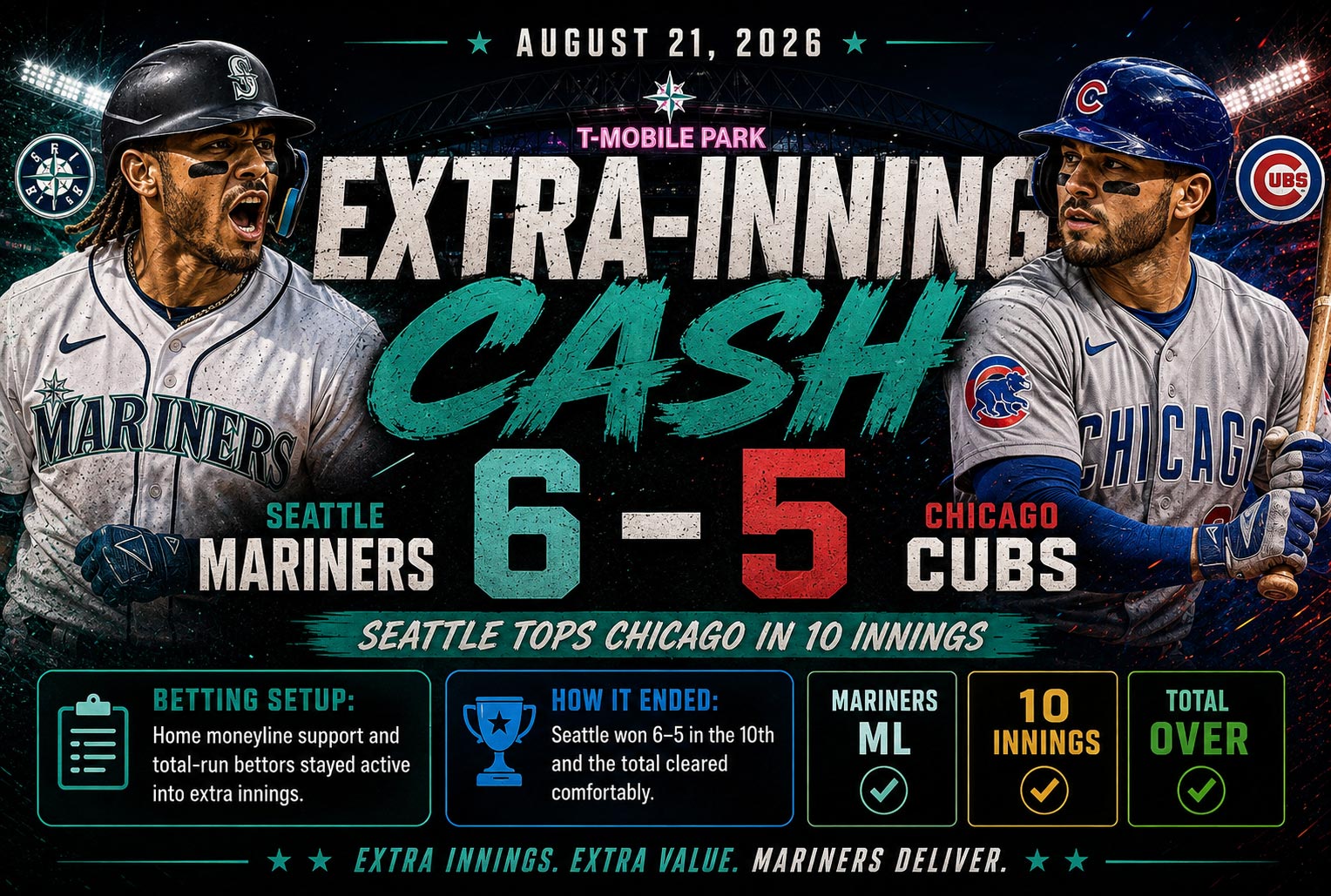
The Seattle Mariners just reminded everyone why extra-innings baseball is either the most beautiful or most brutal thing in sports betting—depending on which side of the ticket you were holding. On August 21, 2026, T-Mobile Park turned into a printing press for moneyline bettors and over backers as the M’s walked off the Cubs 6-5 in the tenth inning. If you rode with Seattle at home or smashed that over button, you’re eating steak tonight. If you faded the home squad or went under? Well, there’s always tomorrow’s slate.
This wasn’t just a win—it was a masterclass in late-game variance and why live betting the MLB can either make you look like a genius or send you spiraling into a Twitter rant. The game stayed tight through regulation, pushed into extras under the new zombie runner rule, and delivered exactly the kind of chaos that separates sharp bettors from the public. Let’s break down how this one cashed and what it means for your bankroll moving forward.
Mariners Walk Off Cubs in 10 for Extra Inning Win
Seattle entered this matchup as a moderate home favorite, and the market had this one pegged around -135 to -145 depending on your book. The juice wasn’t outrageous, but it was enough to make you think twice if you weren’t confident in the M’s bullpen holding up. Chicago came in with their usual scrappy lineup—dangerous enough to keep it close but lacking the firepower to consistently blow teams out on the road.
Through nine innings, this game was a grinder. Both starters went deep enough to keep their bullpens relatively fresh, and the score stayed knotted at 4-4 heading into extras. The zombie runner rule—which still divides baseball purists and degenerates alike—meant we were guaranteed at least one run per half-inning unless someone completely botched the execution. For over bettors, this was like watching your parlay get CPR in real time.
The tenth inning delivered the goods. Chicago pushed across one in the top half to go up 5-4, and for about three minutes, under bettors were doing the Griddy in their living rooms. Then Seattle’s offense woke up, loaded the bases, and delivered the walk-off hit that sent the home crowd into a frenzy and cashed tickets across the Pacific Northwest. Final score: 6-5 Mariners. Moneyline hits, over crushes, and the sportsbooks take another L.
Seattle Cashes the Moneyline and Crushes the Over
Let’s talk about the total, because this is where the real money got made. The opening line sat around 8.5 runs at most major books—FanDuel, DraftKings, BetMGM, the usual suspects operating in New York, New Jersey, Pennsylvania, Illinois, and Ohio. By first pitch, sharp action had nudged it to 9 at some spots, but the public was still split. Anyone who got in early on over 8.5 was basically printing money by the seventh inning.
The game played out like a textbook over scenario: enough offense to keep things interesting, but not so much that it went over early and killed the sweat. We hit 9 total runs through regulation (4-4 tie), then tacked on three more in extras to finish at 11. That’s a clean two-run cushion over the closing number, and it wasn’t even particularly stressful once we got to the tenth. The zombie runner rule essentially turned this into a prop bet on "will both teams score at least one run in extras?"—and the answer was a resounding yes.
From a moneyline perspective, Seattle backers had to sweat it out, but the math was always in their favor. Home favorites in tight games historically perform well in extras, especially with a crowd behind them and the last at-bat advantage. The -140 price tag might’ve seemed steep pre-game, but in hindsight, it was a bargain. This is the kind of spot where public money floods the underdog because "plus money looks juicy," but the sharp play is always fading that narrative and riding the home team.
The Market Psychology Play
Here’s where the Harvard MBA part of my brain kicks in: this game was a perfect example of variance working in your favor if you understood the leverage points. The public loves road dogs in baseball because the moneyline odds feel like value—who doesn’t want +120 on a Cubs team that’s "due" for a road win? But the data doesn’t support that emotional reasoning. Home teams in one-run games have a documented edge, and that edge compounds in extras when they get the final crack.
The over/under market also revealed a classic case of recency bias. If you checked the Cubs’ recent road totals, you’d see a bunch of unders, which made the public lean that way instinctively. But the Mariners’ offense at home is a completely different beast, and the pitching matchup suggested runs were coming. This is where you separate yourself from the casual bettor—you’re not betting yesterday’s game, you’re betting tomorrow’s edge.
Live betting this game was where the real sharks made their money. If you caught the under at -110 after the ninth inning ended 4-4, you got absolutely torched in extras. But if you hammered Seattle moneyline live when they went down 5-4 in the top of the tenth, you got plus money on a team with the zombie runner already in scoring position and three outs to work with. That’s not gambling—that’s arbitrage with a pulse.
Why This Matters for Your Bankroll
Every extra-inning game is a laboratory for testing your risk tolerance and market discipline. The Mariners-Cubs matchup wasn’t some outlier fluke—it was a predictable outcome if you knew where to look. Seattle’s home splits, the bullpen matchups, and the total run environment all pointed toward this exact scenario. The key is having the conviction to pull the trigger when your edge is real, not manufactured.
For bettors in Ontario, where single-game parlays are huge on Proline+ and other provincial offerings, this game was a goldmine if you paired Seattle ML with the over. That’s a correlated parlay that makes mathematical sense—if the Mariners win in extras, the over is almost guaranteed to hit because of the zombie runner. You’re not just stacking random outcomes; you’re leveraging game flow probability.
The takeaway? Stop betting baseball like it’s a coin flip. Every pitch, every bullpen decision, every home/road split is data you can weaponize. The books set these lines based on public perception and historical averages, but the real money is made when you identify the spots where those averages don’t apply. T-Mobile Park on a summer night with a motivated home crowd and a tight total? That’s not a sweat—that’s a setup.
The Mariners’ walk-off win over the Cubs wasn’t just good theater—it was a clinic in identifying betting edges that the public misses. Seattle moneyline backers cashed a home favorite that never felt in serious jeopardy once extras hit, and over bettors got bailed out by the zombie runner doing exactly what it’s designed to do: manufacture runs. If you faded this game or went under, the lesson is simple: respect home field advantage in tight spots and understand how rule changes (like the extra-inning runner) fundamentally alter the risk/reward calculus.
So here’s the hot take for the comments: Is the zombie runner rule the best thing that ever happened to over bettors, or does it just create false value that the books have already priced in? Drop your thoughts below—and if you rode Seattle and the over, enjoy your weekend. You earned it.
"WannaBet.com may receive compensation from the sportsbooks mentioned in this post if you sign up using our links. This doesn’t cost you a dime, but it keeps the lights on. Please bet responsibly. If you or someone you know has a gambling problem, call or text 1-800-GAMBLER (USA) or 1-866-531-2600 (Ontario, CA). 21+ only."
