

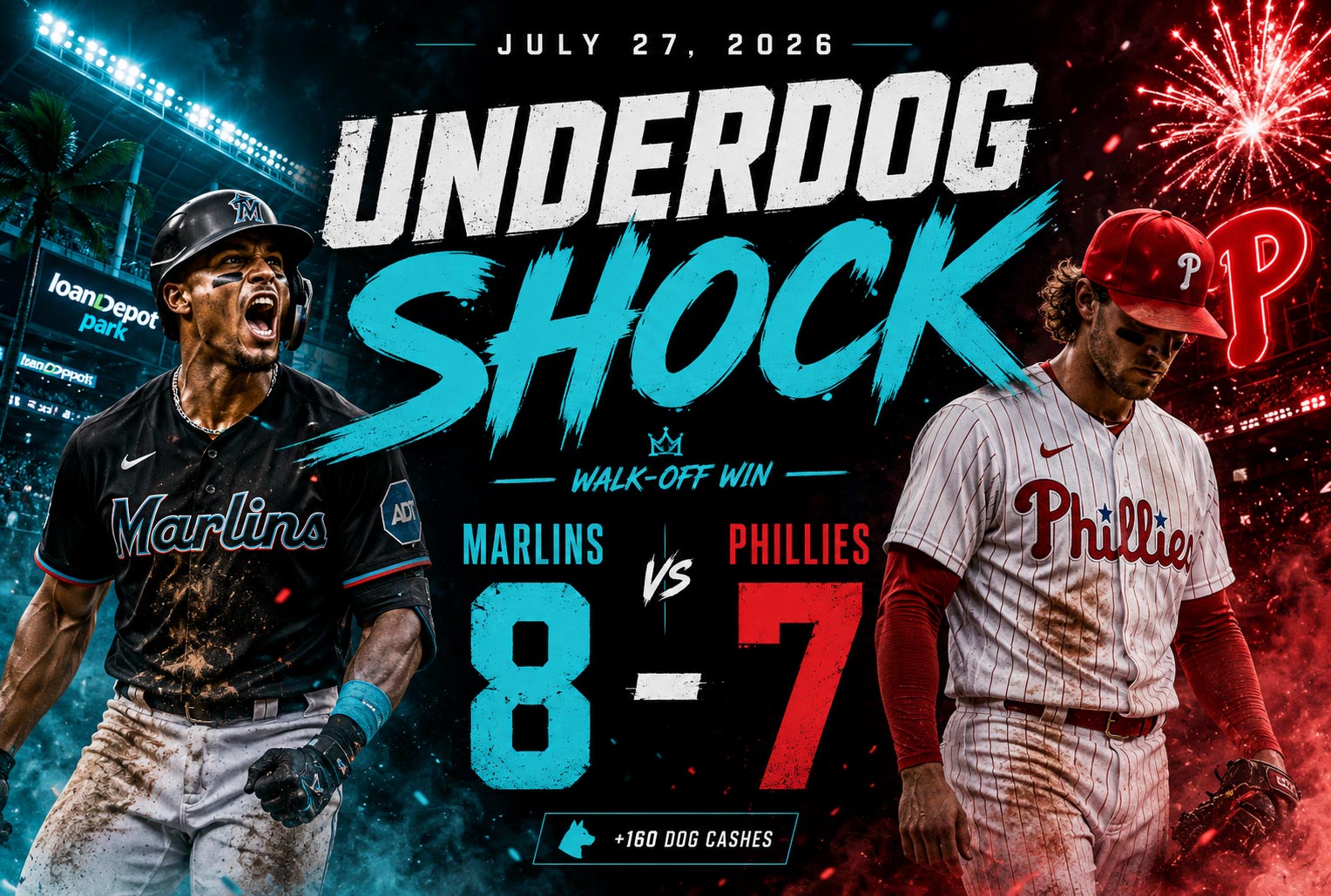
Marlins Walk Off as Heavy Dogs Cash Big Over Philly
Sometimes the best plays in sports betting aren’t about backing the team with the better record—they’re about finding value where the public refuses to look. Tuesday night in Miami delivered exactly that kind of payday, as the rebuilding Marlins walked off against the Phillies in an 8-7 thriller that had sharp bettors counting stacks while the public nursed their wounds. If you faded the casual money and rode Miami’s +170 to +180 moneyline, you just experienced what we call "asymmetric upside"—risking a hundred to win almost two hundred on a team that absolutely had the talent to compete, even if their record didn’t scream "investment opportunity." This is the kind of game that separates the spreadsheet degenerates from the guys who just hammer whatever ESPN is hyping.
Marlins Walk Off as Heavy Dogs Cash Big Over Philly
The setup couldn’t have been more textbook for a public trap. Philadelphia rolled into Miami as road favorites, typically priced around -190 to -210 depending on your book, with the majority of casual bettors salivating over backing a playoff contender against one of baseball’s most notorious rebuilding projects. The Phillies had the superior record, the deeper lineup, and frankly, the kind of brand recognition that makes recreational bettors feel safe—which is precisely when you should start asking questions.
Miami flipped the entire narrative in a back-and-forth offensive explosion that saw both bullpens get shelled harder than my GPA during pledge week. The Marlins scratched and clawed their way to an 8-7 walk-off victory, cashing tickets for anyone brave enough to back them at those juicy dog prices. For context, a $100 bet on Miami at +170 netted you $170 in profit—that’s a 170% ROI in roughly three hours, which beats the hell out of any index fund.
The beauty of this game wasn’t just the moneyline cash—it was a multi-angle winner for anyone who understood market inefficiency. Over bettors crushed with 15 total runs in a game that probably had a total around 8.5 or 9, while Marlins +1.5 run line backers (-120 to -130 typically) got an easy sweat-free winner. This is what we call "correlated parlays" in the business—when multiple bets on the same game all point toward the same market oversight.
Why Sharp Money Rode Miami’s +170 to the Bank
Here’s the thing about sharp bettors that separates them from the "I bet on my favorite team" crowd: they think in terms of expected value, not win probability alone. Sure, the Phillies might win this matchup 55-60% of the time over a large sample, but when you’re getting +170 on a team that should be closer to +130, you’re printing money long-term. The public overvalues team records and undervalues specific matchup dynamics—things like bullpen fatigue, day game after night game situations, and the simple fact that even bad MLB teams win 40% of their games.
The sharp angle here was recognizing that Miami’s price was inflated by narrative rather than actual probability. Philadelphia’s bullpen had been getting torched in their previous series, and the Marlins—despite their rebuild status—still have major league hitters who can absolutely rake when they catch the right pitching. Professional bettors saw a line that suggested maybe a 35% win probability for Miami when the actual number was probably closer to 42-45%, creating what we call "line value" or "positive expectation."
This is also where understanding market psychology becomes your edge. Sportsbooks know the public will hammer the Phillies regardless of the actual matchup factors, so they shade the line to balance their liability rather than reflect true probability. Smart money waits for these moments when public perception diverges from statistical reality, then strikes hard. It’s the same principle as buying undervalued stocks—except instead of waiting months for the market to correct, you get paid in nine innings.
The risk mitigation strategy here was also chef’s kiss. If you were nervous about the straight moneyline, Miami +1.5 at -120ish gave you a safety net while still offering solid value. The Marlins could lose by one and you’d still cash, which in a sport as variance-heavy as baseball, is basically risk management 101. Combine that with an Over play (recognizing both bullpens were compromised), and you’ve got a diversified portfolio that would make your finance professor proud—if he knew you were using his lessons to hammer baseball games instead of analyzing quarterly earnings.
Tuesday night in Miami was a masterclass in why betting the board and not the narrative pays dividends. The Marlins didn’t just win a baseball game—they validated every sharp bettor’s thesis about finding value in overlooked spots and letting the public chase brand names while you cash premium prices. Whether you rode the moneyline, the run line, or stacked it with the Over, this game delivered the kind of multi-angle winner that funds weekend trips to Vegas and makes you insufferable in the group chat. Next time you see a rebuilding team catching +170 or better at home against a "public darling" team with bullpen issues, remember this game and ask yourself: am I betting on who I think will win, or am I betting on where the value actually lives?
Hot take for the comments: Are the Marlins actually a sharp play every time they’re catching +150 or better at home, or was this just variance doing variance things? Drop your thesis below.
WannaBet.com may receive compensation from the sportsbooks mentioned in this post if you sign up using our links. This doesn’t cost you a dime, but it keeps the lights on. Please bet responsibly. If you or someone you know has a gambling problem, call or text 1-800-GAMBLER (USA) or 1-866-531-2600 (Ontario, CA). 21+ only.
