

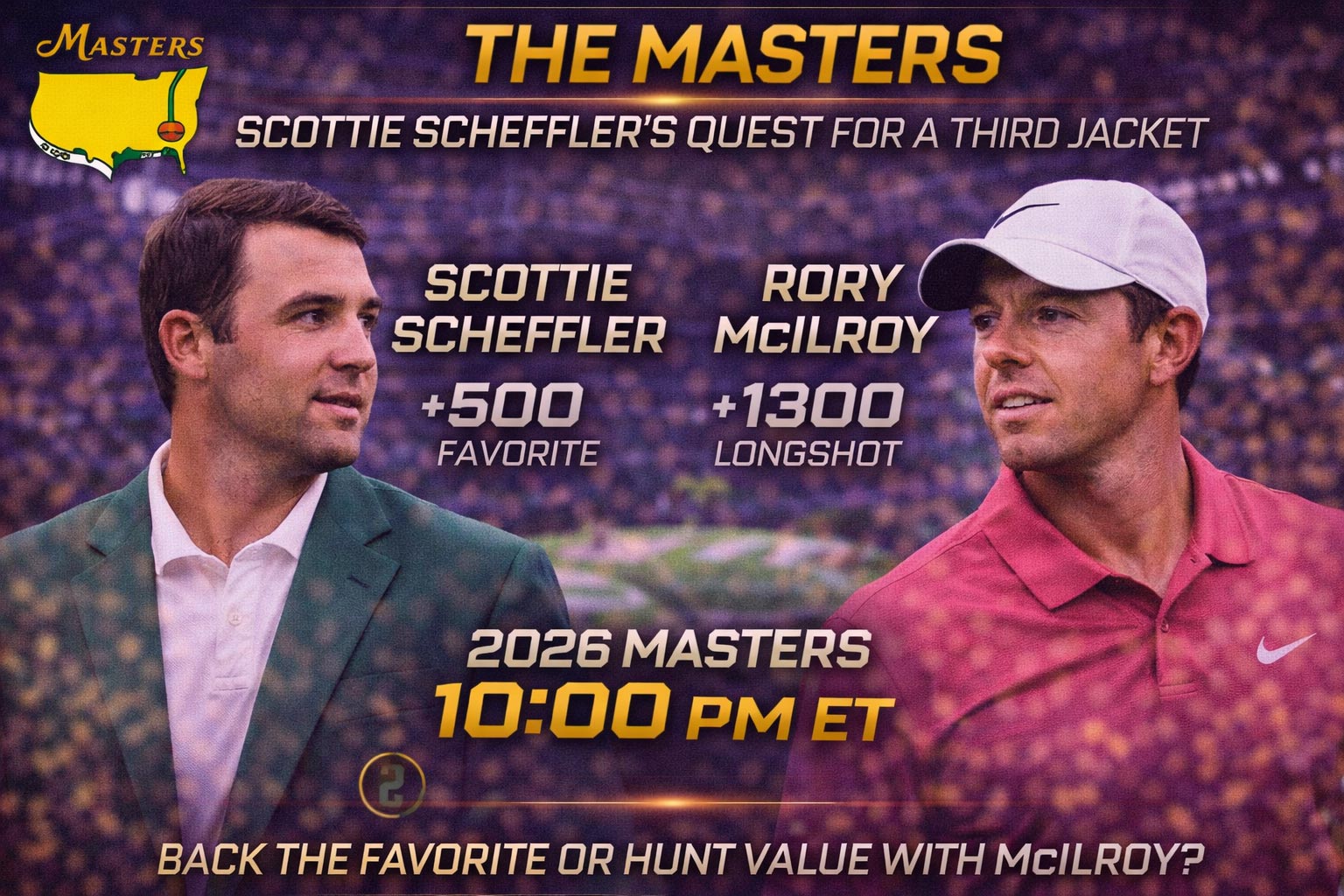
The azaleas are blooming, the pimento cheese sandwiches are back, and we’ve got ourselves another Masters Thursday where the smart money needs to decide: do we ride with the chalk or hunt for value in the mid-tier? Scottie Scheffler comes into Augusta at +500 looking to join some seriously elite company with a third green jacket, while Rory McIlroy is once again staring down the one major that’s haunted him since he was old enough to drink legally. The market’s basically screaming at us to make a choice between backing the best player in the world at mediocre odds or taking a shot on the most talented guy who can’t seem to figure out how to play 72 holes at this specific golf course.
This isn’t your typical "favorite vs. longshot" debate—we’re talking about two generational talents with completely different risk profiles. Scheffler’s been the world No. 1 for what feels like three years straight, and his game fits Augusta like a tailored suit from Loro Piana. Meanwhile, Rory’s got the talent to shoot 63 on any given day but also the mental baggage to three-putt from six feet on Sunday when it actually matters. Let’s break down whether we’re getting actual value or just lighting money on fire with either of these plays.
Scheffler’s Third Green Jacket: Lock or Trap?
Here’s the thing about Scottie that makes him such a fascinating betting case study: the dude doesn’t really have a weakness that Augusta can exploit. His iron play is statistically absurd—we’re talking strokes gained approaching the green numbers that would make prime Tiger blush—and that’s literally the entire game plan at Augusta National. You hit your spots, you make your putts, you collect your oversized novelty check. The market knows this, which is why +500 feels almost disrespectful for a guy who’s won here twice already and hasn’t finished outside the top 10 since 2021.
But here’s where the MBA brain kicks in: at +500, you’re getting implied odds of about 16.7%, which means the market thinks Scheffler wins this tournament roughly once every six years. Does that pass the sniff test for a guy in his absolute prime who’s already got two jackets in his closet? The historical comp here is Tiger from 2000-2005, and even prime Tiger wasn’t winning Augusta every other year. The base rate for even the most dominant players is maybe 20-25% at their absolute peak, so we’re potentially looking at slight positive expected value if you believe Scheffler’s truly in that stratosphere.
The trap scenario is pretty simple though: golf tournaments have 156 players, and variance is a cruel mistress even when you’re the best in the world. Scheffler could hit a tree on 13 on Sunday and make triple, or some random Euro Tour guy could go nuclear for 72 holes, or the wind could blow 30 mph all weekend and turn this into a complete crapshoot. At +500, you need to win 20% of the time just to break even long-term, and that’s asking a lot even for Scottie. The juice on favorites in golf is real, and the books aren’t stupid—they’ve priced in his dominance and then some.
Rory’s Grand Slam Chase: Value Play or Fool’s Gold?
Let me start with the uncomfortable truth: Rory McIlroy at the Masters is the golf betting equivalent of dating your ex and thinking "this time will be different." He’s been chasing this career grand slam since 2015, and every single April we convince ourselves that maybe, just maybe, this is the year he figures out Augusta’s back nine. The talent is undeniable—when Rory’s on, he’s got the most complete game in golf and can overpower a course that’s supposedly all about finesse. At +1300, you’re getting way better implied odds than Scheffler (around 7.1%), which feels like legitimate value for a guy who’s won four other majors.
The bull case for Rory is actually pretty compelling if you can ignore the decade of psychological torture. His ball-striking metrics are elite, he’s been putting better than any point in the last five years, and Augusta’s recent setup changes (letting the rough grow, firmer conditions) actually favor his power game. Plus, there’s a legitimate market psychology play here: the public is so burned out on Rory’s Masters failures that his odds are probably inflated compared to his actual win probability. If you ran a Monte Carlo simulation based purely on strokes gained data, Rory’s probably closer to +900 than +1300.
But here’s where we need to be brutally honest about the behavioral economics at play: Rory’s got more mental scar tissue at Augusta than a guy who spent his twenties in a toxic relationship. The market might actually be efficient here, pricing in the very real possibility that he melts down on Sunday like he’s done in 2011, 2018, 2022, and basically every other year he’s been in contention. You’re not just betting on talent—you’re betting that a guy can overcome a decade of failure at one specific golf course, which is asking a lot even at +1300. The value might be real, but so is the risk that we’re all falling for the same trap we fall for every April.
So what’s the actual play here? If you forced me to pick one, I’m probably sprinkling a half-unit on Scheffler at +500 and accepting that I’m paying a premium for the best player in the world at the course that fits his game perfectly—that’s just smart risk management even if the odds aren’t screaming value. The Rory play is spicier and potentially offers better expected value if you believe the market’s overpricing his mental demons, but I’d need to see him navigate Thursday and Friday without any meltdowns before I’d add to that position. Honestly though, the sharpest move might be fading both of these guys entirely and finding value in the +2500 to +5000 range where the public’s too focused on the narrative plays. Drop your actual Masters picks in the comments—are we backing Scottie, chasing Rory’s grand slam dream, or getting weird with it?
WannaBet.com may receive compensation from the sportsbooks mentioned in this post if you sign up using our links. This doesn’t cost you a dime, but it keeps the lights on. Please bet responsibly. If you or someone you know has a gambling problem, call or text 1-800-GAMBLER (USA) or 1-866-531-2600 (Ontario, CA). 21+ only.
