

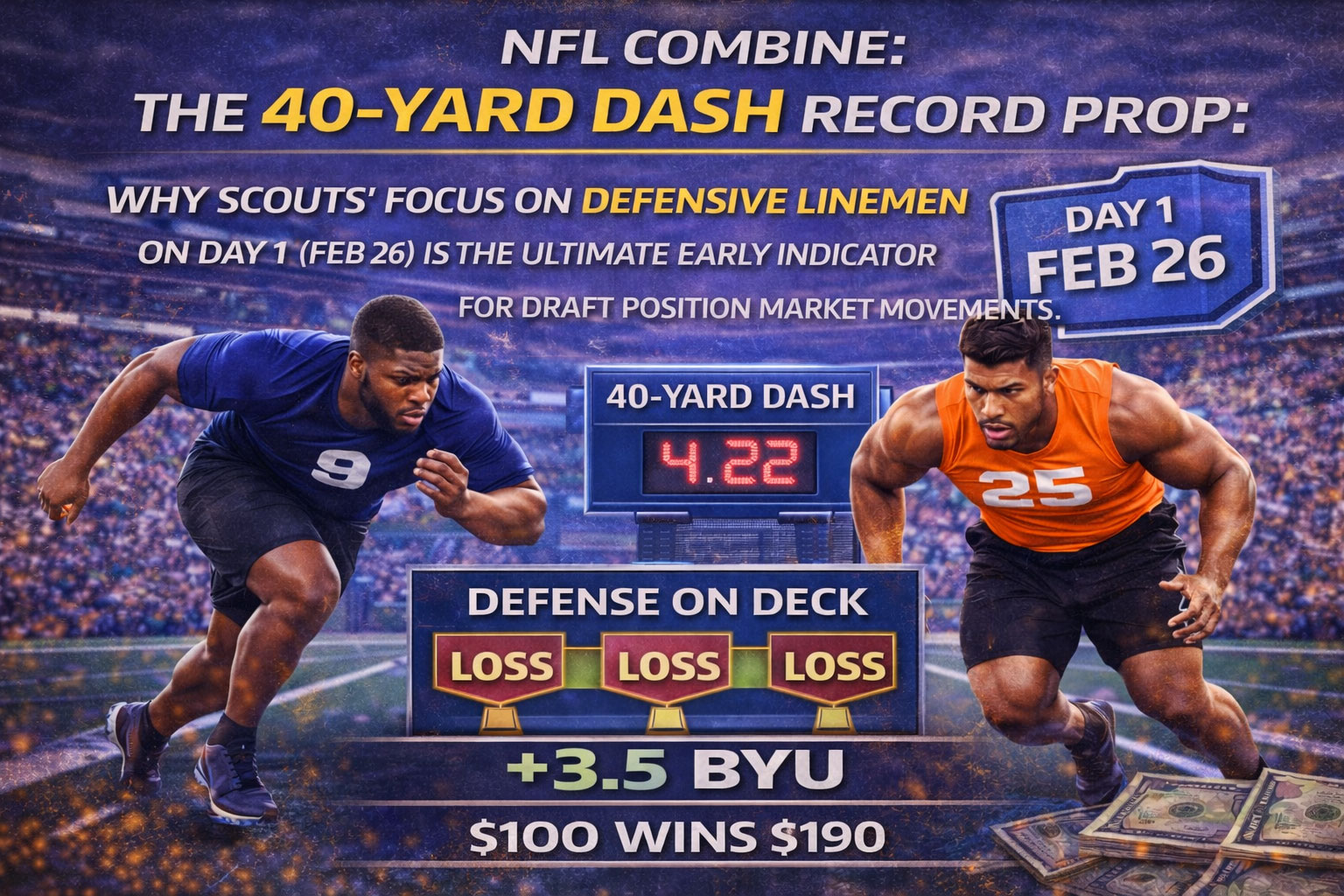
Look, I know what you’re thinking. "The NFL Combine? That’s just some workout in Indianapolis where prospects run around in spandex while retired coaches pretend they can still do a push-up." Wrong. Dead wrong. The Combine—specifically Day 1 defensive line testing on February 26—is basically insider trading for the draft market, except it’s completely legal and most degenerates are sleeping through it. While you’re scrolling through mock drafts written by guys who haven’t watched film since college, the sharp money is already moving based on 40-yard dash times that’ll hit Twitter at 10 AM EST. This isn’t just about who runs fast; it’s about understanding how scouts think, how Vegas reacts, and how you can front-run both of them before the public even realizes the board has changed.
Day 1 D-Line Testing: Your Draft Market Edge
Here’s the framework: NFL teams are obsessed with "measurables" for defensive linemen because it’s the one position where raw athleticism translates almost directly to draft capital. A 6’4", 290-pound edge rusher who runs a 4.6 forty? That’s a top-15 pick, full stop. The market hasn’t priced this in yet because the books set their draft position lines based on mock drafts from November, before anyone knew if these guys could actually move. Day 1 testing—which includes DL, LB, and special teams—gives you the first real data point to exploit the lag between performance and line adjustment.
The beautiful part? Defensive linemen test first, which means you get actionable intel before the media cycle even catches up. By the time ESPN’s talking heads are debating whether some edge rusher "looked explosive," the smart money has already hammered his draft position Over at +140. This is pure information arbitrage—you’re buying low on uncertainty and selling high once the consensus catches up 48 hours later. Think about it like earnings season in equities: the price moves on the whisper number, not the actual report.
The key metrics scouts obsess over are 40-yard dash, three-cone drill, and broad jump. But here’s the insider edge: the 40 time is what moves Twitter, which moves casual bettors, which moves the lines fastest. A defensive end who runs a 4.55 when everyone expected 4.7? That’s a three-round jump in draft stock overnight. Meanwhile, you’ve already locked in his Over before FanDuel and DraftKings adjust the juice. It’s not about being smarter than NFL GMs—it’s about being faster than the market.
Why Feb 26 Moves Vegas Before You Even Notice
For context on how offseason roster decisions interact with draft positioning, see our analysis of the Kyler Murray decision day and NFC West futures impact. Vegas doesn’t wait for you to figure this out. The sportsbooks have guys watching the Combine live with their fingers on the line-adjustment button, ready to move numbers the second a prospect posts an elite time. But here’s their vulnerability: they’re conservative on Day 1 because the handle is relatively low and they don’t want to overreact to small sample size. That 6-to-12 hour window after testing but before primetime coverage is your arbitrage opportunity. The books know the sharp money is coming, but they’re waiting to see where the volume goes before they make aggressive moves.
The public—and I mean the average bettor scrolling through their app at lunch—doesn’t even know the Combine is happening until they see a highlight on Instagram. By then, a defensive tackle who ran a 4.9 forty (elite for the position) has already seen his draft position move from 18.5 to 14.5, and the value is cooked. This is why Feb 26 matters more than any other Combine day: defensive linemen are the highest-variance position for draft stock movement, and they test first. You’re literally getting a 24-hour head start on 90% of the betting market.
Here’s the game theory: books in New York, New Jersey, and Ontario see the most sharp action on draft props because those markets have the highest concentration of sophisticated bettors. If you’re betting in Illinois or Pennsylvania, you might catch even slower line movement because the local books are more focused on NBA and NHL during this time of year. Check multiple books the morning of Feb 26—BetMGM, FanDuel, DraftKings, Caesars—and find the one that hasn’t moved yet. That’s your edge. That’s your alpha.
The NFL Combine isn’t entertainment—it’s an information asymmetry you can exploit if you know where to look. Day 1 defensive line testing gives you the earliest possible read on draft position market movements, and most bettors won’t even realize the board has shifted until it’s too late. This isn’t about getting lucky on a 40-time; it’s about understanding how scouts value measurables, how Vegas reacts to new information, and how you can position yourself ahead of both curves. Set your alarm for 9 AM EST on February 26, have your betting apps open, and be ready to move when the numbers hit. The sharp money doesn’t wait for consensus, and neither should you. So here’s my question: are you actually watching Day 1 testing live, or are you just pretending you have an edge when you’re really just tailing Twitter analysts three days later? For more on how the NFL Draft market is pricing in prospects right now, check out our Fernando Mendoza -7000 No. 1 pick analysis and the pre-Combine draft market breakdown.
WannaBet.com may receive compensation from the sportsbooks mentioned in this post if you sign up using our links. This doesn’t cost you a dime, but it keeps the lights on. Please bet responsibly. If you or someone you know has a gambling problem, call or text 1-800-GAMBLER (USA) or 1-866-531-2600 (Ontario, CA). 21+ only.
