

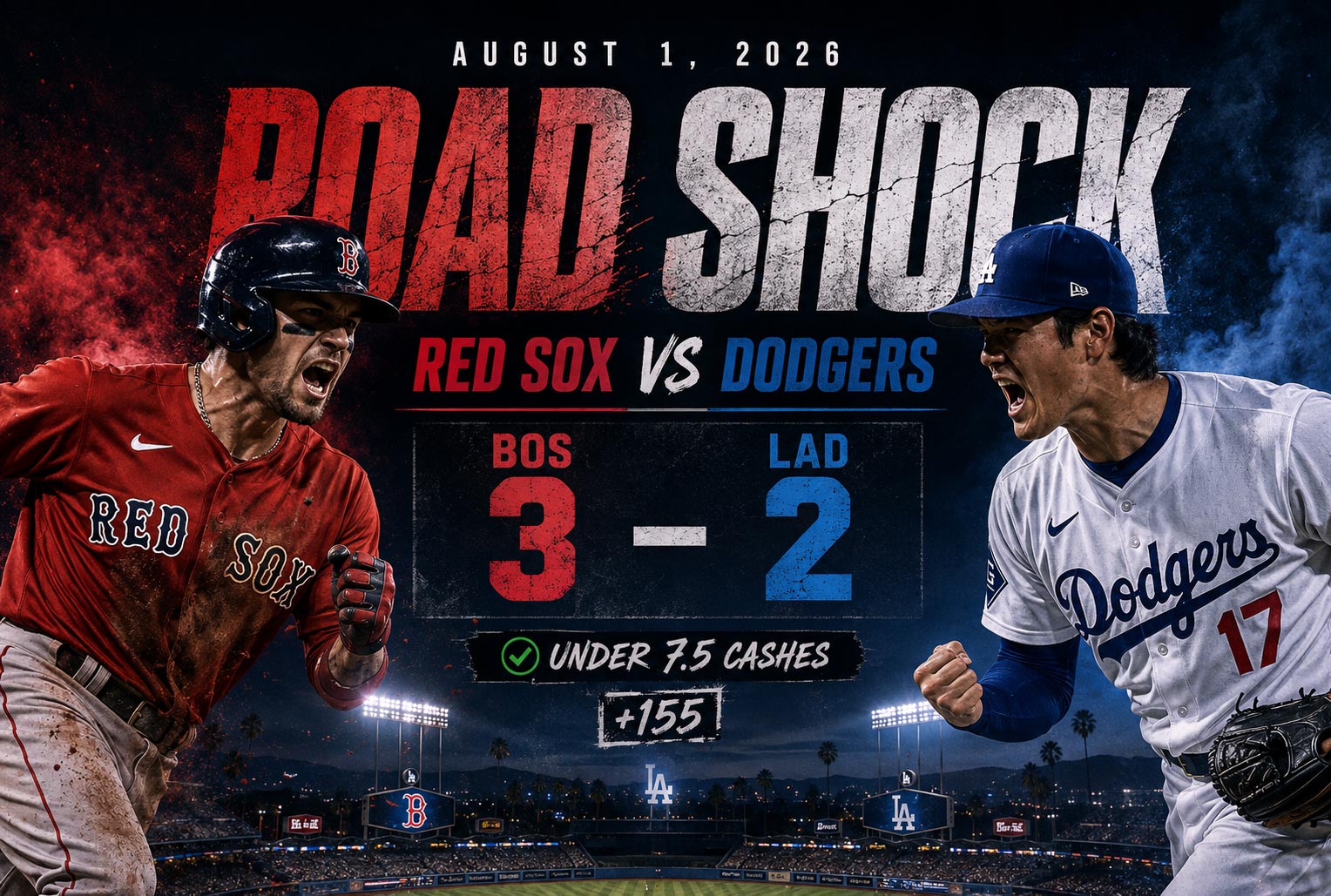
Red Sox Upset Dodgers: Why Favorites Fail Late
The house always wins, right? Well, someone forgot to tell the Red Sox that on August 1, 2026, when they strolled into Chavez Ravine and absolutely torched the public’s favorite cash cow. Boston closed at +155 against a Dodgers squad that had every bettor with a pulse hammering the -189 home favorite. The final? A crisp 3-2 Red Sox victory that had sharps quietly cashing tickets while the masses watched their parlays die in real-time. This wasn’t just an upset—it was a masterclass in why late-game variance makes favorites a dangerous proposition when the juice gets heavy.
Red Sox Upset Dodgers: Why Favorites Fail Late
The Market Psychology of Heavy Favorites
Here’s what nobody wants to admit: laying -189 on a baseball game is objectively stupid from a risk-adjusted return perspective. You’re putting up $189 to win $100 on a sport where even the best teams lose 40% of their games. The Dodgers were getting hammered with public money because casual bettors see "best team in baseball" and think it’s a lock. Meanwhile, sharp money was quietly nibbling at that +155 Boston line like it was free money at a buffet.
The oddsmakers knew exactly what they were doing here. They hung a line that screamed "bet the Dodgers" and let the public pile in while keeping the total at 7.5 to balance their exposure. This is textbook market manipulation—not in a sketchy way, but in a "we know human psychology better than you do" way. When 80% of tickets are on one side and the line doesn’t move, that’s your first red flag that you’re on the wrong side of the trade.
The real kicker? Baseball is the ultimate variance sport. One bad pitch, one defensive miscue, one unlucky bounce—and suddenly your -189 "lock" is toast. This is why professional bettors focus on expected value over short-term outcomes, and why they rarely lay this kind of juice on nine innings of chaos.
Late-Game Execution: Where Favorites Bleed Money
The Dodgers didn’t lose this game in the first inning—they lost it in the eighth when Boston scratched across a run that held up. This is the nightmare scenario for favorite bettors: your team dominates for seven innings, you’re already planning what to do with your winnings, and then late-game execution failures torch your ticket. It’s like watching your stock portfolio tank five minutes before market close.
Late innings amplify every mistake because there’s no time to recover. The Dodgers had multiple chances to extend their lead but couldn’t capitalize, while Boston played mistake-free baseball when it mattered. This is where the "better team" narrative falls apart—baseball isn’t played on paper, it’s played in moments where one swing changes everything. The sharps understand this; the public doesn’t.
From a betting perspective, this is why moneyline dogs in close games offer such incredible value. You’re getting plus-money on essentially a coin flip in late innings, while the favorite bettor is sweating bullets hoping their -189 investment doesn’t evaporate. The risk-reward here is so skewed that it’s almost comical—you risk 100 to win 155, they risk 189 to win 100. Who’s really getting the better end of that deal?
When Public Money Gets Torched at Chavez Ravine
The Anatomy of a Public Betting Disaster
Let’s talk about what actually happened to your buddy’s parlay that night. He probably had Dodgers ML in a three-leg parlay with two other "locks" that already hit. All he needed was the Dodgers to close it out at home against a mediocre Red Sox squad. Instead, he got to experience the special kind of pain that comes from watching your last leg die in the eighth inning. This is the tax you pay for chasing parlays built on heavy favorites—one failure nukes everything.
The public money on this game was obscene. Every sportsbook from DraftKings in New Jersey to BetMGM in Ontario was getting crushed with Dodgers tickets. Casual bettors see a home favorite with a better record and don’t think twice. They’re not considering lineup matchups, bullpen usage from the previous series, or the fact that the Red Sox had nothing to lose as road dogs. They’re just clicking buttons and hoping for the best.
This is exactly why sportsbooks love heavy favorites—they print money when the underdog wins. The public loses their parlays, their straight bets, and their minds. Meanwhile, the books are sitting pretty because they balanced their exposure by taking sharp money on Boston at +155. It’s a beautiful system if you’re on the right side of it.
The Under Bettors: The Only Winners in This Chaos
Now let’s give credit where it’s due—if you took Under 7.5, you had the easiest sweat of your life. The total stayed under from the first pitch, and you got to watch everyone else panic while you kicked back knowing your ticket was already good by the seventh inning. This is what smart betting looks like: finding value in the total when everyone else is obsessing over the moneyline.
The Under play here was actually the highest-EV bet on the board. With two solid pitching matchups and a total that the public pushed slightly higher, you were getting value on a number that should have been closer to 7. The sharps knew this, which is why you saw early Under money before the public pushed it back up. This is market inefficiency in action—the masses bet what they want to happen, not what’s likely to happen.
The beautiful irony? While favorite bettors were melting down over a 3-2 loss, Under bettors were celebrating the exact same final score. Same game, completely different outcomes based on where you placed your chips. This is why diversification matters even in sports betting—don’t put all your eggs in the moneyline basket when the total might offer cleaner value.
Lessons for the Savvy Bettor
So what’s the takeaway from this Chavez Ravine disaster? First, stop laying heavy juice on baseball favorites unless you’ve got a legitimate edge that the market is missing. The math just doesn’t work in your favor long-term, no matter how "sure" the play feels. Second, pay attention to line movement and ticket percentages—when 80% of bets are on one side, you should at least pause and ask yourself why.
The Red Sox upset wasn’t a fluke—it was variance playing out exactly as expected in a sport where anything can happen over nine innings. The favorites will usually win, but "usually" doesn’t cut it when you’re risking $189 to win $100. You need a win rate of nearly 65% just to break even at those odds, and nobody in the history of baseball has maintained that edge consistently.
Here’s your homework: next time you see a heavy favorite, ask yourself if you’re betting on the better team or just following the crowd. Check the sharp money, look at the total for alternative value, and remember that underdogs exist for a reason. Sometimes the smartest play is fading the public and taking the plus-money dog, even when it feels uncomfortable. That discomfort is usually a sign you’re on the right side of the trade.
The Dodgers will be fine—they’re still a great team with World Series aspirations. But that doesn’t make them a good bet at -189, especially when late-game execution can flip a game in seconds. Boston showed up, executed when it mattered, and sent a reminder that in baseball, favorites fail more often than the public thinks. The real question is: are you still chasing heavy chalk, or are you ready to start betting like someone who actually understands expected value? Drop your worst bad beat on a heavy favorite in the comments—misery loves company.
WannaBet.com may receive compensation from the sportsbooks mentioned in this post if you sign up using our links. This doesn’t cost you a dime, but it keeps the lights on. Please bet responsibly. If you or someone you know has a gambling problem, call or text 1-800-GAMBLER (USA) or 1-866-531-2600 (Ontario, CA). 21+ only.
