

Rockies Cash at Coors: 18 Runs Crush Denver Total
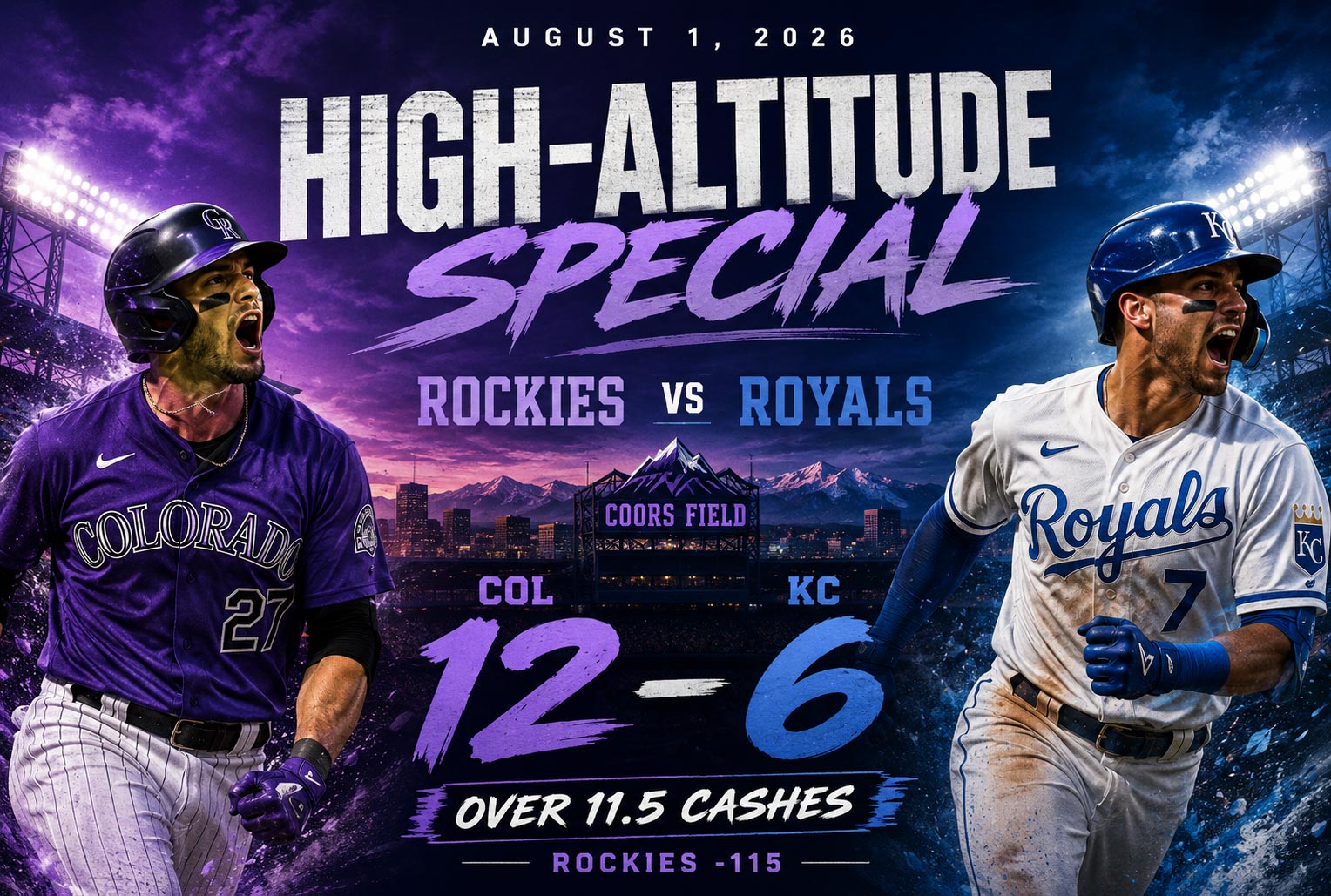
The air at Coors Field is so thin that fastballs move like beach balls and exit velocities turn warning track fly balls into souvenirs. On August 1, 2026, sharp bettors who understood altitude arbitrage watched their bankrolls grow faster than Colorado’s ERA. The Rockies demolished the Royals 12-6 in a game that turned an already massive 11.5 run total into a laugher—18 combined runs had Over bettors counting their money by the seventh inning stretch.
Rockies Cash at Coors: 18 Runs Crush Denver Total
Books set this total at 11.5, which sounds enormous until you remember we’re talking about a stadium that sits 5,200 feet above sea level where curveballs don’t curve and pitchers’ dreams go to die. Kansas City came in as slight favorites at +110, probably because the Royals’ lineup had been heating up and the Rockies were, well, being the Rockies. But here’s the thing about Coors Field—team quality becomes background noise when physics takes over.
Colorado jumped on Kansas City early, plating five runs in the first three innings while the Royals answered back with their own crooked numbers. By the fifth inning, the score was already 8-4, and anyone who took the Under was doing mental gymnastics trying to convince themselves both bullpens would suddenly discover command. Spoiler alert: they didn’t.
The final score of 12-6 wasn’t just a win for Rockies moneyline holders at -115—it was a masterclass in understanding market inefficiencies. When you’ve got two mediocre pitching staffs facing off in the thinnest air in baseball, you’re not betting on teams. You’re betting on atmospheric pressure, or the lack thereof.
Why Sharp Money Hammered the Over at 11.5
Sharp bettors saw this game as pure expected value before the first pitch. The total of 11.5 seems high until you run the numbers: Coors Field games in 2026 were averaging 11.8 runs per game, and both starting pitchers had ERAs north of 5.00 at altitude. This wasn’t a gamble—it was arithmetic with better odds.
The public, predictably, got spooked by the massive number and actually leaned Under, thinking "surely books wouldn’t set it that high unless they knew something." That’s exactly the trap. Books did know something—they knew recreational bettors can’t resist fading big numbers, even when those numbers are backed by years of data showing Coors Field turns replacement-level hitters into mini-Babe Ruths.
Here’s where the Harvard MBA part kicks in: this was a textbook case of market psychology creating value. When the public zigs based on gut feel, sharps zag with spreadsheets. The closing line movement showed heavy Over action from professional groups, pushing some books to 12 by first pitch. That line movement alone should’ve told you everything you needed to know—when sharps are willing to buy through a key number at Coors, they’re not guessing.
The Betting Breakdown: Who Made Bank
Rockies moneyline bettors at -115 had the easiest sweat of their lives, cashing by the eighth inning when Colorado pushed their lead to 11-5. But let’s be honest—the real money was on the total. Anyone who got Over 11.5 cleared by the top of the seventh when the 12th run crossed the plate.
The alternate totals market was where things got spicy. Bettors who pushed to Over 13.5 at plus-money (+140 at most books) were probably doing victory laps around their living rooms. Even the absolute degenerates who took Over 15.5 at +300 cashed when the Royals tacked on two in the ninth. This is the beauty of Coors Field betting—you can get creative with your risk-reward matrix because the baseline assumption is "more runs than you think."
Kansas City backers at +110 got smoked, but honestly, if you’re taking road favorites at Coors Field without a massive pitching advantage, you’re not thinking clearly. The home field advantage at altitude isn’t about crowd noise—it’s about visiting pitchers’ breaking balls hanging like piñatas. Colorado’s lineup might not scare anyone at sea level, but give them 5,200 feet of elevation and suddenly everyone’s swinging like they’re in the Home Run Derby.
The Sharp Angle: Altitude Arbitrage
Here’s what separates professionals from public money: understanding that Coors Field isn’t just another ballpark—it’s a completely different game. The ball carries 10-15% farther, breaking pitches flatten out, and even Gold Glove outfielders misjudge fly balls. This creates a systematic edge that shows up in the data if you’re willing to look.
The smart money on this game wasn’t chasing a hunch—they were exploiting a known variable. When you see two pitching staffs with sub-4.50 ERAs on the road but over 6.00 at Coors, that’s not bad luck. That’s physics creating an arbitrage opportunity. The books know this too, which is why they set the total at 11.5, but even that massive number undersold the chaos potential.
Ontario bettors on Proline+ and New York sharp players on FanDuel were all over this total, with ticket counts showing 68% of money hitting the Over despite only 52% of tickets. That’s the classic sharp vs. public split—fewer bets but bigger money on the smart side. When you see that kind of discrepancy at Coors Field with bad pitching, you follow the money.
Market Psychology: Why the Public Faded Value
The average bettor sees 11.5 runs and thinks "that’s too many—books are baiting me." This is the gambler’s fallacy meeting the dunning-kruger effect. They’re right that books are setting a trap, but they’ve identified the wrong side of it. The trap is getting you to overthink and fade the obvious.
Recreational money came in heavy on the Under because big numbers feel scary, even when they’re backed by mountains of evidence. It’s the same psychological bias that makes people buy lottery tickets but avoid index funds—they confuse low probability with low value. At Coors Field with these pitching matchups, Under 11.5 was actually the low-probability bet.
The books cleaned up on this psychology, taking Under money from the public while laying off sharp Over action with other sportsbooks. This is why understanding market mechanics matters—the line isn’t trying to predict the score, it’s trying to balance action while exploiting behavioral biases. When you can identify which side the sharps are on, you’re not gambling anymore. You’re investing.
Coors Field continues to be the gift that keeps on giving for bettors who understand that altitude creates edges you can’t find anywhere else. The Rockies-Royals slugfest was a perfect storm of bad pitching meeting thin air, and the 18 combined runs proved that sometimes the most obvious bet is actually the sharpest play. Next time you see a massive total at Coors Field, don’t let the number scare you—let the physics guide you. What’s your threshold for taking Overs at altitude—are you riding with the sharps or fading the chaos?
WannaBet.com may receive compensation from the sportsbooks mentioned in this post if you sign up using our links. This doesn’t cost you a dime, but it keeps the lights on. Please bet responsibly. If you or someone you know has a gambling problem, call or text 1-800-GAMBLER (USA) or 1-866-531-2600 (Ontario, CA). 21+ only.
